

Policy
Lawmakers push Hochul to backfill cuts for crime victims, child advocacy centers
Demand has outpaced federal aid for crime victims, forcing some rape crisis and child advocacy centers to consider closure.
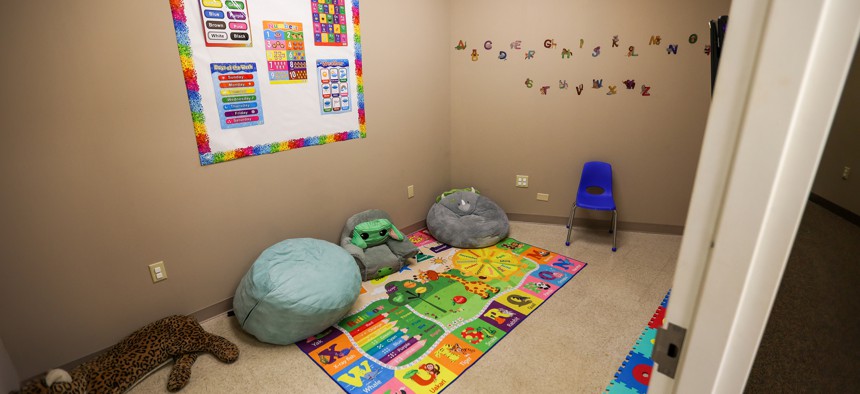
Domestic violence centers, rape crisis programs and child advocacy centers are scrambling as their primary funding source – aid from the Federal Victims of Crime Act – significantly cut. Jason Ardan/Citizens' Voice via Getty Images


Programs for crime victims are in peril across the state as an unprecedented demand for aid has left many rape crisis and child advocacy centers millions of dollars short – forcing some to consider closure. And advocates and lawmakers want Gov. Kathy Hochul to intervene.
Domestic violence centers, rape crisis programs and child advocacy centers are seeing their primary source of funding – aid from Federal Victims of Crime Act – significantly cut.
The state Office of Victim Services, which administers the federal funds, notified organizations that applied for the grants of their tentative awards July 9, though the state Comptroller’s Office still has yet to review those awards. Of the state’s 48 child advocacy centers, 36 applied for funding. Six were denied funding altogether while 21 received substantial decreases. The decision means a loss of over $6.9 million to child advocacy centers statewide, which assist families to investigate instances of child abuse – a 31% decrease.
“This funding drop covers the forensic interviewer, the victim advocate, operational things related to paying rent and keeping the lights on,” said Theresa Roth, executive director of the New York State Children’s Alliance.
The Child Advocacy Center of the Finger Lakes was among the six not awarded any federal aid for the first time in years – a cut of over $700,000 to its three locations. Executive Director Ashley Davoli said that represents two-thirds of their budget, and will force the facilities to cut staff in half, and potentially close one of their locations.
“We’re trying to get really creative. We’re exploring every opportunity,” Davoli told City & State. “We are already doing double the work, because we had a staffing reduction last year, and those numbers and the needs for families continue to rise.”
Likewise, rape crisis centers statewide, are being pushed to a similar fiscal cliff because of the reduced federal awards, which were slashed at a time of higher need. Rape crisis programs in New York City are expected to receive about $2.5 million less than in 2022. The Kingsbridge Heights Community Center in the Bronx lost all of its grant funding when the Bronx has the city’s highest rates of sexual violence.
Planned Parenthood of Central & Western NY saw its award slashed from $1.6 million down to $809,500, or a decrease of 56%, director of public affairs Meredith Ouderkirk said. “This is a complex thing for survivors to respond to, so being able to mold our services and our availability around their needs when they’re feeling brave and ready to confront these things is really pivotal to being able to provide these services,” she added.
Some rape crisis programs are being forced to consider closing locations, eliminating free attorney services for survivors, laying off forensic interviewers, eliminating therapy and other prevention programming and halting services for incarcerated people. State law mandates all hospital emergency rooms have Sexual Assault Forensic Examiners, or SAFE, training by 2027, and the cuts threaten hospitals’ ability to comply.
Lawmakers are perplexed by the current funding procurement system, and want Hochul to fix the administrative and regulatory issues that have led to the dire circumstances for victims’ services, arguing the programs are overreliant on federal funding.
“This is not from an uptick in crime – there’s not more victims, it’s just everybody’s going for the same pot of money,” said Assembly Member Andrew Hevesi, who chairs the Assembly Children and Families Committee. Hevesi wants Hochul to fill in the funding gaps, and include more for victims in next year’s budget.
“It seems like every victim services organization in the state operates right on the edge of closure because we just financially don’t keep them afloat or don’t give them a sustained revenue stream,” he said.
The amount of VOCA grants is unpredictable year to year, with the state awarding $72 million in aid in 2025, $43.9 million in 2024, $77.8 million in 2023 and $83.7 million in 2022, according to the Office of Victim Services.
OVS spokesperson Janine Kava said the agency received 316 applications for the grants, seeking $626.1 million over two years – exceeding what was available by about $500 million.
“Never in its history has OVS received that many applicants seeking that level of funding,” Kava said in a statement. “The incredible demand, the state’s competitive procurement process, and federal rules and funding uncertainty, required us to make difficult decisions. The $126.5 million to be awarded annually represents the single largest investment in victim services in the state’s history, allowing us to fund more programs and reach more New Yorkers in need.”
The state allocated $52.8 million in funding to augment the available federal aid and offset cuts. The state Office of Victim Services also limited funding available for criminal justice agencies to prevent even bigger cuts.
Several lawmakers are expected to participate to call for reform for how the Office of Victims Services distributes the aid in a virtual press conference on Tuesday. State Sen. James Skoufis said the nonprofit Fearless! Hudson Valley Inc. in his district had its aid cut by 30%, and wants a different funding procurement process for crisis centers that is more equitable, similar to aid formulas for school districts. “We need to hit a reset button on these awards and go through the process through ample funding,” Skoufis said. “This should not be a ‘Hunger Games’ type of an outcome when we’re discussing critical services like this.”