

New York City
Talks underway to settle 9/11 World Trade Center air quality records fight
First responders and survivors may be close to getting answers.
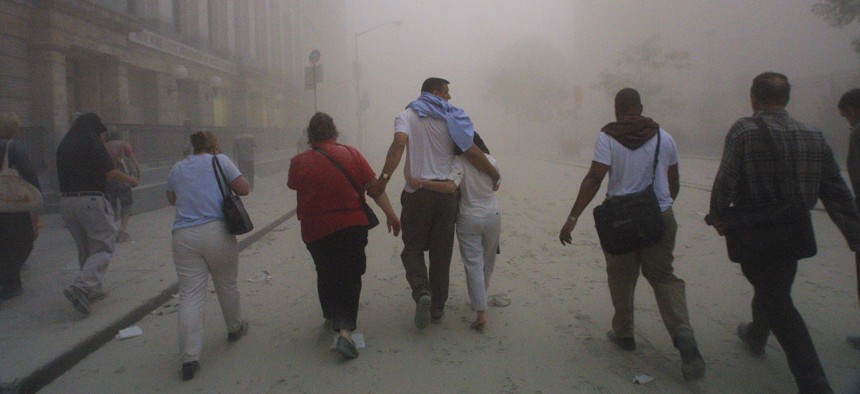
Smoke hangs in the air in the aftermath of the 9/11 attacks. Mario Tama/Getty Images


Both sides in the long-running legal dispute over the public release of thousands of 9/11 World Trade Center documents generated by New York City during the Giuliani and Bloomberg administrations confirm they are in settlement talks with just a month to go before the 25th anniversary of the attacks.
Lawyers representing 9/11 Health Watch, a nonprofit advocacy group, have been in court for years pressing for the secret files. They believe the public, as well as the civilian survivors and first responders suffering from 9/11-related ailments, have a right to know what the city knew and when it knew it about the toxic air in lower Manhattan.
Confirmation of the negotiations come on the heels of New York City Mayor Zohran Mamdani's commitment as part of the city’s new budget to spend $34.2 million in fiscal year 2027 to create “a public online portal for documents related to post-9/11 air quality and health risks.”
The funding announcement came as part of the high-profile “handshake” press conference at the end of June announcing his first budget deal with City Council Speaker Julie Menin. It came as a surprise to Matt McCauley and Andrew Carboy, who are representing 9/11 Health Watch pro bono on the documents case, because they were trying to reconcile that commitment with the city’s lawyers move just hours later to dismiss the lawsuit looking for the 9/11 World Trade Center documents.
In early July, Mamdani said: “For too long, New Yorkers who have become sick have had to fight for information that should have been theirs from the very beginning. We will provide the transparency that New Yorkers living with post-9/11 health concerns deserve.”
Currently, the World Trade Center Health Program has over 145,000 participants suffering for one or a combination of World Trade Center ailments, including a myriad of cancers, chronic rhinosinusitis, gastroesophageal reflux disease, asthma, post-traumatic stress disorder, chronic respiratory disorder, chronic obstructive pulmonary disease, major depressive disorder and several more.
In September 2021, then-Rep. Carolyn Maloney and Rep. Jerry Nadler asked the de Blasio administration to produce the documents and initially then-Mayor Bill de Blasio seemed open to the idea. Back then, the September 11th Victim Compensation Fund reported it had received 3,900 death claims related to World Trade Center health conditions and the U.S. Centers for Disease Control and Prevention disclosed that 3,311 people enrolled in its World Trade Center Health Program had died. Both of those figures exceed the nearly 3,000 people that perished on the day of the attack.
Today, according to the most recent September 11th Victim Compensation Fund, 8,996 death claims have been paid out related to post-9/11 WTC deaths, with 1,458 of those occurring in 2025, the highest annual total yet.
Since that original congressional document request in 2021, through both the de Blasio and Adams administrations, the city refused to budge, at one point suggesting it might need additional indemnification, which raised more than a few eyebrows.
In September 2024, New York City Council Member Gale Brewer introduced a resolution to empower the city Department of Investigation to obtain and review all 9/11 World Trade Center documents at issue.
Three days after the 9/11 attacks, it was Christie Todd Whitman, the then-head of the U.S. Environmental Protection Agency, who reassured the world that “the good news continues to be that air samples we have taken have all been at levels that cause us no concern.”
That inaccurate statement was splashed around the world as the fires at the World Trade Center site continued to burn and smolder.
Three years later, the EPA inspector general reported the EPA “did not have sufficient data and analyses to make such a blanket statement … (as) air monitoring data was lacking for several pollutants of concern.” Moreover, the inspector general learned that it was then-President George W. Bush’s White House Council on Environmental Quality that heavily edited the EPA’s press releases “to add reassuring statements and delete cautionary ones.” Despite the fact that samples taken indicated asbestos levels in lower Manhattan were between double and triple EPA’s limit, the Council on Environmental Quality described the readings as just “slightly above” the limit the EPA inspector general found.
And when the inspector general tried to identify who had crafted the press statements they “were unable to identify any EPA official who claimed ownership” because investigators were told by the EPA chief of staff “the ownership was joint ownership between EPA and the White House” and that “final approval came from the White House.”
A generation of journalists have tried to determine what the city knew about the air quality around ground zero. In 2007, New York Times reporter Anthony DePalma perhaps got the closest when his reporting referenced an internal city memo written for then-Deputy Mayor Robert Harding in October 2001. It highlighted the potential lawsuits that could be generated as a consequence of the ambient air quality in lower Manhattan and the lack of respiratory gear for workers.
McCauley and Carboy weren’t able to get the city to produce anything like that during years of litigation. In fact, top of their list was the Harding memo, which the city Department of Environmental Protection said did not exist. In December, Carboy happened to be thumbing through Wayne Barrett’s and Dan Collins’ book “Grand Illusion, the Untold Story of Rudy Giuliani and 9/11” and saw a footnote referencing the Harding memo.
“I wondered if Wayne had an archive and as it turned out he did at the University of Texas Briscoe Center for American History in Austin” Carboy told City & State. After a few phone calls to Texas, Carboy got buy-in for his project and the Harding memo was found and sent to him in January. “For just $20, I finally had it,” he recalled.