

New York City
Never forget: Betrayals of 9/11 first responders have lingered for 25 years
Since the terrorist attacks, police officers, firefighters and survivors have had to fight for health justice.
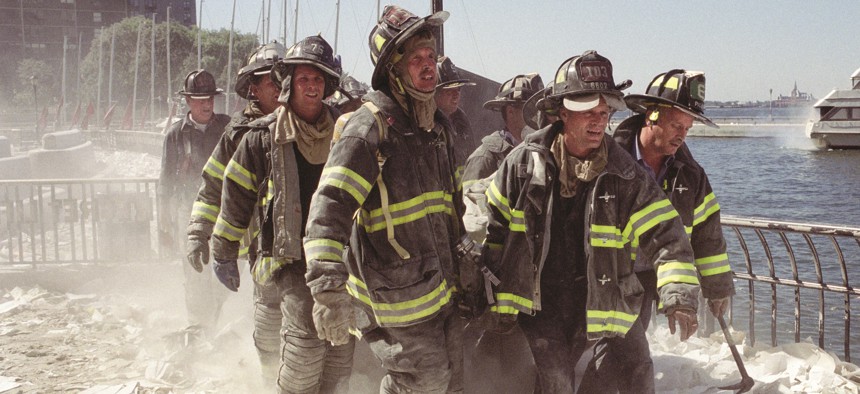
Firefighters carry an injured fellow firefighter away from the World Trade Center site on Sept. 11, 2001. Matt Moyer/Corbis via Getty Images


Around this time of year the phrase “never forget 9/11” gets invoked at the commemorations of the anniversary of Sept. 11, 2001, when 2,996 people died in a multipronged terrorist attack in New York City, Washington, D.C., and Shanksville, Pennsylvania, that would upend the world as we knew it.
In the immediate aftermath of the attack, the world and the nation rallied around a wounded New York City and city residents also embraced each other. Impromptu wanted posters of people looking for their lost loved ones were everywhere.
What people did not know at the time after the attack was that the toxic air in lower Manhattan that the head of the U.S. Environmental Protection Agency said was “safe to breathe” would eventually kill thousands more people than died in the terrorist attack.
As was well documented by a 2003 EPA inspector general report, those false assurances upon which so many relied were generated by a Bush White House that wanted the world to see nearby Wall Street not missing a beat after the catastrophic attack.
Recently, New York City Mayor Zohran Mamdani committed to the full release of all of the city’s files related to what it knew and when it knew it after 9/11. And a preliminary report on those documents by The New York Times appeared to confirm what many suspected about environmental toxins lingering in the air around ground zero. Through a statement, former New Jersey Gov. Christine Todd Whitman, who was the EPA administrator at the time, told City & State she “fully supports making everything public from that time.”
“It says a lot about our politics that it’s going to take a mayor that was in grade school on 9/11 to finally release these documents that the older generation of politicians held onto all this time,” said Lila Nordstrom, who was in Stuyvesant High School on 9/11.
In the years since the attacks, the fight for 9/11 first responders to get healthcare coverage has been an uphill battle nearly every step of the way.
So when we pledge to “never forget,” there’s a lot to remember that all came after that exquisite September primary day 25 years ago when there was not a cloud in the sky.
It was like when the twin towers fell, the earth was knocked off its axis in a sea of unending grief and death.
A devastating toll
Since 2001, the New York City Fire Department has lost more than 600 members to 9/11-related diseases, far surpassing the 343 firefighters who died on the day of the attacks. There are more than 150,000 first responders and survivors who have enrolled in the World Trade Center Health Program.
And Dr. Kristi Anderson, the program’s chief medical officer, said researchers estimate some 400,000 first responders, students, workers and survivors were exposed to the toxins in and around lower Manhattan and in portions of western Brooklyn.
After the attacks, New York City, in its bid to get back to normal, sent close to 20,000 K-12 students back into schools inside the Federal Emergency Management Agency-defined hot zone.
“We are doing outreach now because someone who now may be living in California, Iowa or Texas are both geographically and time-wise distanced from this event but still might be eligible,” Anderson told City & State. “The idea is that people still may have developed diseases from their exposure during that time so this kind of outreach is important to us.”
Anderson said cancer patients in the World Trade Center Health Program have an impressive track record. According to a new report on the program, 86% of World Trade Center first responders diagnosed with cancer are alive five years after diagnosis, compared with 63% of New York state residents who were not exposed to the World Trade Center and were diagnosed with the same cancers.
“Cancer-specific mortality rates for the World Trade Center Health Program enrollees is approximately 35% lower than demographically similar New York residents with cancer – that’s a big deal,” Anderson said.
At the start of President Donald Trump’s second term, cuts made to the U.S. Department of Health and Human Services resulted in the World Trade Center Health Program losing one-fifth of its staff, according to 9/11 Health Watch, a nonprofit advocacy group. Anderson said the agency now was authorized to fully staff up and that hiring was underway.
The program has critics like Anne Marie Principe, who had a talent agency located in lower Manhattan and now leads Affinity Healthcare Advocates, a nonprofit committed to improving the quality of healthcare for the 9/11 community.
“Nearly 25 years after the toxic dust settled over lower Manhattan, a devastating illusion persists in the minds of the American public,” Principe wrote to City & State. “People see the multibillion-dollar federal funding packages passed by Congress – such as the mandatory funding extensions secured through 2090 – and they assume the battle is won. They assume all in the 9/11 community are finally being taken care of. The grim reality on the ground is that the systems built to protect the 9/11 community – the World Trade Center Health Program and the Victim Compensation Fund – are fracturing under the weight of administrative failures, staffing freezes, a large influx of new patients and corporate red tape. For thousands of survivors and responders who are literally fighting for their breath and their lives, the nightmare didn’t end in 2001. It is happening right now, fought in the sterile, unresponsive corridors of a broken federal bureaucracy.”
Passing the torch without dropping it
Firefighter Bobby Eustace, who recently assumed the presidency of the New York City’s Uniformed Firefighters Association, was just 20 years old when he became an emergency medical technician in April 2001, just months before he responded to ground zero. Prior to the World Trade Center, the most catastrophic FDNY loss of life was the Oct. 17, 1966, 23rd Street fire when a dozen members died after a floor collapsed at American Art Galleries.
“Now, the largest loss of life is 9/11, but we’ve never been able to look back and reflect on that truly because that wound keeps opening up because there is still another funeral almost weekly,” Eustace told City & State. “You can’t sustain that level of grief – you can’t. Even our turnout for funerals is not as good as it once was.”
The firefighters of the FDNY are represented by the UFA and the Uniformed Fire Officers Association, with a combined rank and file of about 11,000 people, according to Eustace. “So, if you add the UFA and UFOA that are still active on the job, figure there’s about 1,500 of us who were working on 9/11 and are still working today,” he said.
City & State asked FDNY Deputy Chief Jim Brosi, who has been president of the UFOA since 2023, if it gets harder to maintain the same level of advocacy for ailing firefighters as more FDNY members retire and die prematurely of their 9/11-related diseases.
“The further we get from the incident, the more difficult it becomes because there are more tragedies since 9/11 that fill the void making demands on the government, and it is a very hard concept to fathom the loss of thousands of people on a single day and the loss of thousands of people following the event along with the multiple of ailments that people are experiencing,” Brosi said.
As far as society “never forgetting” the sacrifice of 9/11 first responders, both Eustace and Brosi pointed to what they called the sorry state of the FDNY’s Bureau of Emergency Medical Services, the city’s refusal to restore a fifth firefighter to its engine companies and its aging rolling stock.
And then there are the subpar firehouses, like Engine 79 in Bedford Park, Bronx, where earlier this year a major fire left 14 firefighters injured and several others trapped in the firehouse’s second story living quarters that lacked a sprinkler system.
For Emergency Medical Services, the sense of political abandonment is even greater thanks to low wages, chronic understaffing as well as turnover and worsening response times. Vincent Variale, who served on 9/11 and is president of Uniformed EMS Officers Local 3621, told City & State it’s not uncommon, even as response times to the most serious medical calls continue to deteriorate, for there to be 100 FDNY ambulances sitting idle – almost a quarter of the city’s fleet – because of a lack of crews to staff them.
Variale told City & State that EMS’ second-class status predates 9/11 and goes back to the Giuliani-era merger of EMS with the FDNY.
“This year is the 30th anniversary of the forgotten service,” he said. “The fire and EMS merger happened 30 years ago, and still, EMS has the same inferior staffing, pay, benefits and resources compared to other fire and first responders. The promises that were not kept by the city have not only contributed to the plummeting morale in EMS, it has sacrificed the lives of many New Yorkers with unacceptable response times.”
FDNY paramedic Michael Greco, who was elected earlier this year to lead Local 2507 Uniformed EMTs, Paramedics, and Fire Inspectors, wrote in a text message: “You can’t forget what you’ve never acknowledged.”
Required to report
In the immediate aftermath of 9/11, while the world was focused on the cops and firefighters, New York City’s municipal civil service sprang into action.
Joseph Colangelo is the president of SEIU Local 246, which represents the city’s mechanics, some of whom found themselves working on FDNY fire trucks that were still contaminated with World Trade Center dust even after the Giuliani administration had sent them to be cleaned by outside contractors.
“They did whatever needed to be done so the city could recover. At the same time, it became clear that those workers were exposed to dangerous conditions and would need protections and lifelong medical care, and our union fought to have our members protected,” Colangelo told City & State.
He added that 20 of his members have died from illnesses related to their 9/11 work.
Carol Wachter, along with her husband Charles Wachter, served generations of New Yorkers by creating and administering civil service exams for agencies like the Fire Department as employees of the Department of Citywide Administrative Services. Their office was in the David N. Dinkins Manhattan Municipal Building on Centre Street. They were not “first responders” but went back to work a week after the attack just blocks from ground zero.
Carol Wachter died after contracting World Trade Center-linked brain and lung cancers that were aggressive as well as inoperable. The couple had no children.
Charles Wachter told me for an interview with The Chief-Leader in 2019 that it was one of his wife’s last wishes that her story prompt fellow civil servants to pay closer attention to their own health for potential symptoms.
“Have yourself checked out,” he said. “Don’t ignore any symptoms whatsoever. And keep checking with the authorities for what kind of symptoms would be meaningful for them to be registered (with the World Trade Center Health Program.)”
He said as a couple they looked forward to retiring together but it was still “weighing on him” that she had “wanted to retire a year earlier,” and he had said “he was not exactly ready” to leave work. “We would have missed the whole thing (9/11) here if we had retired when Carol wanted to,” he said.
Stu Eber was a deputy commissioner in the city Human Resources Administration and led the New York City Managerial Employee Association, a voluntary union-like association for 3,500 managers.
“By the end of September, we had the all-clear and were back to work but the major computer hubs for Medicaid and food stamps under 90 Church St. were destroyed," Eber told City & State.
He said he takes pride that he and his colleagues were able to coordinate city, state and federal agencies to get a series of waivers for the hundreds of thousands of New Yorkers who continued to get the support they had come to rely on. “Millions benefited and you have to credit all three levels of government, the city, state and federal government,” Eber said.
Promises made, not kept
Eber is one of the tens of thousands of city retirees who is active with the New York City Organization of Public Service Retirees, which is led by retired FDNY EMS member Marianne Pizzitola, who is also a World Trade Center Health Program participant. Her organization was formed to fight the de Blasio administration’s plan to force 250,000 retired municipal workers from Medicare to a Medicare Advantage plan that would’ve saved the city $600 million a year.
Quite a few of those city retirees were workers ordered back to their desks in the hot zone around ground zero. For this cohort, maintaining their continuity of care was particularly critical. After several rounds in court, the city under Mamdani appears to have backed off the plan that had been supported by the city’s largest public unions.
“The cruel reality is the city tried to force us into Medicare Advantage, diminishing our healthcare in the middle of a pandemic,” Pizzitola told City & State. “After failing to tell the truth about the safety of the air we were exposed to after 9/11, they sought to decrease our care. Not only are we fighting to protect the health benefits we earned, many of us are 9/11 survivors and others are battling illnesses or cancer as a result of 9/11. The city told us Medicare Advantage was ‘just as good,’ and we all knew that wasn’t true. When you’re fighting cancer, access to the best doctors isn’t a luxury, it’s lifesaving. The city repeatedly lied and put our lives at risk.”
In the immediate aftermath of 9/11, and for a few years after the attack the Bloomberg administration resisted the notion of any liability for occupational health issues, with Mike Bloomberg at one point asserting that NYPD Detective James Zadroga, for whom the 9/11 Health and Compensation Act was named, was not a hero but a drug addict, an allegation he later apologized for. (Bloomberg declined to comment for this story.)
Joseph Zadroga, who died in 2024, was a retired chief of police of North Arlington, New Jersey, and the father of James Zadroga, who died in 2006 from his 9/11-related health issues.
“We didn’t get the acknowledgement people were getting sick until after he died,” Joseph Zadroga said in 2022. “Luckily, he died in New Jersey so when the medical examiner did the autopsy, he put on the death certificate he died of all of the contaminants from 9/11 and that blew it all wide open. Prior to that, all the editors and producers, senators, members of Congress, anybody you would talk to, were told to leave the story alone.”
At the time, when the cleanup was underway, there were a handful of people who pushed back on the air being safe to breathe, like Rep. Jerry Nadler and former Daily News columnist Juan González, who told Democracy Now his writing “about the dangers, the health dangers, in the future for people who were living in or working at ground zero have proven to be true.”
Joel Kupferman, the executive director of the New York Environmental Law and Justice Project, worked closely with first responder unions right after 9/11 who were concerned about their members’ exposure to toxins in the air.
“It was mainly their withholding of information about the contamination of City Hall due to the large amount of World Trade Center dust that penetrated, and they disingenuously told us that there was no detection from the air monitors," Kupferman told City & State. “That was an indication to me it was just hocus pocus and complete misrepresentation of the data. The city told pregnant mothers and children that it was safe to go back.”
Bob Hennelly is a former reporter for The Chief who has been covering the aftermath of 9/11 for the past 25 years.
NEXT STORY: State audit finds room for improvement in NYC’s AI governance