

Policy
Hochul commits to changing state rape law after Cornell case
Legislation to close the so-called “voluntary intoxication loophole” has stalled in the Assembly for years. Gov. Kathy Hochul said Friday she will work to pass it.
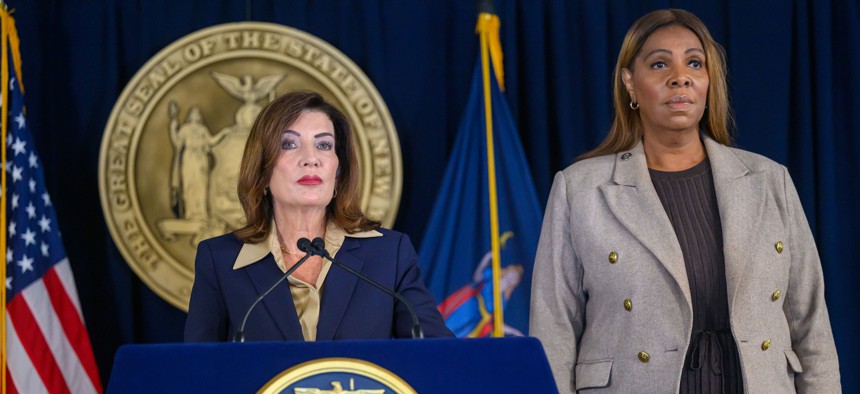
Gov. Kathy Hochul, joined by state Attorney General Letitia James, announces new efforts to address the “voluntary intoxication loophole” in the state’s rape law following the alleged gang rape at Cornell University. Susan Watts/Office of Governor Kathy Hochul



Gov. Kathy Hochul announced on Friday she plans to work with state lawmakers to pass legislation that would close the so-called “voluntary intoxication loophole” in the state’s rape law. The measure has burst into the national spotlight as a 2024 case of alleged rape at Cornell University has gained nationwide attention.
“Voluntary intoxication is not a license for sexual assault or gang rape. Period,” Hochul said at her Manhattan office. “I support closing this loophole, and will work with the New York state Legislature to accomplish this.”
An anonymous former Cornell Univerity student, dubbed Jane Doe, alleged that she was gang raped in 2024 by seven men at a fraternity house. She has said in statements and a new civil lawsuit that she willingly drank and did drugs, though added she felt pressured into doing ketamine, ahead of the alleged assault that lasted multiple hours.
Hochul was flanked on Friday by state Attorney General Letitia James, whom she had just appointed as the special prosecutor to oversee the Cornell case. Hochul said in a statement Thursday night she had “lost faith” in Tompkins County District Attorney Matthew Van Houten’s “ability to oversee” the case, even as Van Houten said he would reopen the investigation.
Van Houten declined to bring charges two years ago. In a statement released earlier this week about that decision, he said Jane Doe’s statement “described her participation in drug use and sexual conduct as voluntary.” The circumstances have turned the state’s “voluntary intoxication loophole” into a national lighting rod.
Current state law has a very high bar for proving incapacitation in rape and sexual assault cases if the alleged victim voluntarily becomes intoxicated. State law says someone is unable to give consent if they are “mentally disabled or mentally incapacitated.” That is applied to when someone is drugged against their will or without their knowledge, but does not automatically cover a person who willingly accepts drinks or drugs beforehand – even if they become heavily incapacitated to the point of confusion.
Lawmakers have tried for years to update the state law to add a provision that covers incapacitation from heavy voluntary intoxication. The state Senate has repeatedly passed the measure unanimously, including earlier this year. Many had hoped this would be the year the Assembly brought the bill to a vote, but members ultimately left Albany in June without acting on it.
The bill has nearly 100 cosponsors from both parties in the Assembly, more than enough to get it approved in the 150-member body. But it has only 79 Democratic cosponsors, just three more than the 76-member majority needed to get it approved. Assembly Speaker Carl Heastie typically does not bring bills to a vote unless he has at least 86 Democrats in case some change their mind when it comes to the actual vote. And he is known not to rely on Republican votes to ensure measures pass, so the extra minority cosponsors don’t provide that extra cushion.
One Assembly member who was granted anonymity to discuss internal debates said the “voluntary intoxication loophole” bill has been discussed in private conference meetings more than once in the past. The source said that some members who have signed onto the bill publicly have privately said they wouldn’t actually vote for it or spoke against the premise. The most common issues raised, according to multiple legislative sources, related to concerns about due process and expanding the state’s penal code that could lead to increased incarceration rates in marginalized communities. One legislative source said those concerns are among many things Heastie has taken into consideration regarding the bill.
The legislation has gone through multiple revisions since over the last several years to address such concerns, including narrowing the language and making it more precise. But that still hasn’t been enough to get it over the finish line in the lower chamber.
A spokesperson for Heastie said the governor has spoken with the speaker about the legislation and her new support of it. Earlier this week, he announced a working group to review the state’s sexual assault laws. “The allegations being reported out of Cornell University are truly horrifying,” Heastie said in a statement at the time. “We want to do everything we can to ensure victims of sexual assault see justice served.”
Heastie noted the working group includes “a broad cross-section of experience and viewpoints” among its 14 members. It includes, for example, Assembly Member Jeffrey Dinowitz, the sponsor of the “voluntary intoxication loophole” bill, and Assembly Member Latrice Walker, one of the people who has publicly expressed concern over its due process impacts.
Advocates for sexual assault survivors have called for updates to the state’s rape and sexual assault laws, many of which were written decades ago, independent of the current zeitgeist. And they have had some success in the past. Hochul signed a measure dubbed the Rape is Rape Act at the start of 2024 that created an expanded definition of rape under criminal law to ensure that non-penetrative acts still fell under the statute. In 2019, the state approved extending the statute of limitations for rape in the second and third degrees.
Hochul said she did not intend to call an extraordinary session before the end of the year that would permit her to dictate the agenda, instead suggesting action early next year at the start of the regularly scheduled session. “There's legislation that has passed one of the houses,” she said. “We can take a look at that, talk to the sponsor, but (also) find out in light of what we've learned: Are there any other glaring deficiencies in state law?”