

Albany Agenda
Here’s where key legislation stands with Gov. Kathy Hochul
How will the governor act on these bills before year’s end?
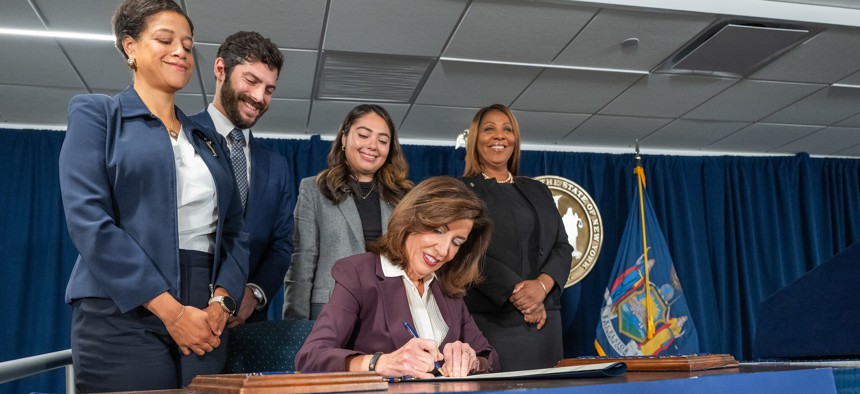
One piece of legislation Gov. Kathy Hochul has already signed into law this year limits the AI chatbot features made available to kids. Darren McGee/Office of Governor Kathy Hochul


Despite a two-month-late budget that ate into traditional legislating time for state lawmakers, they still passed 757 bills and two proposed state constitutional amendments through both chambers before the end of the session in June. So far, Gov. Kathy Hochul has acted on roughly half of those bills, leaving 388 that still require action in the last two months of the year. The governor has no formal role in constitutional amendments.
The final months of the year are usually a flurry of activity for the governor as she makes her way through a backlog of high-profile, complicated or controversial legislation approved earlier in the year. Although lawmakers finished passing bills for the year in June, leaders typically don’t officially deliver them until the governor is ready to sign or veto them to permit her time to review the many measures. Often, that also involves negotiating chapter amendments to make changes that can range from minor tweaks to near wholesale rewrites before Hochul offers her stamp of approval. Any chapter amendments agreed upon are typically approved by state legislators at the very start of next year.
Once legislative leaders formally deliver a bill passed by both the state Senate and the Assembly, the governor has 10 days to act on it, excluding Sundays. Inaction results in the measure automatically becoming law – but since the governor only receives bills she has called up, that has never happened in Hochul’s tenure.
However, Hochul has used pocket vetos more than once in the past. She gets roughly an extra 30 days to make a decision on any bills she hasn’t acted on by the end of the year. At the end of January 2027, any legislation left over from this year she doesn’t actively sign or reject gets automatically vetoed.
With two months left in the calendar year and nearly 400 bills that still need reviewing, here are some of the biggest ones to keep an eye on.
This story was last updated on Nov. 9.
PENDING
One Fair Price Act (S8623/A9349)
Lawmakers passed the One Fair Price Act, sponsored by state Sen. Shelley Mayer and Assembly Member Emerita Torres, which would ban the use of a practice known as surveillance pricing. That’s when companies use personalized customer data to set individual prices online, sometimes in real time, rather than having a single set price for everyone. While the practice may result in lower prices for some, it means higher prices for others based on personal data. Approval in the Legislature came after a concerted push from state Attorney General Letitia James and strong opposition from business interests in the state.
Two-person train crews (S9586/A10706)
If this seems familiar, that’s because it is. Hochul has already vetoed a version of this bill last year that would require maintaining a two-person crew – conductor and train operator – on all subways. Sponsored by state Sen. Kevin Parker and Assembly Member Monique Chandler-Waterman, the bill is a priority for the Transport Workers Union. Hochul’s rejection of the measure a year ago is one of many reasons the TWU isn’t a fan of hers, and spent against her reelection campaign this fall. But having won in a landslide, it seems unlikely Hochul will have a change of heart this year.
Data center moratorium (S10642/A11560)
If you’re also thinking, “Wait, didn’t she do this already?” you’d be half right. Hochul did indeed enact a nation-leading one-year moratorium on the construction of new hyperscale data centers in the state, and then ran on the achievement as part of her winning campaign. It just wasn’t this one – that was an executive order. Sponsored by state Sen. Kristen Gonzalez and Assembly Member Didi Barrett, this legislation represents a compromise on a series of data center and utility-related bills considered during session. The one-year data center moratorium was the centerpiece, already a reduction from the three years proposed in the original bill. Hochul initially gave no sign she was in favor of the moratorium, which was opposed by the construction trades, until she issued an executive order to enact a slightly less expansive one-year moratorium of her own. While supportive legislators and environmental advocates applauded Hochul’s executive order, many would still like to see her sign the full omnibus legislation from lawmakers.
Victims Protection and Sex-Buyer Accountability Act (S8609/A9214)
Under current law, buying sex from minors ages 15, 16 and 17 is treated more leniently than other minors ages 14 and under. An adult having sex with anyone under 18 is considered statutory rape, but that person would face lesser consequences on charges related to sexual exploitation, sex trafficking and prostitution. The legislation from state Sen. Zellnor Myrie and Assembly Member Amy Paulin would close what victims advocates call a loophole so all underage people are treated the same under sex trafficking laws.
Health Information Privacy Act (S9269/A10357)
This is another bill that Hochul vetoed last year. Sponsors state Sen. Liz Krueger and Assembly Member Linda Rosenthal introduced a revision to the measure near the end of this past legislative session in hopes of getting the governor on board after she rejected it for being too broad in a way that could have unintended consequences. The bill is meant to enact data protection measures for reproductive health information that could be weaponized against New Yorkers, especially in states with restrictive abortion laws. But it has faced opposition from tech and business groups concerned with the more far-reaching data privacy and data protection implications it would have. The legislation was one of the most lobbied bills last year.
Moratorium on artificial intelligence chatbots in toys (S9408/A11144)
Separate from the data center moratorium, lawmakers also approved a bill from state Sen. Andrew Gounardes and Assembly Member Rebecca Kassay that would place a five-year pause on companies selling toys equipped with chatbot features. It’s one of many measures introduced, several of which have become law, meant to protect children from harmful impacts of AI features and other technologies, such as algorithmic feeds. Hochul has already signed a bill to prevent companies from allowing children to access certain chatbot features, and she has made protecting kids online a cornerstone of her agenda.
Kyra’s Law (S5998/A6194)
State lawmakers unanimously passed this measure from state Sen. James Skoufis and Assembly Member Andrew Hevesi, named for 2-year-old Kyra Franchetti. Her father killed her in 2016 during a court-ordered, unsupervised visit during an ongoing custody battle, before he killed himself and burned down their home. The proposal would require judges to prioritize the health and safety of the children when making custody and visitation decisions, and make those judges undergo special training around child abuse to help better inform decisions to prevent abuse by caretakers.
Cannabis Supply Chain Integrity and Anti-Inversion Act (S8951/A10698)
At the end of session, lawmakers approved legislation from state Sen. Jeremy Cooney and Assembly Member Landon Dais meant to help crack down on illegally trafficked cannabis products, which often come from out of state. The bill would empower the state Office of Cannabis Management and Cannabis Control Board to investigate instances of alleged “cannabis inversion” and impose penalties on those found to be engaging in it. Those could include revoking state-issued licenses and seizing unregulated and illegal products.
SUNNY Act (S8512/A9111)
Environmental advocates are pushing Hochul to sign the Solar Up New York Act, better known as the SUNNY Act. Sponsored by Krueger and Assembly Member Emily Gallagher, the measure would legalize portable and plug-in solar generation units for use in individual apartments. While homeowners can install solar panels on their roofs, renters cannot install smaller generators, often called balcony solar, for their personal use in their apartments. Advocates say this microscale solar generation can save ratepayers money and help reduce fossil fuel use even on individual scales.