

MTA
New York City ‘raided’ MTA funding, per report
Facing a budget gap, the city was allowed to forego $200 million in bus funding for the MTA. The state never backfilled it, Reinvent Albany says.
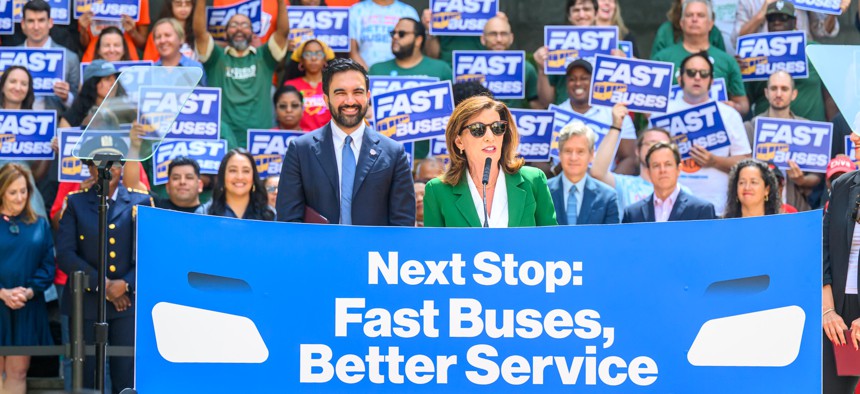
Gov. Kathy Hochul and New York City Mayor Zohran Mamdani unveiled a plan for faster buses back in July. Susan Watts/Office of Governor Kathy Hochul



Government watchdog group Reinvent Albany is ringing alarm bells over a $200 million cut to New York City funding for Metropolitan Transportation Authority buses expected to exacerbate the transit agency’s fiscal woes.
The state quietly allowed the city a one-time, $200 million reduction of its share of MTA bus funding as part of a $4 billion bail out package for the Big Apple to help close its budget gap through a mix of direct dollars and deferred payments. The reduction in bus dollars was not directly publicized when Gov. Kathy Hochul announced the state assistance for New York City in mid-May, but was reflected in both city and state fiscal documents after the announcement.
The city has a legal obligation to cover a portion of MTA funding, and needed the state to let it off the hook. That approval allowed New York City Mayor Zohran Mamdani to redirect that $200 million to other parts of the city budget to close the gap it faced. Rachael Fauss, senior policy adviser at Reinvent Albany, said observers like herself expected the state to step in to fill the MTA’s hole – but that never happened.
“If the state made the MTA whole and the state paid for that, then it wouldn’t have been a raid on the MTA funding,” Fauss told City & State. “It would have been helping the city and holding the MTA harmless. But that’s not what they did.”
According to the Reinvent Albany report, the MTA confirmed in its July preliminary budget it would need to find a solution for the $200 million funding reduction, writing that the missing cash would “be covered by MTA resources.”
The Reinvent Albany analysis noted that earlier in the year, documents from the state and city comptrollers seemed to indicate the state would step in to cover the costs. City Comptroller Mark Levine described the $200 million bus funding reduction as a “one-time shift to the State” in a May newsletter. And state Comptroller Tom DiNapoli wrote in a June review of the city’s financial plan new state action included “funding $200 million in FY 2027 only for city-funded MTA-related costs.”
But additional state funding was not included in the final state budget approved by lawmakers in late May. “The MTA seems to have to eat a lot of these decisions, and they’re not the piggy bank for the state or the city,” Fauss said. “And this is also at a time when there’s a fair hike coming up, and the MTA has big out-year deficits.”
The state came into an unanticipated revenue windfall of $8.1 billion thanks to better-than-expected performances by Wall Street. Hochul previously told City & State she intended to use much of it to replenish the state’s reserves after taking $7 billion out to pay off outstanding federal Unemployment Insurance debt from the COVID-19 pandemic. That in theory would leave plenty leftover to fill the one-time, $200 million hole in MTA funding, if the state chose to use it that way.
That doesn’t seem to be the case. Hochul spokesperson Sean Butler wrote in a statement to City & State the funding reduction has “zero impact on bus service for New Yorkers” and indicated the governor has no current plans to backfill it with surplus dollars when asked. “No Governor has stepped up to support the MTA and its riders like Governor Hochul,” Butler said “She saved the agency from a fiscal cliff and has made historic investments to improve and expand service.”
Transit advocates criticized the move by the state. “Raiding public transit funds or trying to balance the city budget on riders' backs makes New York less affordable and erodes trust in our government,” Betsy Plum, executive director of the Riders Alliance, said in a statement. “When just last month MTA agents assaulted a bus rider over $3, it's clear the transit system needs the money and must be made whole.”
The MTA is set to hold its November board meeting on Wednesday, when transit officials and board members are expected to discuss the authority’s financial outlook and out-year budget gaps.