

Policy
New York pols are pushing bills about Puerto Rico
Some issues to think about, if you’re heading to Somos.
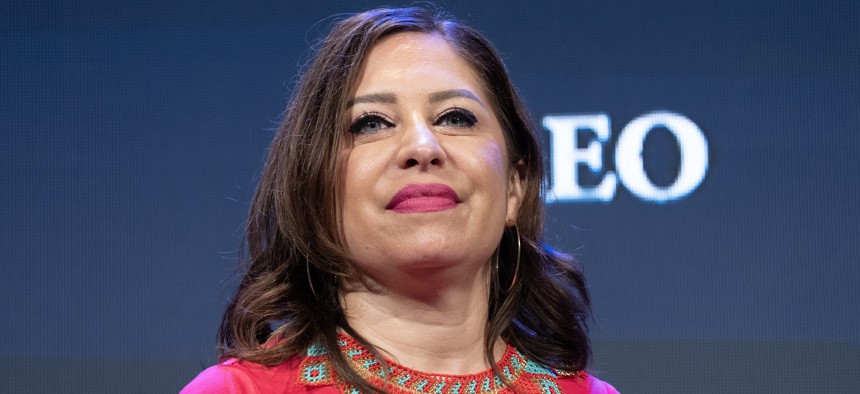
Assembly Member Jessica González-Rojas has been working to pass a bill that could help protect Puerto Rico in the future from private equity. Lev Radin/Pacific Press/LightRocket via Getty Images



Every year, New York’s political class flocks to Somos following Election Day, in a sign of the central importance that Latinos, and particularly Puerto Ricans, have in the state’s politics. But lawmakers of Puerto Rican descent want to do more than just celebrate Puerto Rican heritage; they want to change the relationship that currently exists between the United States and Puerto Rico.
Independence or statehood
When it comes to Puerto Rico-related policy, there is no bigger question than the issue of the island’s status. Currently, Puerto Rico is an “unincorporated territory” of the United States, along with Guam, American Samoa, the U.S. Virgin Islands and the Northern Mariana Islands.
Over the years, Rep. Nydia Velázquez, the first Puerto Rican woman to serve in Congress, has introduced multiple bills aiming to allow Puerto Rico to achieve either statehood or independence. Her Puerto Rico Self-Determination Act of 2007 never got a vote, and neither did her Puerto Rico Self-Determination Acts of 2020 or 2021 (both of which were cosponsored by Rep. Alexandria Ocasio-Cortez, among others). But she also played a key role in crafting the bipartisan Puerto Rico Status Act, which passed the House in 2022 before dying in the U.S. Senate.
“For the last two years I have been tirelessly fighting to craft a bill for Puerto Rico that is anticolonial, fair and transparent. And that will first and foremost, put the people of Puerto Rico – who since the days of the 1898 invasion have remained on the sideline – front and center,” Velázquez said as she cast her vote for the bill.
The bill would allow Puerto Ricans to vote in a binding referendum for one of three options: full independence, full independence as well as a “free association” treaty with the United States or becoming the 51st state. Previous nonbinding referenda have found that most Puerto Ricans favor statehood, and that’s also the mainstream Democratic Party position. But many progressive electeds within the diaspora favor some form of independence, and there’s growing (though still minority) support for independence on the island.
La Junta
It’s impossible to discuss federal policy toward Puerto Rico without mentioning the Financial Oversight and Management Board for Puerto Rico, or “La Junta,” which has exercised control over the island’s finances for the past decade.
In 2016, with the Puerto Rican government facing an unsustainable $70 billion debt load and lawsuits from angry creditors, Congress passed the Puerto Rico Oversight, Management and Economic Stability Act. The legislation, known as PROMESA, essentially allowed Puerto Rico to declare bankruptcy, freezing the creditor lawsuits and enabling the island to renegotiate the terms of the debt. But it also imposed La Junta on Puerto Rico, giving the unelected body the power to negotiate with creditors and dictate Puerto Rico’s budgets over the objections of the island’s elected government.
Although many Puerto Rican advocates opposed the bill, Velázquez ultimately supported it. “Trust me, the easy path for me would be to oppose this bill – but in my heart I do not believe that is right,” she wrote in a 2016 statement explaining her vote. “What I do believe, now, more than ever, is that we have to make this difficult, but necessary choice. And PROMESA, in its current form, while far from perfect, is better than sitting on our hands and doing anything at all.”
The very nature of PROMESA was a consequence of Puerto Rico’s territory status. In the past, individual states have imposed similar fiscal control boards on debt-ridden cities, such as when New York state set up the state Financial Control Board to oversee New York City’s budget in 1975. But the federal government does not have the power to impose a financial control board on a state; the only reason it could pass a law to force one on Puerto Rico is because it’s an unincorporated territory.
In 2022, Rep. Ritchie Torres and Velázquez introduced a bill to eventually disband La Junta, and earlier this year, fellow Democratic Reps. Raja Krishnamoorthi of Illinois and Darren Soto of Florida sponsored a different bill to eliminate La Junta and restore Puerto Rico’s financial authority to its own government. Neither bill has moved in the House.
Sovereign debt
Given Puerto Rico’s current status as a federal territory, state and local governments have essentially no role to play when it comes to the island. But while New York state cannot directly control policy toward Puerto Rico, it can regulate the New York-based hedge funds that are speculating on Puerto Rico’s debt.
Assembly Member Jessica González-Rojas, whose mother is Puerto Rican, and state Sen. Liz Krueger are sponsoring a bill that would block corporations from purchasing debt for the sole purpose of litigation. “The practice is that they buy sovereign debt and then go back to the country, island, the entity that they bought the debt from, and then … they don’t negotiate in good faith,” González-Rojas said. “They often demand – what they paid for pennies on the dollar – they demand full repayment, and then if the country entity can’t repay, which they can’t, then they sue them.”
Until 2004, this practice was illegal under New York state law’s champerty doctrine. But that year, the law was changed to exempt debts of more than $500,000. “Now, as you can imagine, sovereign debt generally is not under half a million dollars,” González-Rojas said. “So this loophole allowed for private equity funds, hedge funds, to purchase sovereign debt from struggling nations for the sole purpose of litigation.”
The bill has passed the state Senate in each of the past three years but has never passed the Assembly. Even if it were enacted, it would not directly aid Puerto Rico, which is still under the control of La Junta and in the process of restructuring its debt. But González-Rojas hopes it would help the island avoid being exploited by private equity funds in the future and allow Latin American countries to escape Puerto Rico’s fate.
Last month, New York City Council Member Alexa Avilés, who was born in Puerto Rico, introduced a group of nonbinding resolutions meant to signal opposition to what she called the ongoing exploitation of Puerto Rico. One of the resolutions calls on the state Legislature to pass González-Rojas’ bill, while another calls for the end of La Junta.
“It’s well past time that the NYC Council stands in solidarity with the working class of Puerto Rico,” Avilés said in a statement. “My community suffers from the active colonial control of our homeland. PR is being gentrified, our beautiful ecology destroyed, our economy weaponized, and our public services dismantled.”