

New York City
Three of a kind: All NYC casino proposals recommended to Gaming Commission
After years of bureaucracy and local approvals, an end is in sight to finally license a slate of downstate casinos.
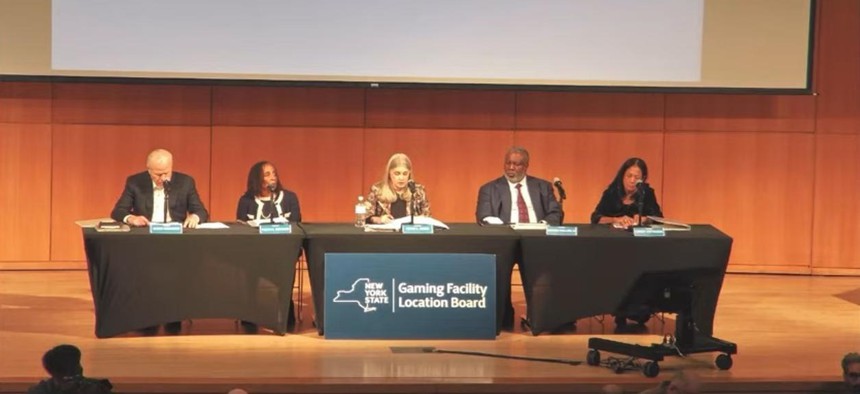
The state Gaming Facility Location Board meets to issue its final recommendations. Screenshot/State Gaming Facility Location Board


The state Gaming Facility Location Board made its final decision in the race for three coveted downstate casino licenses Monday, recommending Genting’s Resorts World New York City and Mets owner Steve Cohen’s Metropolitan Park, both in Queens, and Bally’s Corp.’s proposal in the Bronx.
Just a few months ago, when many more applicants were still in the running, Monday’s decision may have felt much more suspenseful. But with only three remaining projects being considered and up to three licenses available, the question was more about whether the state would award all three. And even that was not a terribly large question mark.
The board cited the economic benefits of approving all three casinos, projecting that the completed projects would bring in close to $7 billion in gambling tax revenue between 2027 and 2036. That’s on top of the $1.5 billion in total one-time licensing fees that the three casino developers will pay, as well as an additional $5.9 billion in other state and local taxes. “No alternative scenarios produce comparable revenue or fiscal benefits,” said board member Greg Reimers.
Speaking to reporters after the meeting, board Chair Vicki Been dismissed concerns that advancing all three projects would cannibalize the market and hurt the projected financial benefits. “We ask our consultants to be very, very conservative,” Been said. “And even with that very, very conservative look, they believed that the New York market is strong enough, is plenty strong to give the three casino licenses.”
The state’s four full-fledged upstate casinos have consistently fallen short of their projected revenues and tax contributions, according to the state comptroller’s office.
Gov. Kathy Hochul praised the board’s decision to advance the three licenses, the money from which will largely go toward funding transit. “The three projects approved today promise to unlock billions in funding for the (Metropolitan Transportation Authority) and create tens of thousands of jobs,” she said in a statement. “It is critical that they keep those promises.”
Though Monday’s meeting largely went off without a hitch (with the exception of a brief interruption from protesters), the road to get there was not without conflict. Numerous projects – including ones at Nassau Coliseum, Coney Island and Times Square, among others – fell apart for a variety of reasons, be it failing to get local approvals or internal concerns about a project’s economic outlook. The proposal with perhaps the most high-profile – and last-minute – exit was that of Empire City Casino by MGM Resorts in Yonkers, which currently operates as a racino and was seeking a full-fledged casino license. For years, the conventional wisdom was that Empire City Casino, along with Resorts World, would likely get two of the three licenses, given their existing infrastructure, with a third up for grabs. But MGM abruptly dropped its bid in mid-October, citing the unlikeliness of obtaining the 30-year license it sought, much to the chagrin of Yonkers Mayor Mike Spano.
Both the Bally’s and Metropolitan Park had moments when it seemed they were dead in the water.
Because the Citi Field-adjacent proposal is on state parkland, a major hurdle for the project was getting a parkland alienation approved by the state Legislature. Though state Sen. Jessica Ramos, whose Queens district includes a vast majority of the project area, had refused to introduce legislation to do so, this spring state Sen. John Liu sidestepped her and carried the legislation himself – a break in Senate tradition. It ultimately passed the chamber 54-5. Last month, the city was sued by the U.S. Tennis Association, which operates the Billie Jean King National Tennis Center at Flushing Meadows Corona Park, over an accusation that the city’s deal with Cohen would violate the terms of the USTA’s lease with the city. That issue, however, has since been resolved with a new lease agreement.
Bally’s required a similar parkland alienation exception from the state Legislature, but its proposal faced more opposition in the City Council, which had to issue a home rule message to make that possible. When it looked like that might not pass, New York City Mayor Eric Adams stepped in and issued a mayoral message, lowering the threshold the home rule message needed to pass from a two-thirds majority to a simple majority. Adams would later veto the council’s decision to reject a land use application for the project, clearing the way for Bally’s to proceed. That’s all despite the fact City Council Member Kristy Marmorato, whose Bronx district includes the Ferry Point Park project, was vehemently opposed to the casino plan. The project has also been subject to scrutiny as it is at the site of what was formerly Trump Golf Links at Ferry Point; as per President Donald Trump’s agreement with Bally’s when he sold the land, The Trump Organization would be paid $115 million after the license is secured.
In a statement, Genting Americas East President Robert DeSalvio said Resorts World expects its expanded operations to be underway within 90 days of licensure.
The board’s decision Monday, while a major step in a process that has stretched more than 12 years, is not the final one: The state Gaming Commission still needs to confirm the applicants have met all necessary requirements and completed environmental reviews before it can formally issue the licences, which it needs to do by Dec. 31. That process is largely procedural, though, and given the significant scrutiny the projects have already been subject to, at this point it seems unlikely the commission would deviate from the board’s selections.
NEXT STORY: Epstein endorses Powers for AD 74