

Energy & Environment
Residential buildings struggle to meet NYC’s decarbonization goals
Many middle-income co-ops are weighing steep fines against huge costs to comply with New York City’s big climate change law.
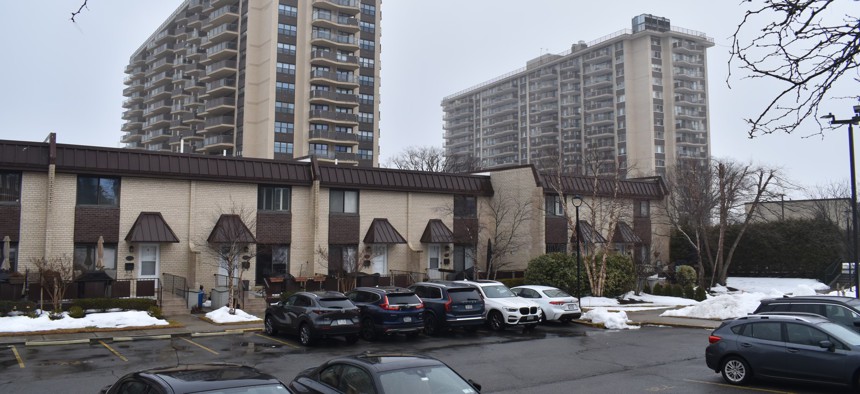
The Bay Terrace Cooperative in northeast Queens, where there are concerns about the city’s climate law. Shenal Tissera


As president and chief financial officer of the Glen Oaks Village co-op in Queens, Bob Friedrich balked at the $50 million price tag for installing new heating and cooling systems for every building within the large complex, a step required by New York City’s Local Law 97, which aims to slow climate change by drastically reducing greenhouse gas emissions from city buildings.
The low-hanging fruit such as installing insulation, updating windows and making valve changes had already been accomplished as part of the first phase of the law. Now it was time for the big stuff. “Most co-ops are kind of on the financial edge, so adding more debt is not an answer,” said Friedrich. “A clean environment and affordable housing (should not be) a binary choice. You can have one without destroying the other.”
Glen Oaks comprises 134 buildings across 125 acres and houses roughly 10,000 people. Finding $50 to $70 million for the required upgrades is nearly impossible, Friedrich said. Instead, the co-op will probably end up paying the hefty fines, starting at $1 million per year, he said.
In fact, many cooperatively owned apartment buildings across the city are looking toward the next deadline, 2030, with uncertainty about how to comply with the law while remaining financially stable. That uncertainty was compounded by new federal policy restricting or eliminating government assistance for green energy building renovations. Mayor Zohran Mamdani voiced commitment to the city’s climate law on the campaign trail, and he committed to pursuing tax breaks for co-ops to make renovations to comply with the law, but the mayor has not made the issue a central focus of his first weeks. City Hall spokesperson Casey Berkovitz said there will be “more to share on this work in the coming months.”
“This administration is working to deliver a more affordable city that New Yorkers can build a life in, and delivering a cleaner, greener city is an essential part of that work,” Berkovitz wrote. “This administration continues to support Local Law 97, tackling climate issues that disproportionally impact working communities.”
Across the city, 63,000 buildings are affected by Local Law 97, and about 45,000 of them are residential. The law applies to buildings greater than 25,000 square feet, including many of the city’s 6,800 co-op buildings, which are collectively owned largely by middle-class New Yorkers. Expensive renovations and installations in and around a property can result in significant cost-of-living increases for co-op residents trying to live in one of the priciest cities in the country.
Going electric
Local Law 97 passed the City Council in 2019 with the goal of significantly reducing greenhouse gas emissions from large buildings, which are New York City’s largest source of carbon emissions. The law imposed varying carbon emission limits based on the property type starting in 2024 and getting stricter over each following compliance period.
So far, over 90% of buildings have met the easier phase one requirements, which vary based on the size and type of the building. But only 43% of buildings currently meet the requirements for the next compliance period in 2030, which requires reducing emissions by 50% below the 2024 carbon limit or face hefty fines calibrated to the amount they’re polluting.
This next step in compliance entails electrification. The idea is to get buildings to stop directly burning fossil fuels for heating and cooling and instead to switch to heat pumps and other newer kinds of hardware that run on electricity. Currently electricity is produced by both dirty (coal and natural gas) and clean (wind and solar) sources, but as the electric grid becomes increasingly sourced from renewables, buildings that heat and cool electrically will seamlessly stop emitting greenhouse gases. In that way the city’s Local Law 97 is interdependent with New York state’s ongoing transition to renewable energy.
The state laid out its climate goals in the Climate Leadership and Community Protection Act of 2019, which called for a 40% reduction in greenhouse gas emissions from 1990 levels by 2030 and a zero-emission grid by 2040, though New York is way behind on meeting these goals.
“Local Law 97 is a city law, but the grid is state regulated so the two need to work hand in hand,” said Urban Green Council CEO John Mandyck.
Many residents of New York City co-ops are supportive of addressing climate change. But co-ops are self-supporting networks of apartment owners who already face high mortgage and maintenance payments. They said they felt that if the government is going to target them as the problem, it should offer them some financial assistance.
“No one is paying us to do this. When we decide to go electric, we would have to pay for it,” said Karen Goldman, treasurer of the University Towers Apartment Cooperative in Downtown Brooklyn. “We are in between a rock and a hard place.”
New York’s renewable energy transition took a major hit in July with passage of the “One Big Beautiful Bill Act.” The bill reduced the window of time for wind and solar energy projects to qualify for tax credits while eliminating expansions for other credits related to renewable energies such as the Energy Efficient Home Improvement Credit for heat pumps and other equipment that had been created in the Inflation Reduction Act of 2022.
Statewide progress was already lagging, and with the federal pullout faces additional obstacles. As of today, the state has achieved only 23% of its emissions reduction and 32% of its renewable energy generation goals for 2030.
Moves Gov. Kathy Hochul has made such as the approval of the Northeast Supply Enhancement Project natural gas pipeline and her refusal to move forward with her cap and invest program, which would require high carbon-emitting companies to contribute financially to the state’s clean energy transition, have made some advocates question the state’s commitment to its climate goals.
“Lately, we’ve been very concerned with the state’s recent actions that are walking back the CLCPA commitments,” said Joe Chavez, the director for sustainable buildings at the Mayor’s Office of Climate & Environmental Justice.
Feeling the squeeze
The University Towers co-op board in Brooklyn conducted a study to estimate costs of replacing all of the AC units, radiators and pipes in every apartment. The whole endeavor came out to $30 million. Another calculation in the same study which involved keeping the current system in place and incurring fines came out to be cheaper than actually making any renovations.
The only financing options available for many co-ops in the city come through NYC Accelerator, a program run by the Mayor’s Office of Climate & Environmental Justice. Its main offering is the Property Assessed Clean Energy long-term, fixed-rate loans geared toward building owners. However, for many co-op residents, even the idea of taking on more debt seems risky.
Borrowing isn't an option for the Queensview co-op in Queens that is still paying off a $22 million loan taken out in 2022 to replace all of the roofs and modify the facades. After conducting an electrification study carried out by environmental engineers, the estimate hovered around $60 million and ranged between $65,000 to $125,000 per resident depending on their square footage.
“People here either are shareholders who've lived here a very long time, they're aging, they're on fixed incomes. I don't know if they have that type of liquidity,” said Queensview co-op board treasurer Alicia Fernandez.
All of the work done to electrify buildings in the city will be mostly for naught if the state’s electric grid still runs mainly on fossil fuels. “A clean grid is something that will benefit the entire state, but is also something we’re relying on in New York City because these are things we don’t have full control over,” said Chavez.
According to New York’s 2025 energy plan draft, fossil fuels will continue to be an important fuel source that will meaningfully contribute to the energy system through 2040 and “likely beyond.” As current policies stand today, the state would reach its goal of 40% reductions in economy-wide emissions eight years late – in 2038.
Many residents of city co-ops feel their efforts to reduce greenhouse gas emissions through costly electrification projects will all be for naught if the state doesn’t begin to pick up the pace on the renewable energy transition.
“A lot of electricity is generated, but they are using fossil fuels to do that,” said Warren Schreiber, president and resident of Bay Terrace Cooperative Section 1 in Queens. “What’s the benefit if we are still polluting the atmosphere?”
This story was published in partnership with the Craig Newmark School of Journalism.
NEXT STORY: Socialists take aim at commercial rent