

New York City Council
Julie Menin unanimously elected City Council speaker
The moderate Democrat’s relationship with the democratic socialist down the hall could define her tenure.
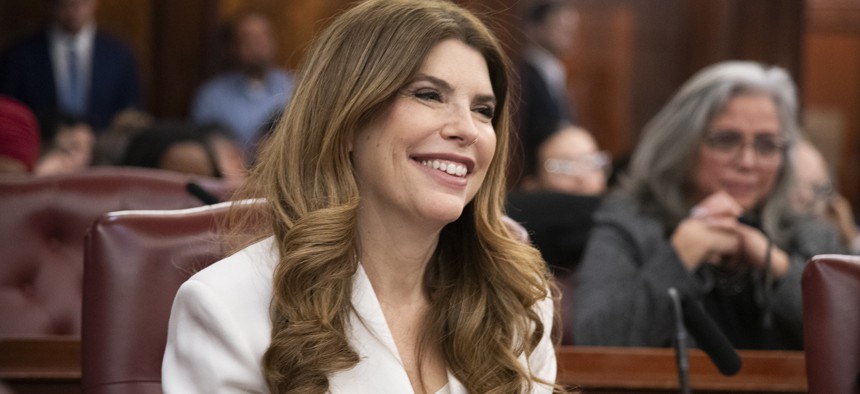
Council Speaker Julie Menin John McCarten/NYC Council Media Unit


In celebrating her election to speaker of the New York City Council on Wednesday, Julie Menin subtly pushed back against the narrative that has dominated her ascent to victory.
Menin’s City Council will not, if she can help it, be defined by tired dichotomies like moderate versus progressive. “Our city has flourished because our foundation wasn’t built on simplistic paradigms – and because of our ability to hold two truths that may seem mutually exclusive, but are, in fact, mutually reinforcing,” she said in a packed City Hall chambers, following her unanimous election as speaker.
The moderate Democrat Menin, who will be working with the democratic socialist Mayor Zohran Mamdani, will pursue criminal justice reform, but not at the expense of public safety. She will court businesses and protect consumers. She will, as the first Jewish speaker, fight antisemitism and Islamophobia. “Our city needs to protect the first amendment right to peacefully protest, and at the same time we must never jeopardize a New Yorker’s right to worship, because we cannot let what happened outside Park East synagogue ever happen again, at any house of worship,” she said Wednesday.
It’s a string of commitments, and a kind of thesis statement for her council, that she will be relentlessly judged against by both supporters and skeptics for the next four years.
Wednesday’s proceedings were the opening act of Menin’s reign, part declaration of unity, part road map of how she intends to steer the City Council’s 51 members, part preview into the relationship she hopes to have with Mamdani. And the vote itself, unanimous in her favor despite a typically contentious speaker’s race, a testament to Menin’s ambition.
Menin locked up support for the speaker’s race in late November, earlier than any other speaker candidate in New York City history. An Upper East Sider with a raft of experience in city government, Menin has been running for speaker for years, gradually building support with institutional power players, sponsoring bills friendly to unions and courting county machines and incoming members. This strategy helped drive Menin’s dominant victory over her more progressive leading competitor, Council Member Crystal Hudson, as well as her other opponents, Amanda Farías, Chris Marte and Selvena Brooks-Powers.
Menin was all humility and gratitude Wednesday, thanking both her competitors for “their spirited campaigns” and her longstanding allies in labor and beyond. She spoke extensively of her Jewish heritage, likening the story of her mother and grandmother who’d arrived in New York after surviving the Holocaust in Hungary, to that of so many other immigrant New Yorkers. And while she never mentioned Mamdani by name, she highlighted the historic nature of their joint ascension – and voiced support for aspects of his affordability-centric agenda, such as enacting universal child care.
“We live in a day when the first Muslim mayor of New York City, and the first Jewish speaker of this council, are serving at the same time,” Menin said. “What will write this interfaith leadership into the history books is if it can act as an opportunity for all of us to come together – to calm tensions, to bridge divides and to recognize we are one city, no matter the religion we practice or the language we speak.”
While Menin already has plenty of business leftover from the last council on her plate – 19 mayoral vetoes by the outgoing Eric Adams administration to start – she also sketched out some of her policy priorities. The council will release its own affordable housing plan considering public library branches it could add housing to, and studying other city-owned assets it could convert to housing. It will also capitalize on some of her own priorities over the last four years, like utilizing an office dedicated to ensuring health care cost transparency that her legislation created. “We all have an exceptional opportunity to take the Council into a new era,” Menin said. “A proactive era. An era of initiative and ingenuity.”
Mamdani was not in attendance Wednesday, though this in itself is not unusual. Four years ago, former Mayor Eric Adams did not attend the meeting where former Speaker Adrienne Adams was elected either. First Deputy Mayor Dean Fuleihan was present, however, representing the administration.
In a brief statement, Mamdani offered boilerplate congratulations to Menin and focused on their shared interests. “Together, we will work to tackle the cost-of-living crisis, protect workers and consumers, and restore belief in city government,” he said. When asked in a press conference following the vote, Menin did not offer direct support for other Mamdani priorities like free buses, tax hikes and a rent freeze, explaining that those are policies over which the City Council does not have jurisdiction.
Menin and Mamdani have largely played nice throughout the transition and the first week of 2026 – she even joined him at a mayoral press conference on Jan. 5. But the two leaders across City Hall have key differences that could quickly shift from underlying tensions to cavernous divides. Israel is perhaps the most glaring of those issues. Notably, Menin spoke extensively about combating Islamophobia as well as antisemitism on Wednesday, pointing to the “deplorable surge of Islamophobia" that arose in the wake of 9/11.
“That surge we saw over 20 years ago is not unlike the atmosphere we are unfortunately currently experiencing,” Menin said. “Hatred and violence are running rampant across our country and around the world – from the horrific shooting at Brown University, to the antisemitic terror attack at Bondi Beach in Sydney, it’s happening all over. We must ensure that New York continues to serve as a beacon of hope, tolerance and inclusion.”
As she cast her vote, Council Member Shahana Hanif, one of the body’s only Muslim members, expressed confidence in Menin’s ability to protect the city’s diverse array of residents. “Our council has so many opportunities to show the path of what solidarity, love and care looks like,” she said.
A testament to the broad coalition she built, council members across a wide ideological spectrum heaped praise upon Menin – while also voicing very different visions for how she’ll lead in relation to Mamdani and revealing some potential obstacles in her message of unity. Republican Council Member Vickie Paladino, for example, opened her remarks by identifying herself as a “a rugged individual who believes in rugged individualism” – an apparent dig at Mamdani’s “warmth of collectivism” line in his inauguration speech. Paladino, who is under scrutiny for Islamophobic comments on social media, said she was “proudly” casting her vote for Menin for many reasons, but foremost for “her ability to, I hope, steer this ship on a very centrist course.” Republican Council Members including Frank Morano and Inna Vernikov also expressed a desire to see Menin act as a check on Mamdani’s agenda when it “goes too far,” Morano said. Vernikov, more brashly, called it a “radical, Marxist agenda.”
Hudson, Menin’s strongest competitor in the speaker race, didn’t offer any of the lofty praise expressed by her colleagues, pointing instead to the opportunity Menin will have over the next four years to deliver on the affordability-centric agenda that spurred New Yorkers to vote for Mamdani this fall.
“Strong people don’t need strong leaders, but they do need leaders willing to share power,” she said. “My hope is that in the next four years, you will lead with collaboration and innovation and never lose sight of who we are here to serve. Congratulations Speaker Menin.”
Meanwhile, Republican David Carr of Staten Island was elected minority leader by the five-member GOP conference. He’ll be the first out gay minority leader. The win puts an end to a saga that began almost a year ago, when then-Minority Leader Joe Borelli’s departure sparked an ugly fight for the role, with Council Member Joann Ariola ultimately winning the role.
But with the minority caucus shrinking from six to five members this term, the math was no longer in Ariola’s favor. Her loss Wednesday was by a larger margin than anticipated just two months ago – per a source familiar with the deliberations, Carr won in a 4-1 vote where Ariola was the only vote in opposition. That means that Paladino, Ariola’s minority whip and fellow Queens member, flipped to back Carr in the end.
This developing story has been updated with more comments from Menin and details of the minority leader vote.
NEXT STORY: DSA member Christina Cover weighing Assembly bid in the South Bronx