

Zohran Mamdani
Mamdani vs. the vortex
The new mayor faces a January crucible. Will he fare better than Bill de Blasio? Worse than Eric Adams?
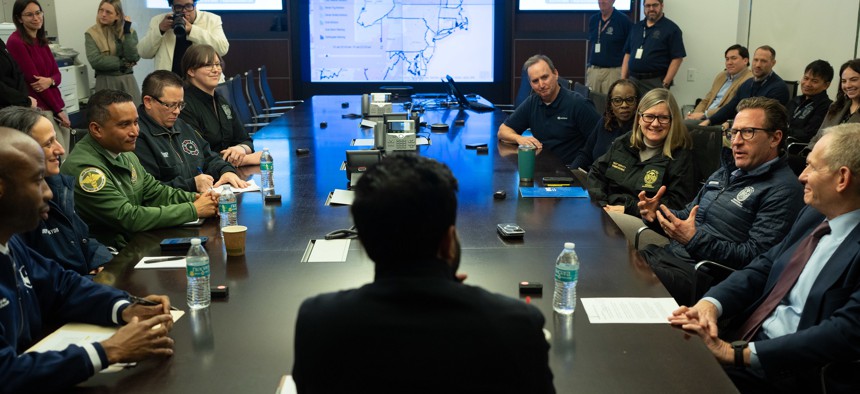
Mayor Zohran Mamdani gets the update from senior officials, including outgoing emergency management Commissioner Zach Iscol. Michael Appleton/Mayoral Photography Office


With a potentially historic snowstorm poised to barrel across New York City this weekend, Mayor Zohran Mamdani is facing perhaps his biggest challenge since taking office.
Forecasters are predicting somewhere between 8 and 12 inches of snow to blanket the city, most of it expected on Sunday. It could be one of the biggest snowstorms the city has seen in several years, bringing with it a flurry of questions about how Mamdani, most recently a junior Assembly member with little managerial experience, will handle the situation. He knows he’s under a microscope.
“This is the mark of an administration, of whether you’re actually ready to respond,” Mamdani told The Weather Channel on Friday. “As much as we talk about politics, what New Yorkers want to know is, ‘Can I keep living my life the way that I have been?’” The new mayor spent the morning doing a blitz of television interviews. He started detailing the city’s plan as early as Thursday, announcing that roughly 2,000 sanitation workers would begin 12-hour shifts come Saturday morning and that about 700 salt spreaders would be deployed.
Judging the city’s mayor for how they handle a massive snowstorm is a time-honored tradition – one that bridges the partisan divide. Efficiently managing something like a snowstorm is the sort of nuts-and-bolts of governing New Yorkers expect of their mayors. The allure of flashy policies and charisma can tarnish quickly amid a failure of competency. And missteps have haunted a long line of Mamdani’s predecessors. A deadly snowstorm in 1969 nearly ended former Mayor John Lindsay’s political career after 15 inches of snow pummeled the five boroughs, killing 42 people and injuring 288 others as the city struggled to respond.
“New Yorkers expect that when they go to sleep at night the mayor is turning off the lights and they expect in the morning the mayor will be turning on the lights,” said veteran Democratic strategist Hank Sheinkopf. “Here’s a test of whether (Mamdani) can do it, and he can’t blame anyone else. He can’t blame previous mayors. He can’t blame Adams. He can’t blame Cuomo. He can’t blame anybody. This is about his management ability.”
Former mayors Michael Bloomberg and Bill de Blasio also drew criticism for how they responded to snowstorms. Bloomberg’s plane was spotted in Bermuda just before the big blizzard first hit the city after Christmas in 2010, forcing him to race back to the city. Many roads were left unplowed for days after the snow stopped. “We did not do as good a job as we wanted to do, or as the city has the right to expect,” Bloomberg said, apologizing for the snafu several days later, according to the Daily News.
Just a few years later, de Blasio garnered harsh criticism for failing to plow the Upper East Side during a storm a mere month into his tenure, drawing conspiracy theories that it had been a deliberate snub of the tony neighborhood. While he denied anyone was treated differently, he also acknowledged the city’s efforts had fallen short. A few weeks later though, de Blasio faced a barrage of questions for keeping schools open during another winter storm.
De Blasio told City & State he thinks Mamdani has handled things well so far. Had he been given an opportunity to respond to that first storm again, he said he’d have "immediately" called a press conference to explain what was going on, dispelling “the many political rumors that were being pushed.”
“That would have been a better way to do it, but from that experience I learned: communicate early and often and give people direction,” de Blasio recalled. “I think the mayor is doing that very effectively, but I think he's a great communicator to begin with.”
“He has a powerful voice as a leader, as an individual, but what I’m sure he’s realizing more and more is people actually listen to what a mayor says,” he added. “Even though New Yorkers are kind of tough and opinionated, in the end, in a crisis, they really do listen to what their mayor advises.”
Acknowledging the pitfalls of mayors past at a pre-storm press conference Friday, Mamdani said that one of the key directives he’s given himself and his team is to overcommunicate with New Yorkers going into the weekend.
“We are going to tell you at every instance when we have new information about the storm,” he said. “This is a time where we want to make sure that city workers have every ability they can to deliver on their job, and what makes it easier for them to do their job is for more New Yorkers to stay home.”
To that point, Mamdani said the city will make a final decision by noon Sunday on whether public schools will hold classes in-person or remotely on Monday. School leaders have been instructed to ensure students have devices and know how to log on if remote learning is deemed necessary. It’s been roughly two years since city schools switched to remote learning due to a snow day, and it went poorly then. Wide-spread technical issues prevented many teachers and students from logging on for classes – a day schools Chancellor Kamar Samuels said “will live in infamy." He and Mamdani expressed confidence that things will be different this time around, pointing to increased system capacity and recent stress tests.
Former New York City Mayor Eric Adams, who was widely seen as handling his first major snowstorm well, offered a few words online going into the weekend.
“Big storm on the way. Reminder: I don’t run City Hall anymore. Yelling at me on Twitter will not speed up snow removal,” Adams wrote on X.