

News & Politics
Mamdani once said his admin would be ‘Trump’s worst nightmare.’ In practice, he’s taking a cordial approach.
The New York City mayor didn’t mention the president’s funding threats as he bemoaned a coming budget gap. He didn’t go to a Pride flag raising at a national monument. He texts the president regularly.
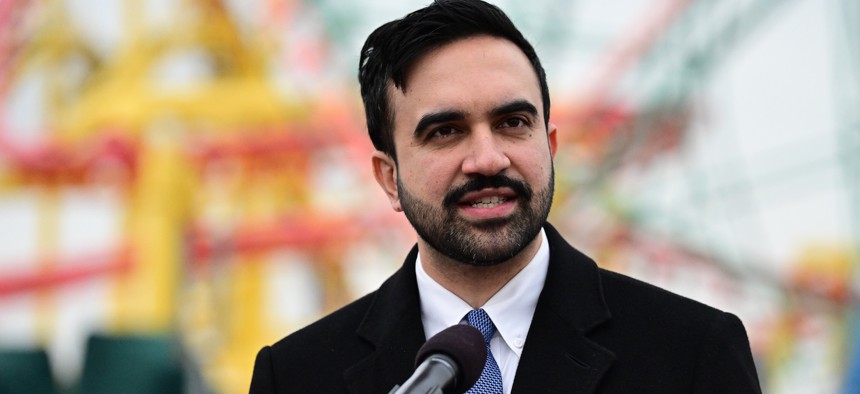
Mayor Zohran Mamdani is not interested in Trump bashing. Kyle Mazza/Anadolu via Getty Images


Not long after he clinched the Democratic nomination for New York City mayor, Zohran Mamdani launched a week-long campaign tour called “Five Boroughs Against Trump.” Each day brought a new element of how his administration would stand up to the Republican administration in Washington D.C.
It was a late summer PR play from an ascendant mayoral contender spinning his wheels in an odd general election, which at the time included independent candidates Andrew Cuomo and then-Mayor Eric Adams, as well as Republican nominee Curtis Sliwa. Polling well ahead of that field, Mamdani decided to spend a week focusing his ire on another target.
“My administration will be Donald Trump’s worst nightmare,” Mamdani said on Aug. 11.
At his victory speech on election night in November, Mamdani spoke about how to defeat Trump. “If there is any way to terrify a despot, it is by dismantling the very conditions that allowed him to accumulate power,” Mamdani said. “So, Donald Trump, since I know you’re watching, I have four words for you: turn the volume up.”
It’s tough, threatening talk that Mamdani hasn’t matched in tenor since taking office on Jan. 1. If he had, Trump likely wouldn’t have referred to Mamdani in his State of the Union address on Tuesday night as a “nice guy,” adding, “I speak to him a lot.” (Trump also called Mamdani a “communist mayor” with “bad policy.”)
In his first two months, Mayor Zohran Mamdani has been measured in his public condemnations of Trump and actions by his administration. He hasn’t joined other elected officials at rallies protesting immigration enforcement, the detention of a City Council staffer by immigration officials, or the removal of a pride flag outside Stonewall. While celebrating Martin Luther King, Jr. Day at the National Action Network in Harlem last month, other elected officials like Sen. Chuck Schumer decried, “Trump, with his recklessness, his lawlessness, his viciousness,” while Mamdani declined to mention the president, focusing instead on more ambiguous “forces of darkness.” Since Jan. 1, he’s reserved most direct criticism of Trump for social media statements and some TV interviews.
Weeks into Trump’s first term in 2017, then Mayor Bill de Blasio, by contrast, joined a massive protest against Trump’s attempted immigration ban. In 2019, de Blasio (gearing up for a presidential campaign) held a climate rally inside Trump Tower. In 2020, he painted a giant “Black Lives Matter” on the street outside Trump’s building.
But while de Blasio had to shout to be heard over counter-protesters and blaring music in the Trump Tower lobby seven years ago, Mamdani was welcomed to the Trump White House as an invited guest in mid-December. Following a private meeting, the mayor-elect stood beside Trump at his desk for an Oval Office press conference that struck a shockingly cordial tone. Mamdani for the most part kept a straight face, while Trump, apparently charmed, complimented Mamdani and stated that he wanted to help rather than hurt him.
Since then, Mamdani hasn’t taken recent high-profile opportunities to antagonize the president. When laying out his preliminary budget plans, Mamdani avoided mentioning Trump or his perennial threats to cut federal funding to sanctuary cities like New York. Many other players in the budget process – both the city and state comptrollers, fiscal watchdogs and City Council Speaker Julie Menin – have highlighted federal funding cuts as a major risk.
Earlier this month, Mamdani’s office passed by what seemed like a prime opportunity for two Democratic mayors to stand together against federal overreach when Minneapolis Mayor Jacob Frey visited City Hall. The two mayors met privately, without so much as a Q&A with reporters. There are no photos from the visit on the mayor’s official Flickr account. A stale readout of the meeting simply said the two mayors discussed “shared values,” “standing up for our vibrant immigrant communities” and “their mutual love of long distance running.”
That circumspection extends to this article. A spokesperson for City Hall declined to comment on why Mamdani has taken a less publicly hostile stance with the president, or their strategy for dealing with the White House more broadly.
Meanwhile, Mamdani has maintained behind-the-scenes communications with Trump, including over semi-frequent texts, the New York Post and Axios reported last month. Mamdani did not deny Trump’s State of the Union claim that they speak “a lot” when asked about it Wednesday, though he declined to say how frequently they talk. “We have conversations that are always focused on how to keep the city moving forward,” Mamdani said.
Some of Mamdani’s partners in government see his approach to Trump as an intentional political strategy that shows signs of success. “He’s learned to transition from campaigning to governing,” said Queens Borough President Donovan Richards. “Do you really want to stick your thumb in a president’s eye who is very vindictive?” Richards noted that while immigrant communities have suffered from ICE raids in the city, New York City hasn’t yet seen an incursion of National Guard troops like some other places have. He credited Gov. Kathy Hochul’s approach to dealing with Trump too.
Still, Mamdani’s more diplomatic positioning takes some getting used to. “Was I a little perturbed at the first meeting? I didn’t like the idea of him standing up next to Trump visually,” Richards said of Mamdani’s White House visit. But Richards said he believes it’s the smarter game. “If you’re just out there throwing a hammer at this guy every day, what are you really accomplishing? So I think he’s really played it, thus far, smart.”
While moments in Mamdani’s campaign were punctuated by tough talk against Trump – the five borough tour, “turn the volume up” – it also featured more diplomatic moments that seemed to preview his current approach. In an October interview on Fox News, he didn’t criticize Trump but spoke to him directly: “I will … be a mayor who’s ready to speak at any time to lower the cost of living,” he said right into camera.
The earliest days of Mamdani’s mayoral campaign also highlighted working-class voters in Queens and the Bronx who felt disenfranchised and voted for Trump or didn’t vote at all in the 2024 presidential election. That would become one of the first viral videos of Mamdani’s campaign.
And several times since taking office, Mamdani has criticized Trump, though his criticisms are largely limited to tweets and a few TV interviews. He called Trump to criticize his capture of Venezuelan President Maduro on his third day in office. He referred to the killing of Renee Good by federal immigration officers in Minneapolis “the latest horror in a year full of cruelty” and called for U.S. Immigration and Customs Enforcement to be abolished. In social media statements, he criticized Trump’s threats to federal funding for sanctuary cities, the detention of a City Council staffer by immigration officials, and the federal government’s removal of a pride flag at Stonewall. He called private hospitals shutting down trans health programs “capitulating to the federal government’s assault on transgender rights.”
Mamdani’s predecessor faced scrutiny over his dealings with Trump and his refusal to criticize him publicly. Adams made the case that his ability to work with Trump would benefit New York City, and the former mayor’s notably friendly dealings with Trump included trips to Mar-a-Lago and Trump’s second inauguration. But New Yorkers largely saw those overtures in the context of Trump’s Department of Justice dropping federal corruption charges against Adams, and Adams promising to work with the federal government on immigration enforcement. Both sides denied a quid pro quo, though it was widely seen as one. “Everything here smacks of a bargain: Dismissal of the indictment in exchange for immigration policy concessions,” Judge Wayne Ho wrote when allowing the Trump DOJ to end the case against Adams.