

Zohran Mamdani
Mamdani’s first 100 days: Every politician is now making Reels
In Zohran’s New York, elected officials can’t avoid short-form social media content any longer.
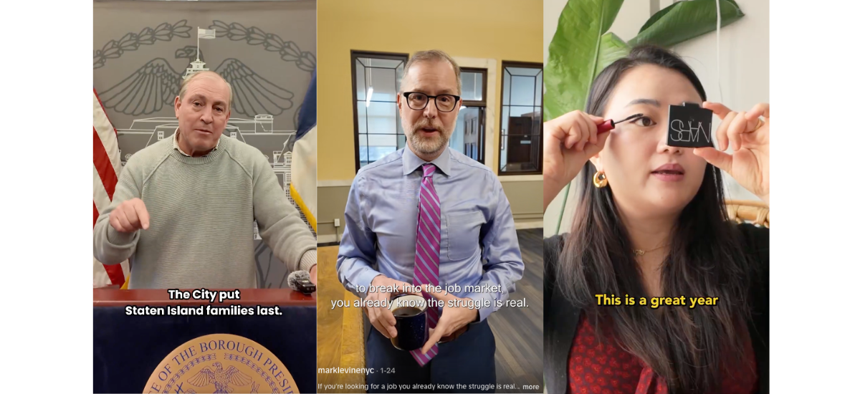
From left, Staten Island Borough President Vito Fossela, Comptroller Mark Levine, and City Council Member Julie Won are all trying out front-facing videos. Screengrabs/TikTok and Instagram


You are scrolling TikTok or X, brainrotting in peace, and suddenly a stiff municipal politician or congressional candidate is staring back at you, clasping a mini mic and trying desperately to relate to you using shoehorned, outdated slang like “brainrot.”
This is Zohran Mamdani’s New York.
Mamdani’s success on social media is by this point the stuff of overwritten legend. The casual, irreverent charm of his TikToks showed younger voters an approachable politician who appeared effortless and was actually entertaining.
Council Member Chi Ossé, his erstwhile frenemy, arguably perfected this medium before Mamdani more widely popularized it. (As he points out in one of his own videos, Ossé is actually Gen Z, unlike the mayor.)
Anthony DiMieri, co-founder of Melted Solids, the firm responsible for many of Mamdani’s campaign videos, told City & State over text that viewership is just one part of the overall goal in political social media. “Are we telling a story? Are people signing onto the campaign? What are the comments/reactions saying (the ones that aren’t from bot farms)?” he wrote. “While big view counts are great sometimes it’s more important to make content that deepens the connection between political leaders and their communities.”
Regardless of who is doing it, connecting with voters through short-form video requires skills not easily acquired. But that hasn’t stopped more than a dozen other New York politicians and elected officials from trying their hardest.
Six years ago, a handful of Gen Z wannabe insurgents were on TikTok. Today, the pioneering pols trying their hands at short-form span every end of the political spectrum and all age groups.
Outside of his clients, DiMieri shouted out Democratic congressional candidates Darializa Avila Chevalier and Alex Bores as doing “great work” with video, and called former Mamdani mayoral opponent, Republican Curtis Sliwa, “one of the greatest content creators in New York history.”
Farther afield, he thinks the UK’s Green Party could teach American politicians a thing or two.
One dead giveaway of a bad video? “Too much walking and talking,” DiMieri said.
Elsewhere, Council Member and congressional candidate Julie Won posted a “get ready with me” that was 80% genuine makeup tips, 20% fundraising ask.
Assembly Member Steven Raga tried out some dynamic camera work to explain public matching funds in his state Senate campaign.
Since at least last September, Council Member Lynn Schulman has maintained a TikTok page to post an “in my neighborhood” series as well as highlights from speeches at council hearings and rallies.
New York City Comptroller Mark Levine (whose presence on TikTok dates to at least 2024), is trying to make the often dry work of comptrolling the least bit appealing to a broad audience with quick cuts and jazzy background music.
Republican Staten Island Borough President Vito Fossella even copped Mamdani’s signature style to criticize him for not expanding 2-K seats to the “forgotten borough.”
If they’re not all quite as polished as Mamdani or Ossé, sometimes the first TikToks out of the gate can be charming in other ways, like watching a baby deer learning to walk.
Keep in mind, we’re gently lobbing stones from a glass house. Journalism is once again pivoting to video, with local outlets including Streetsblog, New York Focus and Politico reaching their audiences with short-form content. Sooner or later, City & State will probably make its own grand return to TikTok.