

News & Politics
A rent freeze is officially on the table
The city’s Rent Guidelines Board set a range of possible allowable rent hikes for stabilized units that starts at 0% for both one- and two-year leases.
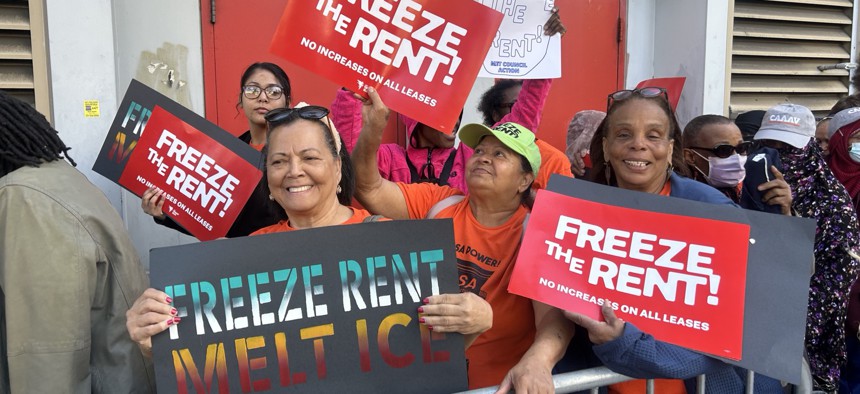
Tenant advocates rallied outside the Rent Guidelines Board meeting Thursday evening. Annie McDonough



New York City Mayor Zohran Mamdani is one step closer to delivering on his campaign promise of freezing the rent.
Of course, he can’t actually say that just yet. The preliminary vote by the city’s Rent Guidelines Board only sets a range of possible allowable increases for one- and two-year leases for the city’s roughly 1 million rent-stabilized apartments. The board voted Thursday night to approve a range of 0-2% for one-year leases and 0-4% for two-year leases, but the board’s final vote on an allowable increase – or freeze – will happen in late June.
And if successful, Mamdani may not claim credit at all, given how careful he’s been since taking office about not publicly calling on the city’s Rent Guidelines Board to approve a rent freeze. The board is supposed to be independent, but the mayor appoints its nine members. Since taking office, Mamdani has appointed five tenant-friendly members and brought back a sixth. In a relatively muted statement right after the vote, Mamdani said he was “encouraged” to see the board “taking seriously the data around affordability, operating expenses, and the pressures facing both tenants and small property owners as it sets this preliminary range.”
“As the RGB begins its public hearings, tenants, owners, and New Yorkers from every borough should make their voices heard and speak directly to what this housing crisis looks like in their lives,” he added. “I’m confident the Board will weigh those perspectives carefully and arrive at a decision later this summer that reflects the urgency of this moment.”
Freezing the rent, however, could further strain Mamdani’s relationship with the business community – and landlords in particular – who argue that owners can’t afford frozen rents with rising costs.
One of those landlord groups, the Small Property Owners of New York, bashed the range approved Thursday night. “It ignores the severe economic realities of mom-and-pop, generational, immigrant small property owners whose capped rent streams make it impossible to keep pace with skyrocketing property tax, insurance, utility, repair, and all other operating costs,” board president Ann Korchak said in a prepared statement. “Flouting its obligations, making decisions based on politics, and demonstrating a clear bias against small owners has serious legal implications.”
The New York Apartment Association, led by former Assembly Member Kenny Burgos, has advocated for a somewhat unique proposal this year: suggesting that the board could approve a different rate for rent-stabilized apartments in buildings constructed before 1974.
But Mamdani is not alone in agitating for a freeze amid a shortage of affordable housing in the city. The tenant movement is always organized around the annual RGB vote, and again this year showed out in full force.
Mamdani’s place in City Hall gave that movement a notable boost this year, with hundreds of tenant advocates rallying ahead of the vote outside LaGuardia Community College in Long Island City on Thursday. Reminiscent of the mayoral debate held at the same location in October, a small band played while advocates hoisted red “freeze the rent” signs – and others saying “freeze the rent, melt ICE” – and chanted in multiple languages. Among the groups in the crowd were the New York State Tenant Bloc, New York Communities for Change, CAAAV and members of the New York City Democratic Socialists of America.
Rallying ahead of the vote was Assembly Member and congressional candidate Claire Valdez, who is endorsed by Mamdani and who backs a rent freeze. “There are things that, as a candidate and as an Assembly member, that I can talk about now, that our mayor cannot, because it is an impartial process, and he needs to remain impartial in this moment,” Valdez told City & State last week. “One person can't do all of this by themselves. And so I’m proud to call for a rent freeze alongside many, many tenants all over the city.”
Each year, the board’s vote is a battle between tenant and landlord advocates, with the former arguing for a freeze – and if not that then the lowest allowable increases – and the latter arguing for much larger allowable increases than the board ultimately approves. But the Rent Guidelines Board is required to analyze the entire picture of the housing market every year, including data about housing availability and costs, owners’ operating costs and more.
Thursday’s meeting considered three possible ranges – one presented by the members designated as tenant representatives, one by the members designated as landlord representatives, and one by the chair, Chantella Mitchell. It’s the third that is routinely approved, and was again this year. The tenant members proposed ranges of -3% to 0% for one-year leases and -4.5 to 0% for two-year leases, while the landlord members proposed ranges of 3-5.5% for one-year leases and 6-8% for two-year leases. Both of those proposals were voted down. When the tenants’ proposal failed, the largely tenant-advocate audience drowned out the panel with boos and chants.
The board voted to allow increases for stabilized units each year under the Adams administration, for a combined 12% allowable hike for one-year leases in those four years. Under former Mayor Bill de Blasio, the board voted to freeze the rent three times, as well as one year in which they approved a rent freeze for half of the year.