

Transportation
No, WE want free buses
The City Council is pushing to expand the Fair Fares program for low-income New Yorkers through automatic access and by covering all transit costs. The Mamdani administration is not enthused.
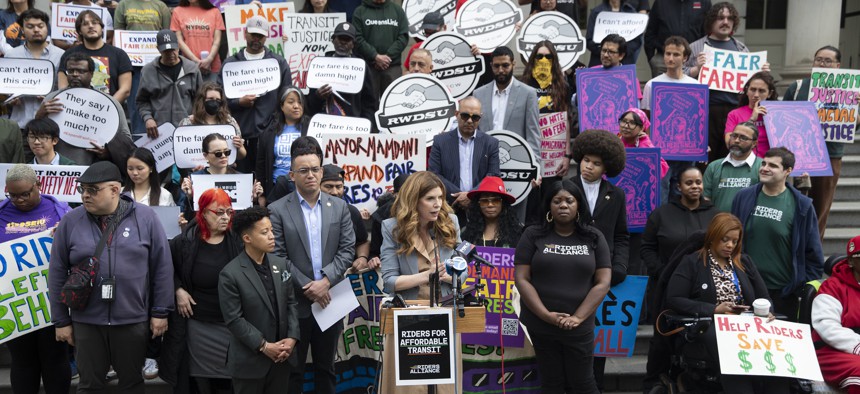
City Council Speaker Julie Menin spoke at a rally ahead of a hearing on Fair Fares Wednesday. John McCarten/NYC Council Media Unit


The call for free buses rang out loud and clear. But this time it was coming from the City Council. And it was barbed with criticism for the Mamdani administration.
The New York City Council wants the Mamdani administration to automatically enroll eligible New Yorkers in an existing municipal program giving them access to discounted subway, bus and paratransit trips.
This was the subject of a hearing Wednesday morning in which council members grilled members of the Mamdani administration about Fair Fares, pressing them for answers about low enrollment while arguing that the city is not doing enough to ensure New Yorkers access the program. While much of the hearing focused on a measure that would require the city to automatically enroll people in Fair Fares, the City Council’s broader push to make the program totally free hung over proceedings – an alternative to Mayor Zohan Mamdani’s marquee transit proposal.
Fair Fares, which was first introduced in 2019, currently offers half-priced rides for enrollees between the ages of 18 and 64 who make less than 150% of the federal poverty line. Of the estimated 1.3 million individuals who qualify, only about 380,000 people are currently enrolled – a mere 35%.
City Council Speaker Julie Menin and other council members have argued that their proposal, unveiled last month in the body’s budget plan, is a much-needed next step. With the help of automatic enrollment, nearly 1 million low-income New Yorkers would get access, and the program would cover their entire fare. The City Council has estimated this would cost an additional $130 million a year to implement, though this would heavily depend on enrollment and participation. Last fiscal year, the program cost about $86 million.
Mamdani, who has advocated for making buses free for all New Yorkers regardless of income, has yet to take a position on the proposal. His preliminary budget plan did not include a Fair Fares expansion, which he attributed in part to the city’s multibillion budget deficit. As his bus proposal looks increasingly unlikely to come to fruition this year, advocates have urged the mayor to expand the program to more income levels and to make it free in the meantime.
The Metropolitan Transportation Authority leaders and the fiscally conservative watchdog Citizens Budget Commission are in favor of the city expanding Fair Fares over Mamdani’s proposal to make buses free. CBC put out a report ahead of Wednesday’s hearing arguing as much. Breaking from the City Council’s proposed expansion though, the budget watchdog recommended that Fair Fares’ current 50% discount should be extended to anyone below 250% of the poverty level – not made entirely free.
Human Resources Administration Chief Program Administrator Rebecca Chew declined to further expand on the Mamdani administration’s position, telling council members that they were reviewing the City Council’s proposal.
As for the legislation directing the city to develop an automatic enrollment system, she stressed that informed consent and client privacy are important parts of the benefits application process. “Benefits applications require access to personal information and clients authorizing review of their confidential information,” Chew said, expressing concern about the risks automatic enrollment could pose. “DSS must be conscious of the fact that such sensitive information is subject to numerous privacy regulations and laws.”
Supporters of automatic enrollment have argued that bureaucratic hurdles and inadequate public messaging are to blame for why the program is so underutilized. The process can be lengthy – applicants must download an app and submit documentation verifying their income, age and residency to apply. Chew described the city’s efforts to advertise the program as “robust,” pointing to the $2 million spent in 2025 on targeted advertising.
Menin, who opened questioning by expressing disappointment that Department of Social Services Commissioner Erin Dalton didn’t testify, was skeptical.
“We need to fix the system,” Menin said, pointing to the program’s low enrollment. “The way to fix the system in our opinion is to make it free for bus, for subway, for paratransit. The council is strongly pushing for that. We believe very much in the need for this and in the automatic enrollment.”
While she defended Fair Fares and its mission, Chew acknowledged that the program can grow.
“We understand that there’s challenges in reaching everyone who can take advantage of the program,” she said. “We are going to continue leaning into our marketing campaign.”