

2026 congressional midterm elections
AIPAC is helping boost Espaillat against DSA challenge
But who’s funding outside spending in the final week of the election isn’t always clear.
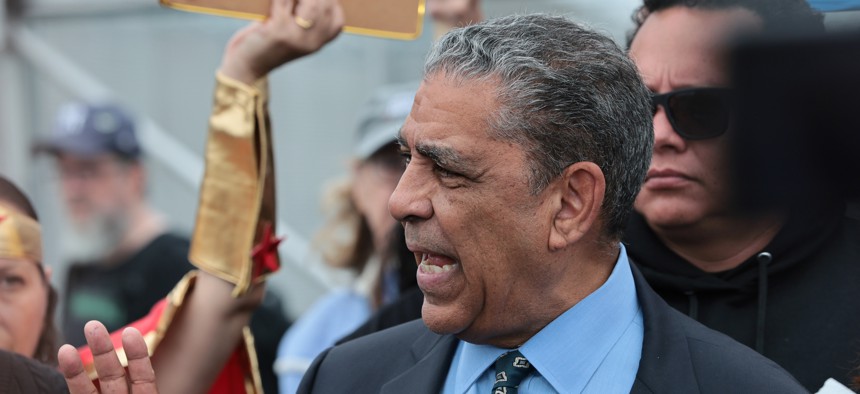
Rep. Adriano Espaillat has long had support from the pro-Israel group, but now he's facing a serious challenge from an anti-Zionist opponent. Michael M. Santiago/Getty Images



There’s a real fight going on in NYC over super PAC spending in congressional races.
In the last week, Democratic Socialists of America-backed congressional candidate Claire Valdez suggested the American Israel Public Affairs Committee, or AIPAC, was funding Real Fight NYC, a super PAC supporting her opponent Antonio Reynoso – only for the American Federation of Teachers to come forward and say they were actually the ones helping fund the super PAC. Real Fight NYC even released an ad about the whole incident.
But while AIPAC may not be funding attack ads against Valdez, it turns out the controversial pro-Israel group is helping fund attacks on another DSA-endorsed congressional candidate: Darializa Avila Chevalier, who’s looking to unseat Rep. Adriano Espaillat. On Friday, United Democracy Project – AIPAC’s super PAC – disclosed that it poured $650,000 last month into BOLD America, a super PAC that has spent at least $2.8 million ($600,000 in May and $2.2 million in June) to oppose Avila Chevalier and support Espaillat.
It’s not a huge surprise that AIPAC is spending big to back Espaillat. Like Rep. Dan Goldman, who’s fighting off a progressive primary challenge from Brad Lander, he’s long been endorsed by the pro-Israel group and still featured on AIPAC’s candidate donation site. Since the start of 2025, Espaillat’s campaign has accepted $5,000 from AIPAC itself, along with over $140,000 in donations earmarked by AIPAC.
Meanwhile, Avila Chevalier is an outspoken anti-Zionist who supports the Boycott, Divestment and Sanctions movement against Israel and played a key role in the anti-Israel encampment protests at Columbia University. If she wins next week’s primary election, she will likely become the most pro-Palestine member of Congress.
The teachers union is also helping out Espaillat, just as it’s boosting Reynoso. AFT’s own super PAC, AFT Solidarity, bought some ads supporting him, and the union also put some money into Progressive Unity Fund, a super PAC run by the same people behind Real Fight NYC. As Jewish Insider recently reported, former New York City Comptroller Scott Stringer, who has close ties to the teachers union, and consultant David Keith are involved in both Real Fight NYC and Progressive Unity Fund, as well as the state-level independent expenditure committee Westside Progress.
Some super PACs are relatively well-known and open about their donors. Justice Democrats PAC, which has spent over $370,000 to support Valdez and $1.5 million to support Avila Chevalier, has been around long enough that it’s disclosed many of its donors, such as The Institute for Middle East Understanding Policy Project and Rep. Rashida Tlaib’s campaign. And it’s been reported that American Priorities, the anti-AIPAC super PAC that’s put $1.3 million behind Avila Chevalier and $455,000 behind Valdez, has received significant donations from Muslim businesspeople who support anti-Israel candidates.
But pop-up super PACs that were only created recently, like Real Fight NYC and Progressive Unity Fund, won’t have to disclose their donors until after the June 23 primary election. That means we’re still in the dark when it comes to much of the dark money funding those groups.
For instance, AFT told City & State it gave Real Fight NYC a little under $200,000, but the super PAC has spent $750,000 running pro-Reynoso and anti-Valdez ads on streaming services and cable TV – which leaves $550,000 unaccounted for. The AFT said they received assurances none of that is AIPAC money, but that hardly narrows it down. The money could be coming from almost anyone: other unions, major real estate interests, other pro-Israel groups, crypto companies, the list goes on.
We won’t know for sure until after the election next week – and by then, it might not matter.