

2026 New York state elections
Lefties didn’t just win state legislative races – incumbents lost big
With Trump in office, Democrats are demanding that someone – anyone – just do something.
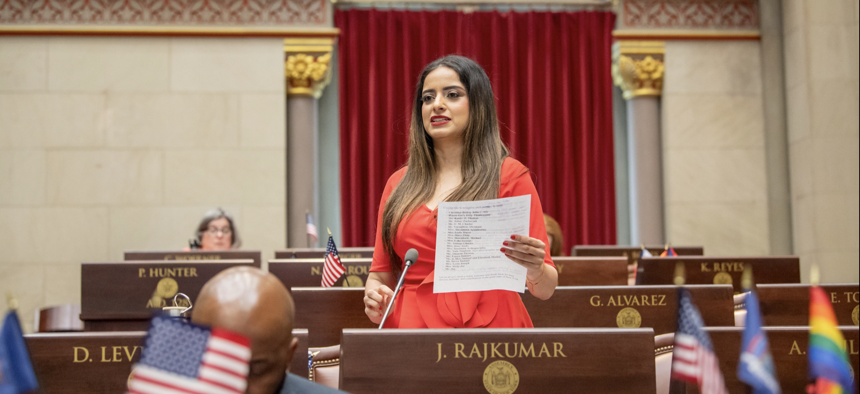
Assembly Member Jenifer Rajkumar was among those incumbent state lawmakers who failed to overcome a challenge from the left. NYS Assembly


Primary night was a particularly good one for progressives and those with the backing of New York City Mayor Zohran Mamdani and the Democratic Socialists of America. But it was a pretty awful one for incumbent state legislators, with at least six lawmakers falling to lefty candidates Tuesday.
Indeed, Brooklyn Assembly Members Stefani Zinerman and Erik Dilan both lost their rematch challenges from DSA-backed Eon Huntley and Christian Celeste Tate, respectively. State Sen. Jessica Ramos lost to her Queens Assembly colleague Jessica González-Rojas, moderate Assembly Member Jenifer Rajkumar lost to DSA-endorsed attorney David Orkin and Assembly Member Eddie Gibbs fell to former New York City Council Member Diana Ayala. Outside New York City, state Sen. Jeremy Zellner lost to Assembly Member Jonathan Rivera, and in Syracuse, Bill Magnarelli, one of the senior-most members of the lower chamber, is trailing democratic socialist Maurice Brown in a close race, with ballots still being counted.
“Zohran Mamdani was not on the ballot, but his impact sure was,” Democratic strategist Trip Yang told City & State. Mamdani only endorsed four Assembly candidates and one in the state Senate – only for open seats to avoid friction with Assembly Speaker Carl Heastie – but DSA-backed candidates still won a handful of hypercompetitive open seats, and took out three incumbents: Rajkumar, Zinerman and Dilan. Mamdani won each of those districts by double digits in the primary last year.
All of these races – ones in which incumbents lost to candidates to their left – undoubtedly have their own nuances. Ramos’ poor relationships with her colleagues and dumbfounding mayoral endorsement of Andrew Cuomo surely did her no favors, Zellner has only been in office for about four months and Rajkumar moved into her district to run in 2020 after losing a lower Manhattan Assembly race, to name a few. Meanwhile, an onslaught of outside spending to back incumbents wasn’t enough to convince voters, in many races.
But the results in Tuesday’s state legislative Democratic primaries are as much about an embrace of Mamdani’s starpower and DSA’s populist momentum as it is a rejection of incumbency.
“I think a big part of why incumbents are losing is they kind of take for granted their strengths and they misunderstand that name recognition is not trust,” said Democratic consultant Ryan Adams.
This isn’t exactly a new pattern; a rejection of the establishment is part of the typical, gradual swinging of the pendulum across the political spectrum. At the same time, NYPIRG senior political adviser Blair Horner said it’s uncommon for a handful of sitting lawmakers to be defeated in a primary – let alone as many as seven. “The public is unhappy, and they have every right to be,” he said.
Democrats of all stripes are furious with the second Trump administration, and while there are echoes of 2018’s blue wave, to be sure, the alarm bells are sounding more loudly than ever. There’s a heightened demand for someone – anyone – to just do something.
“There's a frustration with the Democratic Party with people saying, ‘Why aren’t you doing more,’ even though I’m not sure what it is they could do when the Republicans control both houses, and you got a president who does whatever the heck he wants,” lawmaker-turned-consultant Mark Weprin told City & State. “Short of setting themselves on fire on the Capitol steps, there’s nothing they can do.”
And even though Democrats who control the Legislature took direct aim at President Donald Trump with immigration reforms that spurred concurrent lawsuits this session, and passed a constitutional amendment to make New York more competitive in the redistricting war, that’s not enough to quell a simmering frustration.
That same logic applies to hyperlocal issues; in the primary against Zinerman in Bedford-Stuyvesant, Brooklyn, for example, deed theft became a central issue. “If the narrative is, ‘You don’t stand up for your community, you just do whatever is politically expedient,’ then it doesn’t matter if you’re like, ‘Well, I passed the bill about deed theft,’ and (voters are) like, ‘Cool, did you stop deed theft, though?’” Adams said. “Because passing a bill and then letting something happen isn’t the same thing. There’s a huge difference between ‘I did my homework’ and ‘I learned the lesson.’”
And in all that unrest lies a general anti-incumbent sentiment. “People vote not based upon what’s in their heads, they vote based upon what’s in their guts,” said Democratic strategist Hank Sheinkopf, who worked on Ramos’ campaign. “And the gut is telling them that change is required, and maybe more youthful people are required.”
Meanwhile, the populations of some of those districts are changing. While Zinerman’s district is still home to many Black homeowners, it’s also becoming younger and whiter. That’s also true of the politically energized Ridgewood section of Rajkumar’s Queens district, which seems to have overpowered the predominantly South Asian neighborhoods of Richmond Hill and Woodhaven that make up her base.
“The reality is some of these incumbents put up spirited fights, but their districts had just changed to a point where there might not have been a viable path to victory,” said consultant Evan Stavisky. “And that’s a tough, tough, tough thing to come to grips with, because incumbents generally work hard, they’re in it for the right reasons, but sometimes the world changes on them.”
That hasn’t been a problem for all incumbents facing progressive challengers, though. Assembly Member Didi Barrett who represents parts of Columbia and Dutchess counties, for example, soundly defeated Samuel Hodge, a younger challenger who campaigned against her from the left. And Democratic Assembly Members JoAnn Simon and Jaime Williams comfortably staved off progressive challengers on opposite sides of Brooklyn.
As the DSA rides the wave of Mamdani’s victory, strategists say its continued success rests behind the organization’s sheer ability to mobilize and understand different messaging. While of course, some of that comes from harnessing the power of social media and building a brand – which DSA is especially good at – nothing compares to old-fashioned door-knocking and speaking with voters face-to-face, especially as people grow starved for real connection and unfiltered information that they can trust. And knocking doors is something DSA is also especially good at.
“They have a network of young people who believe in the cause, who, their idea of fun is going out with a bunch of other young people and knocking on doors, and meeting voters,” Weprin said. “And most of the establishment candidates (and their) volunteers are older people who loathe knocking on doors.” Why? “I don’t know, it’s exhausting! It’s tiring. You’ve got to deal with a lot of rejection.”
Jack O’Donnell, managing partner at O’Donnell & Associates, said he received 26 pieces of mail for Karen Hoak, an Assembly candidate supported by Democratic party leaders for outgoing Assembly Member Jonathan Rivera’s Buffalo area seat. But direct mail doesn’t hold the clout it used to.
“It wasn’t the same as folks knocking on the door willing to argue with me about capitalism,” O’Donnell said. “Zellner was all over TV with an ad of him making pancakes and him saying ‘I’m going to fight ICE.’ That’s not the same as seeing you at a rally in front of the ICE office saying we’ve got to stand up for immigrant rights.”
“I think Democrats want fight,” O’Donnell added:“If you can’t show up in the campaign, they don’t have any faith in you to show up when you’re in the office.”
Adams had similar thoughts. “So many people depend on mail, because they think mail is the best way to get directly into someone’s home – and mail is the best way to get directly into someone's garbage,” he said. “If you are trying to build trust with people coming to their door and not shying away from the hard stuff, that’s big. That’s a problem with paid canvassing, too.”
The DSA has schooled party leaders in recruiting energized volunteers to run campaigns. Likewise, the MAGA movement continues to dominate Republican races as Trump galvanizes volunteers. And voters across the political spectrum are motivated by the same thing: anger.
“Populist anger can be buffeted by a well-liked incumbent with a track record of success, who has a sizable war chest,” Horner said. “But an angry public will respond to a well-organized campaign that’s talking about the issues that people care about.”