

Campaigns & Elections
The 26 new rules for elections in ’26
How the game changed after this year’s primaries.
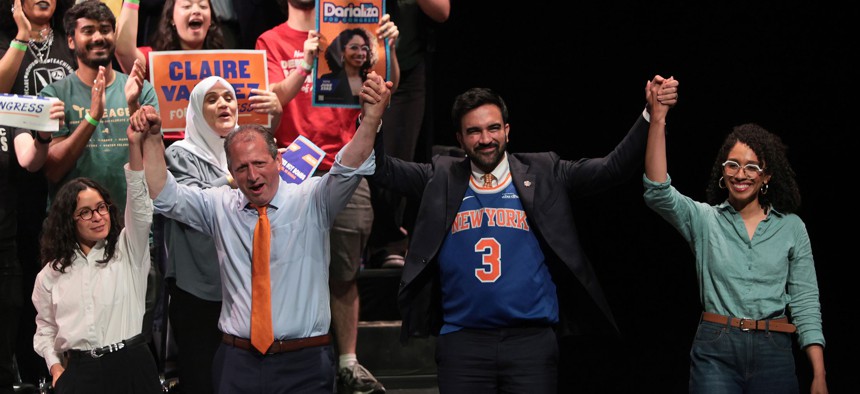
New York City Mayor Zohran Mamdani, along with his three winning congressional candidates, continues to rewrite the election rules. Michael M. Santiago/Getty Images

Want to write a political speech in 2026? All you need is a noun, a verb and the word “affordable.”
Want to win an election in 2026? That’s a little more complicated.
The results haven’t been certified yet in the primaries, but it’s clear that Zohran Mamdani’s 2025 win wasn’t a one-off fluke. Instead, some of the fundamentals of politics have changed in New York. You can’t be caught running the same strategies you learned from a VHS tape in a TikTok world.
There’s not just a 24-hour news cycle now, there’s a 24-hour content cycle. New Yorkers are prioritizing energy over experience. And voters are a lot more forgiving than they used to be – though it seems sexual assault allegations will still sink a campaign.
Of course, like Calvinball in the newspaper comics, the rules of New York politics are made up as we go. So read up on the latest edition, before it all changes again.

1. Hasan Piker isn’t toxic to voters
He’s the shock jock of the left, and candidates only seem to benefit from his attention.
2. Ignore young voters at your own peril
Canvassing is the hot new summer gig, and voting is the hot new summer activity.
3. It’s OK to be a shitposter
In the words of New York City Council Member Chi Ossé, “Woke 1 was crazyyyy,” and many young activists now running for office have yearslong digital archives full of embarrassing and problematic shitposts. Once, the conventional wisdom was that such activists should never run for office – or should at least scrub their X account before they do. But these days, no one seems to care. Darializa Avila Chevalier just won a Democratic primary despite tweeting “Fuck Kamala Harris” and calling for more people to read Lenin. Now, the worst thing you can do is delete your old tweets – because then it looks like you have something to hide. – Peter Sterne
4. Paper endorsements aren’t enough – you need buy-in
Don’t just hoard logos for your literature.
5. Trump trumps everything
If you’re not President Donald Trump’s preferred candidate, be prepared to lose. Both the state Republican and Conservative parties backed Assembly Member Robert Smullen, a decorated U.S. Marine Corps colonel, in the race to replace Rep. Elise Stefanik (who’s retiring after Trump refused to endorse her for governor). But Sticker Mule CEO Anthony Constantino had Trump, Roger Stone and Rudy Giuliani on his side – and a much Trumpier vibe, too, with his attention-grabbing off-color comments and love of cage fighting. “Trump is the establishment in the Republican Party,” GOP adviser David Catalfamo said, “and to think about it otherwise is actually wrongheaded.” – Kate Lisa
6. Be friends with the mayor – not with his predecessor
Hello, Tammamdani Hall. Goodbye Table of Success.
7. Israel is more helpful as a foe than a friend
This past election was all about AI. Not artificial intelligence (unless you were running for Congress in midtown Manhattan), but affordability and Israel. And the Israel script has largely flipped in Democratic primaries, with candidates gaining more from proving their opposition to the country’s government as opposed to how much they support it. We’re a long way from the days when political forays to Israel were a right of passage for many seeking to represent parts of New York, in particular New York City.
Not only is opposition to the Israeli government no longer a poison pill, but standing firm against the country’s actions in Palestine emerged as a key sticking point for progressive candidates and the voters who support them. The new approach to Israel is, at its core, a purity test. As Antonio Reynoso learned in his congressional race, calling the country’s actions in Palestine a “genocide” doesn’t cut it – he did that. You also have to make sure you were denouncing Israel early enough. But if you changed your politics before Oct. 7, 2023, before the issue exploded into the mass shared political consciousness, you’re off the hook.
And god forbid you receive AIPAC money. That cash is now almost as toxic as corporate PAC money among Democratic voters. It’s “babies, not bombs” in the new school of New York politics.
The pockets of New York that remain unabashedly pro-Israel are shrinking, so it pays to understand where your constituents stand before going all-in on supporting the country. It could work, like for Rep. Ritchie Torres, who easily fended off Michael Blake in a Bronx district that includes a pocket of pro-Israel Jewish constituents, and pro-Israel candidate Cait Conley in the 17th Congressional District. It could also backfire, like it did for Rep. Dan Goldman, whose steadfast backing of the Jewish state didn’t resonate with his lower Manhattan and Brooklyn constituents. (With some exceptions, of course, like the Borough Park blocks that Goldman won by 99%.)
It’s hard to think of a time when foreign policy so influenced domestic elections. And this isn’t even a war with direct United States involvement, Iran engagement stemming from Israel and Palestine notwithstanding. But this is the brave new world on the left. And lukewarm cop-out answers about two-state solutions isn’t cutting it for many voters anymore. Just be forewarned that criticizing Israel will still likely earn you charges of antisemitism, whether deserved or not. – Rebecca C. Lewis
8. DSA can be beaten … but it’s not easy
As a socialist wave overtook New York in last month’s primaries, with candidates endorsed by the Democratic Socialists of America winning across New York City and beyond, one incumbent remained standing. In Harlem’s Assembly District 70, Jordan Wright held off an insurgent challenge from Conrad Blackburn, even as several of other sitting lawmakers got bested by a member of the DSA-endorsed slate. And he also prevailed in a portion of the congressional district that Rep. Adriano Espaillat lost to democratic socialist Darializa Avila Chevalier.
Wright is a third-generation Harlem official. His father Keith Wright is a former member of Congress who heads the Manhattan Democratic Party, and his late grandfather Bruce Wright was a judge. The Assembly member’s victory in June was a rare dynastic victory at a time when traditional party machines and political family influence is dwindling. But Wright doesn’t attribute his win to his family name. He sat down with City & State to discuss how old-fashioned, boots-on-the-ground campaigning led him to success where so many others failed in the primary, and what to take away from it. Read more here.
9. Don’t double down against casinos
The house always wins … and the best move for politicians is not to play.
10. Socialism isn’t just for white gentrifiers anymore
Yes, a national survey of DSA members from five years ago found it was 85% white (though the organization has grown in size by 70% since then), and yes, DSA still gets its strongest support in the rapidly gentrifying “Commie Corridor” neighborhoods of western Queens and North Brooklyn. But nearly a decade after AOC won the Bronx, this year’s Democratic primary showed once again that the socialist group’s message appeals to young voters of all races, as DSA-backed candidates won in largely Black neighborhoods like Bedford-Stuyvesant and Latino-majority neighborhoods like Washington Heights. – Peter Sterne
11. Socialism is selling upstate
DSA turned Buffalo and Syracuse rose red with wins by Adam Bojak and Maurice Brown.
12. You can denounce super PACs and they’ll still help you
“No PAC Jack” was a great slogan.
“No job Jack” is the harsh reality.
Across several competitive congressional primaries this year, candidates lambasted their opponents for benefiting from millions in outside spending by fat-cat, dark money super PACs. How dare they. And then, in some cases, those same candidates saw sweet cash flow their direction – whether from super PACs explicitly boosting their candidacy, or tearing down their opponent.
Everyone says they want to get super PACs out of politics. Everyone hates Citizens United. And everyone is a little bit full of shit. It largely doesn’t matter.
Turns out, voters aren’t all that tuned into this level of hypocrisy in politics. Perhaps we’ve all accepted big money or dark money as an inevitability. That’s bad news for candidates like Jack Schlossberg in the 12th Congressional District Democratic primary, who sold himself as unbought and unbossed. He came in a distant third to Assembly Member Micah Lasher, beneficiary of nearly $11 million in super PAC spending. The close second-place finisher, Assembly Member Alex Bores, had a whopping $19 million spent in his favor by super PACs, and another $8 million spent against him.
In the 13th Congressional District, Democratic Rep. Adriano Espaillat and democratic socialist challenger (and victor) Darializa Avila Chevalier showed that you can be hypocritical about super PACs from any part of the Democratic ideological spectrum. Espaillat benefited from more than $5 million in super PAC spending, while Avila Chevalier benefited from just shy of $2 million. His super PAC backers included AIPAC, while hers included the lefty Justice Democrats PAC. Claire Valdez and Brad Lander each benefited from admittedly smaller amounts of super PAC spending in the 7th Congressional District and 10th District, respectively. – Annie McDonough
Alex Bores: “There’s no one more motivated than me to get all of this money out of politics. … All of my opponents looked around at the super PAC attacking me and said, ‘Eh, we’re going to let that happen.’”
Micah Lasher: “It’s all awful and corrosive. And also, there is a difference between the efforts of someone who is the former mayor of the city (Mike Bloomberg) … and AI companies and crypto executives who very much have an agenda.”
Darializa Avila Chevalier: “I’ve said clearly: We need to abolish super PACs. … I can’t control outside groups.”
Adriano Espaillat: “We must end money in politics, and Citizens United is a bad vehicle for politics.”
13. You don’t need labor during an election; you need them after
If recent elections in New York City have taught us anything, it’s that the axis of political power is shifting. The biggest organized labor unions, long regarded as major power brokers in city politics, haven’t been immune to this seismic reshuffling.
Take last year’s Democratic mayoral primary where a young democratic socialist triumphed over a political goliath. Zohran Mamdani defeated Andrew Cuomo in June 2025 without any support from major labor unions, bucking historical precedent. Rather than take a chance on the lefty upstart, the Hotel and Gaming Trades Council, building service workers union 32BJ SEIU, healthcare union 1199SEIU, the United Federation of Teachers and the New York City District Council of Carpenters hedged their bets with Cuomo and a few of the other well-known candidates in the race. Municipal workers union District Council 37 was a rare exception – and even then, they ranked Mamdani second, behind then-City Council Speaker Adrienne Adams.
But Mamdani’s victory wasn’t a one-off. With his support, democratic socialists Claire Valdez and Darializa Avila Chevalier also defeated well-funded, establishment opponents in congressional races last month without the support of traditional labor powerhouses. Read more here.
14. Phone banking still works
You’ve just got to dial a whole lot more to get through “scam likely” screens.
15. You need a full-time social media staffer
Don’t make us explain this again. EVERY. POLITICIAN. IS. MAKING. VERTICAL. VIDEOS. Long-shot Republican state Attorney General candidate Saritha Komatireddy? She’s on TikTok. 10th Congressional District Democratic nominee Brad Lander? He’s on Reels reminding you the mayor endorsed him. Want more austerity in the city budget? Sit down with Citizens Budget Commission President Andrew Rein on the virtual park bench. Sure, vertical videos will one day go the way of town criers. But old-fashioned political ads – ones you can mute during a Knicks game, or skip past after 15 seconds on YouTube – just don’t seem to be grabbing voters’ attention the same way anymore. For now, campaigns ought to learn their way around a mini mic and CapCut. – Annie McDonough
16. You can’t beat someone by calling them a transplant
New York is full of immigrants from around the world, and also Florida.
17. Enthusiastic volunteers are worth their weight in gold …
… and unenthusiastic, paid canvassers shouldn’t show up in videos.
18. The more consultants, the lower your odds
Your team phone calls shouldn’t sound like a bidding war.
19. Voters want absolutists, so communicate a clear vision
The time for being wishy-washy is over. If your policy formation starts with consultants and focus groups, it’s probably not going to work. Trying to carefully thread the needle and politely appease everyone won’t win you any fans on social media. Voters have shown in the past two years that they want moral clarity from their leaders. Take a stance on what you believe is right and wrong and hold that idea closely and apply it consistently. If you don’t have a clear vision, you have no vision. – Eric Holmberg
20. Knock, knock. Who’s there? Canvassers.
Door-knocking is back in a big way, even in dense New York City.
21. Incumbents can’t pick their successors
Having their endorsement helps! But as Antonio Reynoso knows, it’s not a guarantee.
22. If at first you don’t succeed, try, try again
Just ask victorious Assembly candidates Eli Northrup, Eon Huntley, Illapa Sairitupac, Adam Bojak and Pesach Osina. Don’t ask Hiram Monserrate. Just give it up.
23. If you’re worried about a DSA challenge, sign on to their bills
NYC-DSA co-Chair Gustavo Gordillo said after the primary: “I think (Assembly Member) Grace Lee did that, actually, in the past year. She was very supportive of the tax the rich bills and the agenda.”
24. AI is taking over the world … but not campaigns
Few politicians have embraced AI-generated content with as much gusto as Bruce Blakeman. In recent months, the Republican gubernatorial candidate has posted a slew of soulless videos and cartoon-style images of Gov. Kathy Hochul, depicting her as weak or outright villainous. “We ended cash bail so that we would stop punishing people who commit brutal crimes against our fellow New Yorkers, like this nice young man,” an AI-generated Hochul says in one video, gesturing to a heavily-tattooed man lurking behind her. “Want some crack?” he responds. Truly, groundbreaking stuff. Shakespeare would weep if he saw what dialogue has become.
Several other candidates have deployed tacky, cringe and just plain weird AI-generated images and videos. Andrew Cuomo, Jessica Ramos, Jenifer Rajkumar and Albert Baldeo, to name a few. All lost. – Sahalie Donaldson
25. No, the establishment doesn’t own election day
There was no “Mamdani Mirage” – the early vote closely tracked the election day vote.
26. One viral debate clip is worth the days of preparation
Get that quip in before Errol Louis cuts you off.
*By the way … the rules are always subject to change