

DSA
DSA debates how to debate AOC presidential endorsement
Explaining the latest fight roiling the Democratic Socialists of America
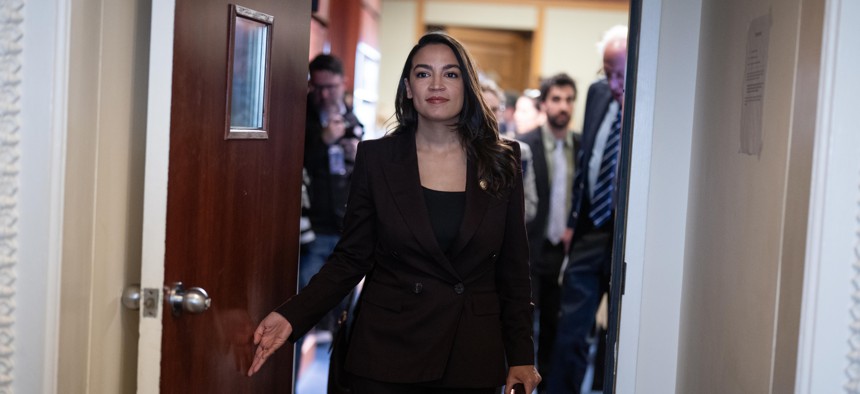
If you want to read 2,000 words about the procedural history of a resolution laying out DSA's process for endorsing Rep. Alexandria Ocasio-Cortez, who are we to stop you? Tom Williams/CQ-Roll Call, Inc via Getty Images



Next year, the Democratic Socialists of America will debate whether to endorse a candidate – most likely Rep. Alexandria Ocasio-Cortez – for president in 2028. This year, the socialist group is debating how that debate will take place – and it’s getting heated.
On Sunday, the National Political Committee, DSA’s 27-member national leadership body, discussed a proposed timeline for next year’s endorsement process and passed a controversial amendment to the proposal, which stripped out a provision that would have instructed the NPC to send out a nonbinding online poll to all members asking which candidate they supported endorsing for president. They did not pass the proposal itself, instead referring it back to another committee for revisions.
But the decision to eliminate the all-member poll was seen by many members of the organization as an unforgivable attempt to undermine the organization’s democracy – leading some to float the (very remote) possibility of severing DSA’s New York City chapter from the national organization.
“DSA’s national leadership (the NPC) just voted to overturn our convention & took away rank and file members’ right to vote in an all-member poll on presidential endorsement,” NYC-DSA Co-chair Gustavo Gordillo tweeted following the NPC meeting. “The NPC (is) taking away our members’ right to vote while NYC-DSA members send them ~ $2M per year in dues.”
In the heat of the moment, NYC-DSA’s treasurer went even further, writing in an email addressed to the NPC, “You need us more than we need you,” along with a spreadsheet projecting the financial implications of a hypothetical split between NYC-DSA and national DSA. The spreadsheet estimated that in the event of a split, only 2,000 to 6,000 of NYC-DSA’s 15,000-plus members would remain with national DSA, while the rest would follow NYC-DSA out the door. The NYC-DSA treasurer is said to have later apologized to the NPC for the email, and hundreds of DSA members have signed an open letter calling for the organization to project unity and resist any efforts to split. DSA leaders on all sides of the debate have reiterated that a split would be disastrous for the socialist movement and is very unlikely to occur.
How could a debate over how to conduct a future endorsement process for a hypothetical presidential candidate lead to such controversy? It’s partly because the procedural debate is really about DSA members’ complex feelings toward AOC. The congressional representative and socialist standard bearer remains a deeply divisive figure within the organization; most members, particularly in New York City, love her and want to see her become president, but others fear she is insufficiently committed to the organization’s politics and prone to making political compromises they see as unacceptable, particularly when it comes to foreign policy.
Another reason why the debate has become so sensationalized is because it’s very difficult to follow. After all, the NPC wasn’t actually voting on whether to endorse AOC for president. It was technically voting on whether to accept an amendment to an amendment to a proposed resolution produced by a committee created by a resolution passed at last year’s national convention.
Resolution 33
DSA first began planning its 2028 presidential strategy at its 2025 national convention, when convention delegates passed Resolution 33: “Unite Labor & the Left to Run a Socialist For President and Build the Party.” As the name suggests, this resolution called on DSA to form an electoral coalition with like-minded unions and progressive groups that could recruit and endorse a presidential candidate.
Specifically, the resolution called on DSA to work to form a left-labor electoral coalition with like-minded labor unions – including United Auto Workers, National Nurses United, Service Employees International Union, Communications Workers of America and United Electrical, Radio and Machine Workers of America– and the Working Families Party and Vermont Progressive Party.
Procedurally, Resolution 33 did two things.
First it created a Presidential Exploratory Committee, composed of members of various DSA caucuses, to explore the possibility of DSA running a presidential candidate in 2028. The resolution directed the Presidential Exploratory Commission to submit a report to the NPC prior to DSA’s 2027 national convention.
Resolution 33 also authorized DSA’s National Political Committee to participate in a left-labor electoral coalition, should one actually be created. But it included a specific caveat to ensure DSA wouldn’t be forced to back a candidate that other organizations in the coalition supported but DSA’s own membership did not: “If a coalition that DSA is a member of decides to endorse a presidential candidate, the NPC shall hold a national all-member referendum on whether to endorse that candidate.”
So far, no left-labor coalition has come into being, which means much of Resolution 33 is moot.
A modest proposal
In the absence of a real left-labor coalition, the Presidential Exploratory Committee proposed at the July meeting a multistep presidential endorsement process for DSA to adopt. The proposal assumes most candidates will announce their campaigns between January and April 2027 and calls on the National Political Committee to begin a 45-day endorsement deliberation period no later than April 1.
During those 45 days, the National Political Committee is supposed to hold a virtual forum open to all DSA members featuring the candidates (or if it’s just AOC, candidate) and individual chapters are supposed to hold meetings to discuss the candidates and poll their members on whether DSA should endorse anyone.
The PEC proposal also calls for “an all-member, non-binding poll regarding member preferences among the nominated candidates for the 2028 election.” If there are multiple candidates nominated for endorsement, then the poll would be ranked choice; if there’s only one person – perhaps a certain congressional representative from New York – being considered, it would be a straight “yes” or “no” poll.
Once the 45-day deliberation period ends, the National Political Committee would have three days to vote on whether and which candidate to endorse. Assuming the 45-day endorsement deliberation period begins on April 1, the last possible day, the NPC would need to vote on the endorsement by May 19. The proposal also envisions a limited role for the DSA national convention, held in August 2027, which would “vote to approve a final campaign plan and settle other political questions related to the 2028 presidential endorsement.” But the real power to endorse lies with the NPC.
The NPC is heavily polarized – nine members belong to either Socialist Majority Caucus or Groundwork, while 14 members belong to “left” caucuses that are more skeptical of AOC – and it’s not clear that NPC members would actually be moved by the results of the all-member poll, even if it showed that a clear majority of members support endorsing AOC.
One poll, two poll
It might seem duplicative to have each chapter poll its members, and then also conduct an additional poll of all members. But these two approaches reflect two different conceptions of democratic decision-making, and each are favored by different internal factions within DSA.
Many of the “left” caucuses and groups within DSA – such as Marxist Unity Group, Springs of Revolution and Red Star – believe that true democracy requires deliberation. They feel that online polls of DSA’s full membership just amount to popularity contests vulnerable to vote-whipping operations and worry that members won’t necessarily make a considered decision before casting their vote.
The “right” caucuses within DSA – particularly Socialist Majority Caucus and Groundwork – believe that true democracy means that everyone has a chance to vote, regardless of whether they deliberate first. They see the “left” caucuses’ insistence on deliberation as a form of anti-democratic gatekeeping that particularly disenfranchises DSA members with disabilities or who are working class and don’t have the ability to attend countless deliberative meetings.
(If these arguments sound familiar, it’s because DSA already had this exact debate at last year’s national convention, over a series of resolutions known as “One Member, One Vote.”)
Ahead of the meeting Sunday, Marxist Unity Group and Springs of Revolution jointly proposed an amendment to the Presidential Exploratory Committee proposal that eliminates the all-member, nonbinding poll. They worry that a simple “yes”/“no” online poll could result in many DSA members instinctively voting in favor of endorsing AOC simply because they like her and want her to be president, without fully considering how DSA will relate to her presidential campaign.
Groundwork defended the importance of an all-member poll, writing that only a single poll of all members would be rigorous enough to show there’s a consensus candidate, be that AOC or anyone else. A similar all-member poll was conducted in 2019 and showed overwhelming support for endorsing U.S. Sen. Bernie Sanders in the 2020 presidential election, and DSA went on to endorse him, even though he wasn’t a member of the group.
Reform & Revolution, another caucus, tried to thread this needle by proposing their own secondary amendment to the Marxist Unity Group/Springs of Revolution amendment, which would have restored the all-member poll while making it more nuanced. Rather than asking DSA members whether to endorse a candidate, Reform & Revolution wanted to offer them three options: DSA not endorsing a candidate, DSA endorsing a candidate and then organizing in coordination with the presidential campaign or DSA organizing an independent expenditure group in support of the campaign with its own messaging (which is Reform & Revolution’s preferred strategy). The amendment also called for the all-member poll to “include a space for members to write out their holistic assessment and analysis of the election and the political landscape.”
The convention option
Marxist Unity Group and Springs of Revolution also proposed a second amendment, which would take the endorsement decision out of the hands of the National Political Committee and into the hands of delegates to the 2027 national convention.
While the national convention is DSA’s highest decision-making body and outranks even the NPC, the 2027 national convention won’t be held until that August, by which point the 2028 Democratic presidential primary will already be in full swing.
To get around that issue, the amendment doesn’t actually say the decision should be made during the national convention: It says all the delegates to the 2027 national convention – who must be chosen by May 31 – should hold their own virtual “Presidential Strategy Conference” to debate the endorsement once the chapters finish deliberating and polling their members. Under the proposal, the conference has to be planned by mid-June – before the 2027 national convention.
NPC weighs in
In the days leading up to the NPC vote on Sunday, Socialist Majority Caucus and Groundwork mobilized supporters to pressure NPC members to vote to keep the all-member online poll. Groundwork sent a text message to DSA members warning them of the upcoming vote, and more than 1,000 people signed an open letter calling on the NPC to “let us vote on whether DSA will endorse a candidate for president in 2028.”
In the end, the NPC voted to pass the first Marxist Unity Group/Springs of Revolution amendment (which eliminated the all-member poll) while rejecting the Reform & Revolution secondary amendment (which would have restored a more nuanced all-member poll). That means DSA members will only be able to participate in the endorsement process by attending chapter meetings and voting in chapter-specific polls.
The NPC didn’t make a formal decision on the second Marxist Unity Group/Springs of Revolution amendment or on the underlying proposal itself, instead kicking it back to the Presidential Exploratory Committee for further revisions. As of now, it’s still undecided whether the final presidential endorsement decision will be made by NPC in May 2027, by the national convention in August 2027 or by a newly created Presidential Strategy Conference some time next summer.
It’s also unclear whether Ocasio-Cortez will even run for president, or instead run for U.S. Senate do something else entirely, leaving DSA to an even more complicated debate over whether to support another progressive contender. The only thing that is certain is that there will not be an online poll of all DSA members about the endorsement.
NEXT STORY: State lawmakers eye LGBTQ+ caucus in Albany