

News & Politics
With Glick retiring, what will become of PRRIA?
Opponents of the packaging reduction bill see an opening to pass a (watered-down) version of it next year.
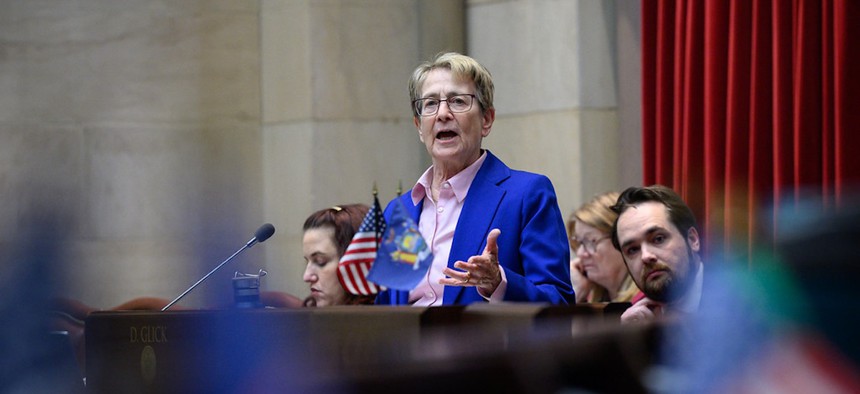
Assembly Member Deborah Glick, the longtime sponsor of the Packaging Reduction and Recycling Infrastructure Act, is retiring at the end of the year. NYS Assembly


Lawmakers packed up and left Albany without passing the Packaging Reduction and Recycling Infrastructure Act for the year just over a month ago, but lobbyists already have big plans to significantly amend the hotly debated bill as Assembly Member Deborah Glick, its longtime sponsor, prepares to retire.
One of the most heavily lobbied and expensive non-budget battles in recent years, PRRIA aims to reduce single-use plastics by 30% in the state over the next 12 years, and make businesses making $5 million or more create an extended producer responsibility program, under which they’d shoulder the costs of waste management rather than municipalities. Large industries and business leaders particularly take issue with the source reduction provision of the bill – the heart of the bill – that requires companies to reduce their packaging by 30%, a figure some businesses argue would be impossible to achieve, even though it was originally 50%.
Despite Glick and state Senate sponsor Pete Harckham meeting with concerned business leaders at the end of last year, Business Council of New York State Vice President Ken Pokalsky told City & State’s Heard Around Town, that provision was not axed in the amended bill this year – and ultimately never reached the Assembly floor.
“You can’t walk around with a handful of cherries and grapes coming in from the grocery store,” said Frank Nemeth, a lobbyist who represents the Business Council of New York State, which has aggressively opposed the legislation.
One lobbyist who represents major beverage companies fighting the bill said “Glick was immutable” and wouldn’t back down on the source reduction provision. But lobbyists see an opening for the bill – which has passed in the Senate the last two years – with Glick retiring at the end of the year.
“If lawmakers work with industry, I think they could get there,” Nemeth said. “It's just going to take some give and take.”
It’s unclear who Assembly Speaker Carl Heastie will select to carry the measure after Glick’s departure, or head up the chamber’s Environmental Conservation Committee.
Still, James McMahon, a lobbyist who represents the American Chemistry Council and companies like Snapple and Keurig, said getting the bill changed won’t be easy. “Some members on her side really aren’t giving up,” he said.