

Budget
Mamdani orders agencies to find 2.5% savings – again
New York City Mayor Zohran Mamdani is putting his own twist on the PEG.
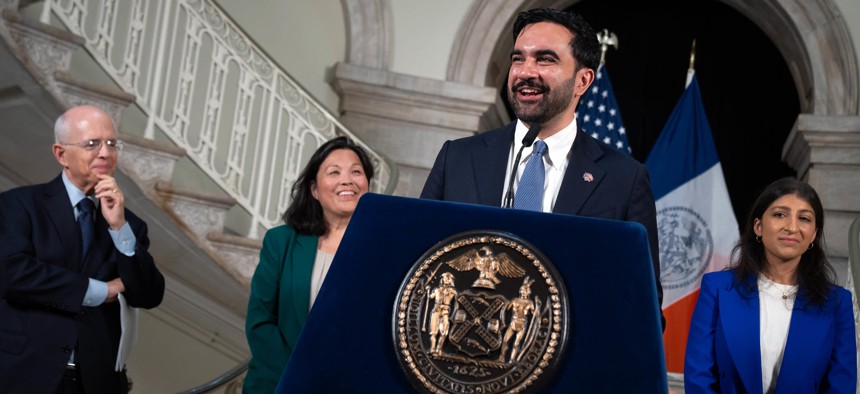
New York City Mayor Zohran Mamdani is directing city agencies to find an additional 2.5% in savings in fiscal years 2027 and 2028. Ed Reed/Mayoral Photography Office



Sooner or later, every mayor comes to the PEG. The Program to Eliminate the Gap, often criticized as an overly blunt budget tool to lower city agency spending, has nonetheless been used (to varying degrees of frequency) by a string of previous mayors to rein in city spending.
New York City Mayor Zohran Mamdani, though a vocal critic of austerity budgets, arguably arrived there earlier this year, when he instructed city agencies to find 1.5% savings in fiscal year 2026 and 2.5% in fiscal year 2027. He didn’t characterize those savings “targets” as a traditional PEG, however, saying in January that there was “a difference between pursuing savings and efficiencies and pursuing austerity.” Under Mamdani’s plan, a designated “chief savings officer” at each city agency was asked to find places to eliminate wasteful spending, an effort that resulted in $1.77 billion in savings across fiscal years 2026 and 2027.
Now, with his first budget done and his next fast approaching, Mamdani is leaning further into the approach, while also putting a fresh spin on it that the administration considers less rigid and more collaborative than traditional PEGs. On Tuesday, City Hall announced that all city agencies are being directed to find an additional 2.5% savings in fiscal years 2027 and 2028. That effort will start, City Hall said, with a “Workforce Savings and Efficiency Survey” through which employees can recommend areas for cutting waste, to be reviewed by chief savings officers. The savings will be worked into the November Plan, a regular update on the budget that arrives (unsurprisingly) in November.
“The administration’s savings exercise is a collaborative effort with our city agencies to do the painstaking work of identifying efficiencies and opportunities to reduce costs, while protecting the strong city services New Yorkers rely on,” press secretary Joe Calvello wrote in an email. He added that “layoffs to city agencies are not on the table” as part of the savings they’re exploring.
Call it a PEG or not, the move has elicited praise from budget watchdogs. “Launching a savings program now, early in the fiscal year, is the right thing to do,” New York City Comptroller Mark Levine wrote on X. “Kudos to the mayor for this prudent step.”
The Citizens Budget Commission, a watchdog group often urging fiscal responsibility, also heralded the savings program as a promising start to chip away at out-year budget gaps. The city has a projected $6.4 billion budget gap for fiscal year 2027, and while those gaps typically narrow in a good economy with growing tax revenues, other tools will likely be needed. “Quite frankly, the gaps are big. They’re growing,” president Andrew Rein said. “We’re going to need more savings over time, so (the mayor is) smart to start now,” he added, calling it a “good start” while saying it won’t solve next year’s budget deficit or longer-term budget problems on its own.
Former City Council Finance Chair Justin Brannan suggested there’s a difference between PEGs under previous administrations and Mamdani’s approach. “Savings that eliminate waste + improve operations & outcomes = good. Typical gun-to-your-commissioner’s-head “find us 5% savings by 5 PM” exercise that’s led to cruel cuts under previous Admins = bad. Also asking employees where the waste is? Smart,” he wrote on X.
City Council Speaker Julie Menin, at the helm of a body that typically presses for more funding for city programs and services, praised it too. “Identifying savings early is the kind of fiscally responsible planning our City needs as we prepare for a potential fiscal gap next year,” she said in a statement.“The Council has long emphasized finding efficiencies without cutting services, and I appreciate the Administration’s commitment to advancing that goal as we work together to deliver the services New Yorkers rely on.”
NEXT STORY: With Glick retiring, what will become of PRRIA?