

New York City
Dozens of city officials are driven around by chauffeurs. Are they living in a bubble?
The passenger princess life can be isolating, but some call it a necessity of the job.
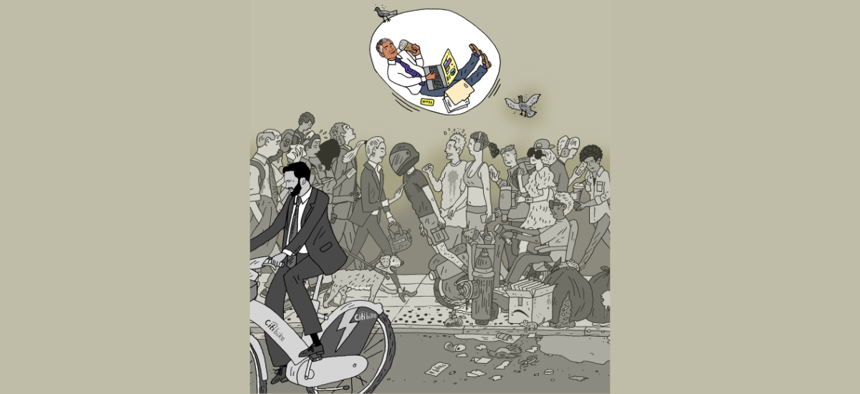
Beep Beep! BP (and many other city officials) coming through! Peter Arkle



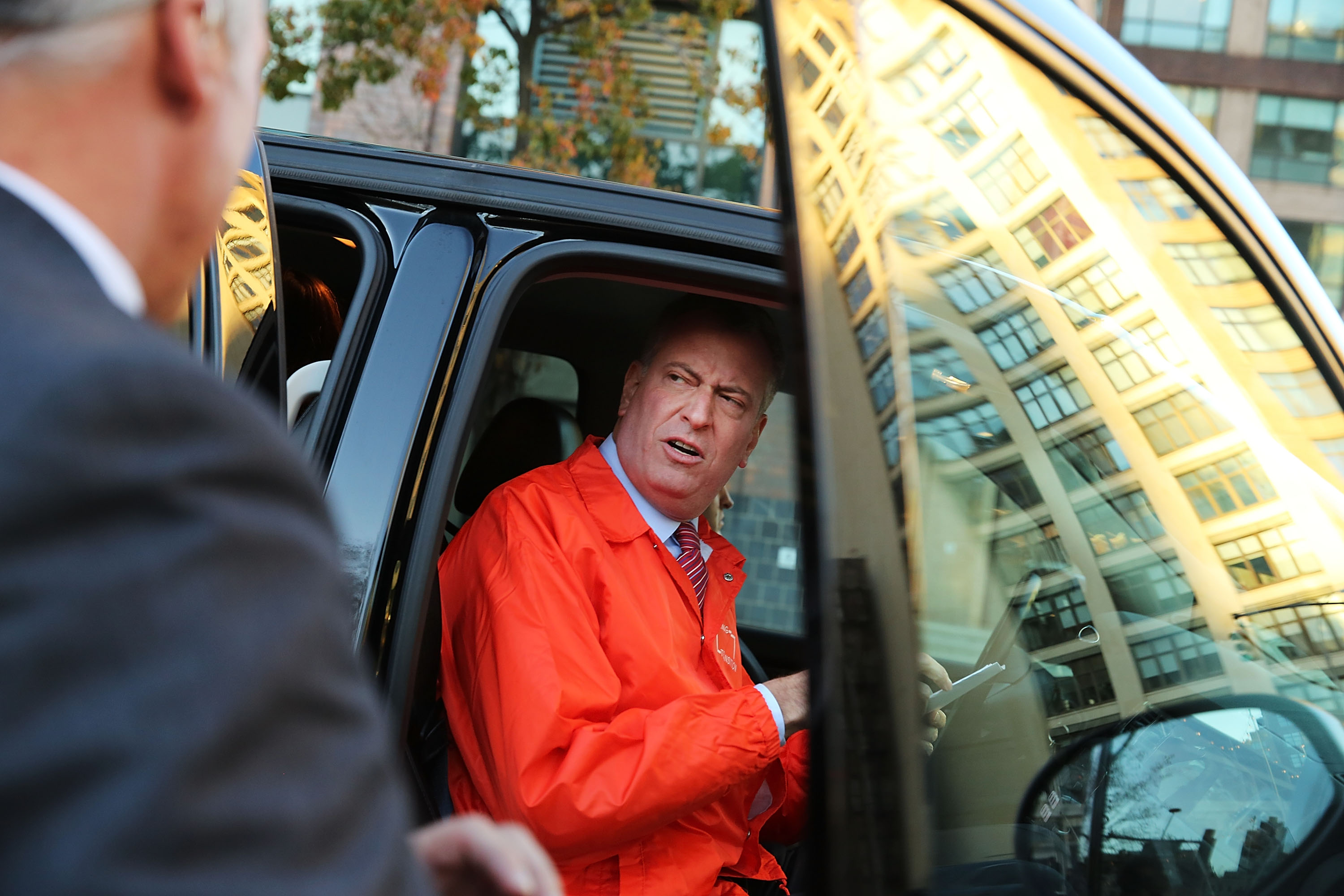
As mayor of New York City, Bill de Blasio kicked off many of his mornings with a cross-borough odyssey by car. Boarding his private, chauffeured SUV at Gracie Mansion, police escort in tow, de Blasio would be driven about 12 miles to the Prospect Park YMCA – a roughly 35-minute drive that would have taken just shy of an hour by train.
Polly Trottenberg often sat shotgun in her city-issued car where she liked to control the music and sing along. What better way to alleviate stress as de Blasio’s Department of Transportation commissioner? Sometimes her driver would join in, she said, the two belting out Frank Sinatra as one.
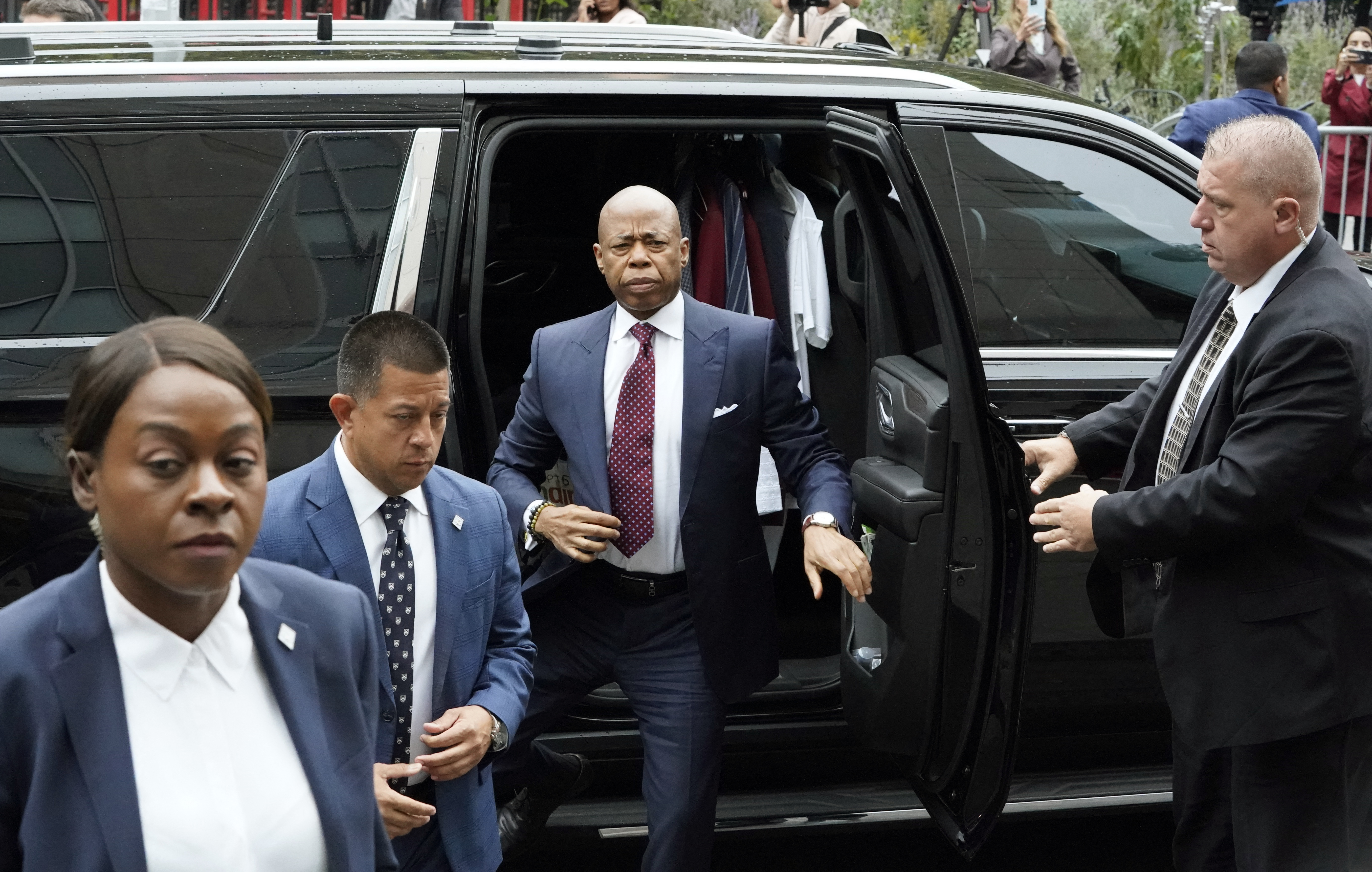
Eric Adams, self-proclaimed mayor of swagger, kept a row of suits, collared shirts and ties strung along a clothing rack in the back seat of his black Chevrolet Suburban – his ride doubling as closet-on-wheels as he was whisked from flag raisings to press conferences to court appearances to dinner at Zero Bond.
As a deputy mayor in the Adams administration, Adolfo Carrión Jr. enjoyed traveling to City Hall from his home on City Island by ferry. But sometimes he had his driver meet him at the Wall Street ferry terminal to be driven the final leg of his journey.
Passenger princess status, city government edition, is a less exclusive club than one might think. Fifty-two of Mayor Zohran Mamdani’s appointees travel in rarified, climate-controlled air, thanks to the full-time car and driver assigned to them, according to a list provided by the Department of Citywide Administrative Services in response to a freedom of information request from City & State.
That includes obvious big shots like First Deputy Mayor Dean Fuleihan, schools Chancellor Kamar Samuels and Police Commissioner Jessica Tisch – officials whose jobs frequently have them on the move. But it also includes lesser-known appointees like Fuleihan’s chief of staff Freddi Goldstein, Chief Actuary Marek Tyszkiewicz and Housing Authority Chief Operating Officer Eva Trimble. Top mayoral press office officials like Joe Calvello and Anna Bahr also get their own chauffeured vehicles, as do the five other deputy mayors and more than two dozen commissioners.
This system isn’t unique to the Mamdani administration. While exact figures aren’t available online, scores of officials working under prior mayors had their own cars and drivers, likely in roughly equal numbers. Car ownership is a politicized issue in New York, but the chauffeured life isn’t partisan or ideological among the city’s government officials. Borough presidents, the City Council speaker, comptroller and public advocate all have this perk.
“It makes a huge difference if you are like I was, going seven days a week, all day, all night, across the whole borough,” City Council Member Gale Brewer said of having a car and driver during her eight-year tenure as Manhattan borough president. “I could not have done it any other way.”
Of course, these chauffeured vehicles don’t come with a 24/7 all-access pass to the city. The Fleet Management Manual states that cars are not supposed to be used “for personal reasons,” though “brief stops for meals or other incidental activities” are acceptable while performing normal work activities.
But even with guardrails, getting driven around doesn’t exactly foster relatability – especially if it’s overly relied upon. Critics argue it’s akin to traveling around in a bubble. Add it to the long list of things that already separate public officials from the many New Yorkers who travel by public transit.
Mamdani’s perceived accessibility and pavement-pounding across the city were fixtures of his upstart mayoral campaign. He has tried not to stray from that since taking office. He has been spotted traveling by Citi Bike, train and on foot. The 34-year-old democratic socialist is acutely aware of how much his life has changed and how fixtures of his new reality – like the chauffeur and police detail – could easily alter his perception of the problems he’s supposed to solve.
Zohran Mamdani hops on a Citi Bike — going back to his campaign office in Chelsea, his campaign tells me after. A woman heckles him, shouting “communist!” pic.twitter.com/pNgkOeE8o3
— Jeff Coltin (@JCColtin) October 8, 2025
“If you spend every single day driving around in a tinted window security detail, you will have a very specific view of the city,” Mamdani said in an April interview with WBUR. By taking other modes of transportation, he said, “You actually meet other New Yorkers and you break out of the bubble that so many have come to expect of politics.”
But he’s still relying on his car and driver virtually every day.
And that can be a barrier. “I still remember feeling just a shock at becoming aware after leaving that meal,” Citizens Union Executive Director Grace Rauh said, reflecting on a dinner she shared with a deputy mayor as an early career journalist covering the Bloomberg administration two decades ago. “That realization that ‘Oh, this person’s meal with me is part of their workday, but they’re going to get driven home and I’m going to go walk to the subway.’”
Perk or necessity?
Ask just about anybody who has had their own car and driver while serving in city government, and they’ll give a strong defense in its favor: Good luck doing the job without one.
Fabien Levy, who started in the Adams administration as press secretary and finished as deputy mayor for communications, said he’d initially been skeptical about the arrangement. But while his gut reaction was to turn down his own chauffeured vehicle, the job’s demands promptly dispelled him of any illusions that he could go without.
One night after getting dropped off at home in Manhattan around 11 p.m., he received a call notifying him that a police officer had been shot – the latest in a string of officer shootings that rattled the city in early 2022. Having already sent his driver home, Levy took a cab to the crime scene, only to be stopped at the police line. It took ages to talk his way in.
Taking the train isn’t a great option for officials who need to be on their phones either, he argued. “Our subway system has no cell service, so you can’t take any calls. You can hardly send emails or text messages,” Levy said. “Depending on where you live, imagine being underground for an hour-plus and there’s an emergency situation.”
For the handful of city officials with a police detail – the mayor, speaker, comptroller and police commissioner – there are real safety reasons for being driven around. Cops and personal aides typically ride alongside them in the vehicle, which is far simpler than flanking their charge on public transportation. How many times has a video of Mamdani riding a Citi Bike or striding down the train platform gone viral? “His security team must be stressed lol” is a sentiment that frequently appears in those comment sections.
The commenters are probably on to something.
“It’s just such a liability,” said Mandela Jones, a former spokesperson for then-City Council Speaker Adrienne Adams. As one of the only speakers who lived outside of Manhattan, she would spend particularly long stretches on wheels as she traveled from her Southeast Queens home to City Hall. Jones remembered taking the train with her once, but the situation stressed out her security detail. “The subway can be a challenging space," he said. "If they were given their choice, they would keep you in a car. Their job is to protect the person and to minimize risk.”
The safety argument doesn’t carry for the majority of officials who are assigned a car and driver. It’s unlikely anyone is closely tracking the head of the School Construction Authority or the chief technology officer, for example. Most can easily take the train under the cloak of anonymity, and many do.
But former and current officials who’ve had their own chauffeur point to other benefits like efficiency. They worked frequently in the car, using the privacy to take calls, respond to emails, pour over documents and pound out press releases on their laptops.
Looking to capitalize on long stretches of time on the road, Department of Buildings Commissioner Ahmed Tigani ordered a small drop-down desk to use in the back of his vehicle. “It has really helped and was fairly inexpensive,” he said. “I read and saw a bunch of people using it during the pandemic who work in different locations, so it sounded like a smart complement to do more detailed and comprehensive work when in the car.”
Another benefit: Private vehicles come in handy for escaping and evading journalists. What better way to get the last word than to fire off a nasty barb and disappear into the safety of 3,000 pounds of metal? “You want a mint? You need one,” Phil Banks, then-deputy mayor of public safety, told The City Reporter’s Katie Honan in 2024 when she asked him about having his phone seized by FBI agents. He jumped into his car and didn’t answer the question.
And in the whirl of high-pressure situations and go, go, go, it’s nice to have someone to bounce ideas off – or even just to make sure you’ve eaten or got home safely. Once, hospital-bound after the cab she was riding in got into an accident, Brewer called her driver for aid, not wanting to break the news to her husband. “They really look out for you,” she said. “In many cases, they become friends because you’re with them more than you’re with family.”
Tapping the brakes
For all the reasons it may be beneficial for high-ranking elected leaders and city officials to be chauffeured around, it’s hard to imagine the arrangement not having some impact on their psyche. How could it not? In a car, you are locked in with maybe four people tops, all of whom work for you, subjected to traffic, sure, but moving through the city shielded from inclement weather, subway delays and fellow New Yorkers who might demand something of you. But on the train, bus or even walking on the street, you’re part of a far more diverse array of commuters, taking in the same inconveniences, the same interactions, the same observations. (Of course, quite a few New Yorkers regularly travel by car – particularly in outer borough neighborhoods with limited public transportation – but this is still a far cry from the chauffeur life.)
“The very people that are able to separate themselves from the experience of everyday New Yorkers through a car and driver are the ones making policy decisions,” Rauh said. “Any mayoral administration should be very judicious about who gets access and why.”
Ryan Birchmeier, who served as Eric Adams’ communications director, noted that the types of jobs that come with their own car and driver are already intense. For him, being chauffeured was just another thing in a “vortex of incoming emails and the political problem of the day” that made being grounded in reality challenging.
“You’re on the phone all the time, you’re on emails all the time,” he said. “Magically popping up in new locations is just one more iteration of getting sucked into this digital world.”
But several people argued that public officials actually see quite a lot in a car – things they wouldn’t see underground that can inform their perspective on issues like disinvestment in neighborhoods and redlining.
“The F or No. 5 (trains) might have no shortage of subterranean human sights, but they can’t reveal the redlining of Allerton or Hillside avenues,” said Amit Singh Bagga, who often drove himself while on the job in the de Blasio administration. “You’ll need the light of day and a set of wheels for that.”
“Forever annoyed” when she’d spot litter or graffiti coming off a bridge or the highway, former City Council Speaker Christine Quinn said she would often call in issues while being chauffeured that she likely wouldn’t have seen otherwise.
“There’s pros and cons,” Quinn said. “If somebody is going to become in a bubble because part of the time they get driven, they are going to be in a bubble anyway.”
Good-government groups urge caution. City officials’ access to chauffeurs has erupted in scandal before. In 2006, then-Public Advocate Betsy Gotbaum was forced to fork over several thousand dollars in repayments for using her driver for personal trips, like Hamptons visits and Costco runs. Concerns about reducing carbon emissions and the city’s dependence on vehicles have stirred conversations about shrinking the city’s fleet. With more than 30,000 vehicles, New York City has the largest municipal fleet in the nation. Environmental and bike advocates argue that’s not a flex. Though in recent years, officials have started to get driven around in more hybrid and electric vehicles, including Toyota Highlanders and Ford Mustang Mach-E’s.
There are also concerns about transparency. Asked for information about how much the city spends on drivers and city-owned vehicles for city officials, the FOIL office said that DCAS does not have the “necessary detailed agency time/salary/usage information that would be needed to report such a report.” Not to mention City & State had to submit a FOIL request to get access to this list.
“I think when it starts to get to a level of where it’s more a perk of the job, rather than a necessity, is where we would question the public policy benefits of extending more cars to the workforce,” Reinvent Albany Senior Policy Adviser Rachael Fauss said.
Of course, as with all perks and pitfalls of public service, the ride comes to an end eventually. Whether it’s in eight years, or mere months, chauffeur access ends with the job. Mayor, press secretary, borough president, agency head alike, all eventually find themselves in the same place: picking up the pieces and readjusting to their old life.
After 16 years of being chauffeured, former Manhattan Borough President and city Comptroller Scott Stringer recalled one of the first times he ordered an Uber. “I said to the guy, ‘Hey, this is my second Uber ride ever.’ And he goes, ‘Well, actually this is my first Uber ride in five years – I’ve been suspended for five years and now I’m back.’ I go, ‘What were you suspended for?’” Apparently, smoking pot while driving. “And then I realized I am back in the real world,” Stringer said.
Some look back with nostalgia. Levy bid his driver farewell in Times Square, just after the clock struck midnight on New Year’s Day, bringing the Adams administration to a close. Levy and his driver keep in touch, he said, but nothing like their daily contact before.
For others, the return to the real world was like slipping on an old skin – or so they say. “It’s all about keeping your perspective,” Carrión said. “I went right back into being a normal, average joe in a hot minute when I walked out of City Hall.”
Additional reporting by Holly Pretsky. This story has been updated with Mandela Jones’ description of the subway ride with Adrienne Adams.
NEXT STORY: NYPD inspector investigated in psych eval scandal getting promoted