

Politics
Encountering AI in elected officials’ statements
City & State set out to survey New York City Council members on affordable housing, but received several AI-generated responses instead.
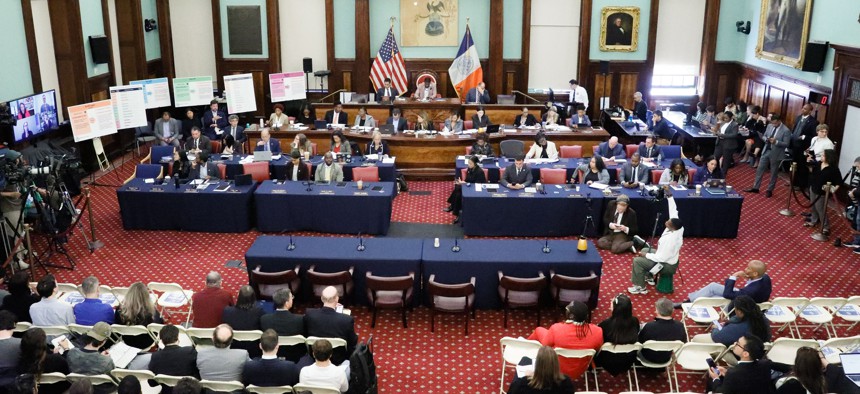
The New York City Council held a hearing on artificial intelligence safety earlier this month. Alex Krales/New York City Council Media Unit


As New York City elected officials grapple with whether they can have a role in regulating artificial intelligence, City & State is grappling with AI’s encroachment on how elected officials communicate with news outlets like ours.
In reporting our story on how City Council members are responding to the new Affordable Housing Fast Track list, we came to a realization as we reached out to dozens of council members: Statements sent out by elected officials were being crafted by AI.
We reached out to 29 council members over email for that story, hoping to survey the members affected by the new fast track, and received 18 statements and quotes from them or their teams in response. While editing our story, we conducted a check for AI use in the written statements we intended to quote, as we’re aware that elected officials – along with plenty others – are increasingly using AI for drafting and editing.
Every statement we intended to quote in the story was flagged by the AI-detection tool Pangram for seeming to be partially or entirely AI-generated. Pangram is an imperfect tool, but one that’s widely used as a first pass to detect possibly AI-generated content. (We’ve adopted it as part of our practice to screen op-ed submissions for AI content.)
After running all of the responses we received through Pangram, seven statements were flagged as completely AI-generated or AI-generated with a mix of AI-assisted or human writing. That included statements from Council Members Frank Morano, Mercedes Narcisse, Chris Banks, Farah Louis, Shahana Hanif, Vickie Paladino and Phil Wong. Three of them, from Morano, Narcisse and Hanif, were flagged as 100% AI-generated.
This phenomenon isn’t new. Elected officials, politicians and their staff have been variably upfront about using AI for research, while New York Focus brought to light recently how elected officials have used AI in drafting op-eds.
For this story, some council members acknowledged using AI, while others denied it outright. Morano said he used AI in drafting his statement. “I sometimes use AI to help me draft or clean up responses, just like I use staff input, notes and other tools,” Morano said over the phone, when City & State asked him about his earlier statement. “The positions and opinions I sent you are mine, and I approved the language before sending it.”
Morano said he also employs AI to analyze data and large PDF documents, such as the Mayor’s Management Report. He felt the “100% AI-generated” classification his response received on Pangram was not totally accurate as he claimed he edited the output he got back from the large language model.
A spokesperson for Hanif said they first drafted their statement without AI but later used AI to condense and refine the initial draft before sending it. “The responses accurately reflect the opinions of our office,” Simone Lavin said in a written statement.
Narcisse said the flagged response they sent to us was crafted by someone in their fellowship program who was no longer there. In a phone call, Narcisse said she only used AI for research purposes on subjects she is unfamiliar with.
Wong’s chief of staff, Daniel Kurzyna, said their office uses AI solely as a grammar check, much like one would use a tool like Grammarly.
Paladino’s team, who only had one quote from the entire statement sent to us flagged by the AI detector, said they didn’t understand the question.
Banks denied using AI at all to generate a response and said that he only uses the technology to check for grammar mistakes. “Our response was consistent with a lot of the language that I have used in the past,” Banks said on a phone call with City & State. “Everything we do, it originates from me. When we are asked by the media to give statements or quotes, it’s coming from me.”
Louis’ team also denied using AI altogether, suggesting the finding was a false positive and said they try to avoid its use for all external-facing content.