

Politics
The evolution of Kathy Hochul and key Jewish voting blocs
Orthodox and Hasidic Jewish communities turned out in big numbers against the governor in 2022. Now, prominent leaders are backing her – or staying out.
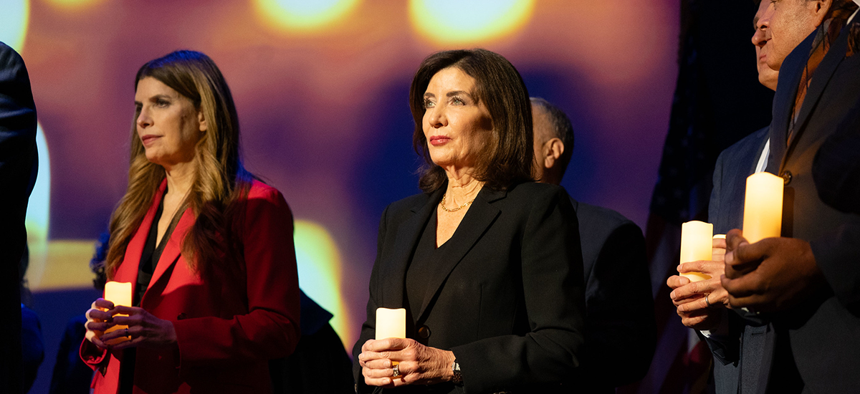
Gov. Kathy Hochul delivered remarks at the UJA’s Oct. 7 commemoration this year. Office of Gov. Kathy Hochul

Four years ago, Gov. Kathy Hochul struggled with powerful Orthodox Jewish voting blocs during her first gubernatorial election. Her Republican opponent at the time, then-Rep. Lee Zeldin, swept Orthodox Jewish and Hasidic communities in New York City and its surrounding suburbs. Voters in the Haredi community – also referred to as “ultra-Orthodox Jews” – turned out in big numbers for Zeldin, who is Jewish, helping eat into Hochul’s vote totals in the city and contributing to her relatively tight, 6-point victory.
Now, after years of making inroads with Orthodox communities, it looks like the script has flipped. In the weeks leading up to Election Day, Hochul has racked up endorsements from a number of major Orthodox and Hasidic voting blocs, including those who rejected her last cycle. And energy that surrounded Zeldin does not appear to have translated to Hochul's opponent this year, Nassau County Executive Bruce Blakeman, who is also Jewish. But Hochul has had to work hard for that support – and some key policy decisions have helped.
Among those blocs now backing Hochul are both competing Satmar sects in Williamsburg, Brooklyn, and Rockland County, Satmars in Orange County’s Kiryas Joel, Chabad-Lubavitch leaders in Crown Heights, Brooklyn, and the Bobov sect, the largest voting bloc in Borough Park, Brooklyn. Other Hasidic communities leaders from Borough Park also released their endorsement of Hochul, as did Assembly Member Simcha Eichenstein, a Hasidic Democrat who represents the neighborhood and stayed out four years ago.
“Don’t be fooled by the 2022 numbers,” Eichenstein told City & State via text, in reference to the fact Zeldin won his district with over 88% of the vote in 2022. “As former British Prime Minister Harold Wilson famously stated, ‘a week is a long time in politics.’” He added Hochul has “consistently addressed our core concerns,” providing funding for public safety, childcare expansion and having “defied enormous odds” to enroll in a new federal scholarship tax credit program. “At a time when antisemitism is rearing its ugly head at a scale we have not experienced before, Governor Hochul has stood shoulder to shoulder with the Jewish community,” Eichenstein said.
The New York Times published an exposé on yeshivas less than two months before the 2022 election, asserting the religious schools were failing its students. The story and intense scrutiny it brought to insular communities angered many Orthodox and Hasidic New Yorkers, serving as a key driver for high turnout in support of Zeldin and against the incumbent. At the time, Hochul had not opined on the yeshivas while her Republican opponent presented himself as a champion for the issue.
But more recently, Hochul quietly supported the easing of yeshiva oversight rules that state leaders approved in last year’s state budget, a major issue for many Orthodox and Hasidic voters.
Earlier this month, Hochul also officially decided to opt into a controversial federal dollar-for-dollar tax credit of up to $1,700 for donations to qualifying scholarship funds. Propped up by school choice advocates, the program has faced staunch opposition from the powerful teachers unions in New York, as well as many Democrats – including both state legislative leaders.
The governor’s decision, so close to Election Day, resonated strongly in Orthodox communities. The move is what stopped the Queens Jewish Alliance from endorsing Blakeman, despite backing Zeldin in 2022, according to a source familiar with the endorsement process. The group, an organization seeking to increase civic engagement among Queens’ Orthodox voters and one of the few to directly opine on electoral politics, explicitly stated it had not chosen a candidate this year, even as it endorsed in both the state comptroller and attorney general races.
Other groups who went with Zeldin like the Flatbush Jewish Community Council and the Belz sect in Borough Park either haven’t endorsed yet or are explicitly staying out. Marcos Masri, a consultant who works on campaigns in Orthodox communities, suggested that supporting Hochul now, or choosing not to get involved, is a strategic decision to ensure leaders have a working relationship with the governor over the next four years. But it’s a significant change; nearly every major sect backed Zeldin four years ago, including communities like Bobov in Borough Park and Satmars in Williamsburg, who have endorsed the governor this time around.
The governor has shown up for Orthodox and broader Jewish communities cited by insiders in other ways, too. She strongly pushed for protest buffer zones around religious buildings largely in response to demonstrations outside of shuls. And she included a measure to bring back a ban on masks. Hochul was also the first elected official in New York – and one of the first in the country – to visit Israel following the Oct. 7 attack by Hamas, a hugely impactful gesture, multiple sources noted.
“The developments since the last election have been quite interesting, as Governor Hochul has put forth significant effort over the past few years to improve her relationship with the community,” Masri said in a text message. “Leadership wishes to maintain an open-door policy.”
Others in Orthodox communities were more explicit about where the energy is – or isn’t – this election cycle. “The number of people who endorse her and who stand with her now … who would love to see Blakeman be the governor, is epic,” said one Orthodox Jewish source granted anonymity to speak candidly. “They have no problem with Blakeman. It's just they don't think he’s going to win.”
Orthodox insiders who spoke to City & State generally agreed enthusiasm for Blakeman is low in such circles. “Zeldin had a certain magic touch within the community that I don’t see Bruce having,” said Yossi Gestenter, a Republican consultant who works in Rockland’s Orthodox communities. He added that four years ago, “visibly Jewish” voters like the Hasidim and other Haredi communities were “worked up to vote against Democrats and excited for Zeldin” in a way that doesn’t exist this year. It’s true that community leadership’s endorsements may not be reflective of voter enthusiasm on the ground. But depressed turnout could still be a boon for Hochulif Orthodox voters simply aren’t motivated to vote for either candidate.
Blakeman dismissed the idea his campaign lacks energy among Orthodox voters and downplayed prominent leaders backing Hochul. “Many more have endorsed me,” he told City & State on Tuesday. But asked for specific names, Blakeman demurred. “I have no doubt that the vast majority – an overwhelming majority – of Orthodox Jews, of secular Jews, of Christians, of Hindus, Sikhs, Buddhists, Muslims are going to support me,” he said. “Because regardless of race, religion, ethnicity, what your abilities are, what your lifestyle is, people are fed up with the high taxes, the high utility bills and unsafe communities.”
Like Hochul, Blakeman has also been trying to court Hasidic voters. A source familiar told City & State that the White House just this week called up Orthodox leaders in order to reiterate that President Donald Trump – whom many Orthodox voters backed in the past two presidential elections – supports Blakeman. He has touted meetings held with leaders, and The New York Times reported Blakeman said at one such meeting that Hochul “doesn’t have the backbone” to defend Jewish New Yorkers in a New York City run by Mayor Zohran Mamdani. “If there is rioting here, if they’re burning down the yeshivas and your shuls, and burning down your house and raping your women, you think Zohran Mamdani is going to stop them?” Blakeman reportedly asked.
Mamdani remains highly unpopular among Jewish voters due to his pro-Palestinian rhetoric. Jewish voters broadly, according to polls, have also significantly moved away from the Democratic Party as pro-Palestinian and anti-Israel sentiment – energy that helped propel Mamdani – has grown among party leaders at the same time as rising antisemitism.
But the progressive mayor is still well liked among young, left-wing voters in New York City whom Hochul needs to turn out in big numbers to bolster her margins. As she has publicly campaigned with Mamdani multiple times in the past several days, Hochul said she isn’t concerned that decision will turn off Jewish voters. “We just walked past a group of individuals who were outwardly Orthodox, and they said they’re voting for both of us,” the governor told reporters during a Friday campaign stop with Mamdani in Brooklyn. “So I think a lot of them have – I’m doing the right thing.”
Hochul campaign spokesperson Ryan Radulovacki pointed to Hochul’s track record as the reason for a growing coalition this year compared to 2022, including the increased support among Orthodox Jewish leaders. “New Yorkers are coming off the sidelines and supporting Governor Kathy Hochul for one reason: she's fought for them,” he said in a statement. “She’s invested $4 billion in public safety and driven down crime, fought back against antisemitism, cut middle-class tax rates to historic lows, and finally put us on a path to universal childcare.”
But as both Hochul and Blakeman attempt to court influential voting blocs, one Orthodox insider suggested the constituency can be very changeable and cautioned against drawing any conclusions too soon. “The last conversation wins,” the source said.