

New York City
Poll: Nine months into Mamdani’s tenure, affordability remains serious problem
A new survey from Honan Strategy Group found that nearly half of New York City voters say they are likely to leave the city within the next five years due to the cost of living.
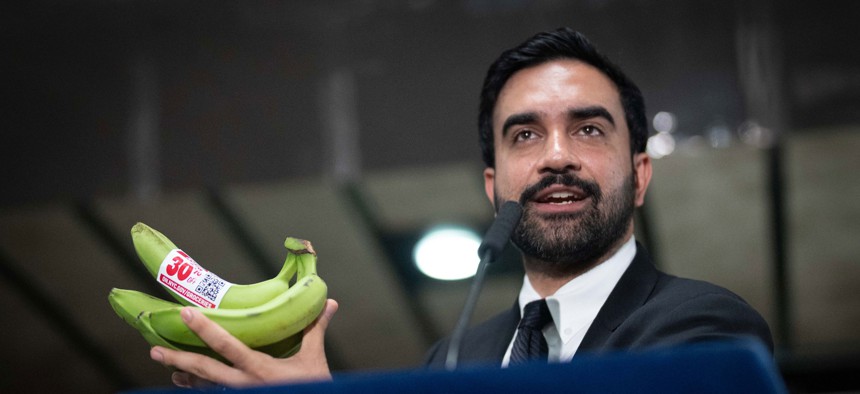
New York City Mayor Zohran Mamdani at a press conference in July 2026 on municipal grocery stores. Michael Appleton/Mayoral Photography Office



New York City’s cost-of-living crisis continues to be crushing. Nearly half of a sample of New York City voters surveyed in a new poll said they are likely to leave the five boroughs within the next five years due to the cost of living.
That’s just one example of the financial strain New Yorkers are grappling with measured in the Honan Strategy Group’s latest 5 Borough Barometer survey, which was shared exclusively with City & State ahead of its release.
For many New Yorkers, the situation is dire. Of the 46% of New York City voters who said they’re likely to leave the city in the next five years, 31% said they were very likely to do so. The crisis has hit New Yorkers at the most basic level. Utilities, groceries and healthcare were each described by a majority of respondents as a major financial strain for their household. Paying for rent or a mortgage posed the single greatest burden, with 46% selecting it as the biggest financial strain. As the city grapples with soaring rents and a historic vacancy rate, the latter comes as little surprise.
The survey comes nearly a year after New York City Mayor Zohran Mamdani made history when he triumphed over former Gov. Andrew Cuomo in the November general election, galvanizing New Yorkers with promises to make the city more affordable. His platform’s focus on economic populist initiatives like universal childcare, holding rents steady for the city’s rent-controlled apartments, building more affordable housing and making buses free resonated with voters. More than 2 million New Yorkers ended up casting ballots in the mayoral election – the greatest turnout since 1969.
Nine months into Mamdani’s tenure, it’s no secret the affordability crisis remains top of mind – and far from solved. The poll found nearly universal agreement that the cost of living is a serious problem in the city, with 92% describing it as such. In terms of how respondents’ household financial situation fares now compared to a year ago, 53% said things are worse and 42% said they are about the same. Just 5% said better.
New York City voters have contended with the crisis in different ways. To make ends meet in the past year, 56% said they cut back on groceries, 47% borrowed money or piled up credit card debt, 37% skipped out on meals and 34% said they went without or pushed back medical care. Nearly a third of respondents said they fell behind on rent or bills. Just over a quarter reported taking on a second job or working extra hours.
Despite the majority saying that their financial situation had worsened over the past year, New York City voters were divided on who they consider to be most responsible for the city’s high cost of living. Only 18% pointed the blame at city government and the Mamdani administration. Landlords and real estate developers, meanwhile, garnered the most scorn, with 25% of respondents charging that they were the party most responsible. Twenty-one percent pointed to the federal government, 14% to the state government and 13% to big corporations.
Bradley Honan, CEO and president of Honan Strategy Group, said that for now, people are pleased with the mayor’s advocacy around issues of affordability and aren’t yet “holding his feet to the fire” in terms of whether he’s actually bringing down the cost of living.
“Right now, the focus is on the rents they pay once a month and Donald Trump,” Honan said. “We’ll keep polling on this, but I think right now we are still in early days where (Mamdani is) getting a pass. A lot of his image is being an advocate and talking in ways people want to hear.”
The Honan Strategy Group surveyed a representative sample of 1,302 New York City voters between Oct. 2 and Oct. 7 for the poll. The margin of error was plus or minus 2.72%.