

Campaigns & Elections
What we’re watching for in the gubernatorial debate
The race isn’t that close. Things could still get messy.
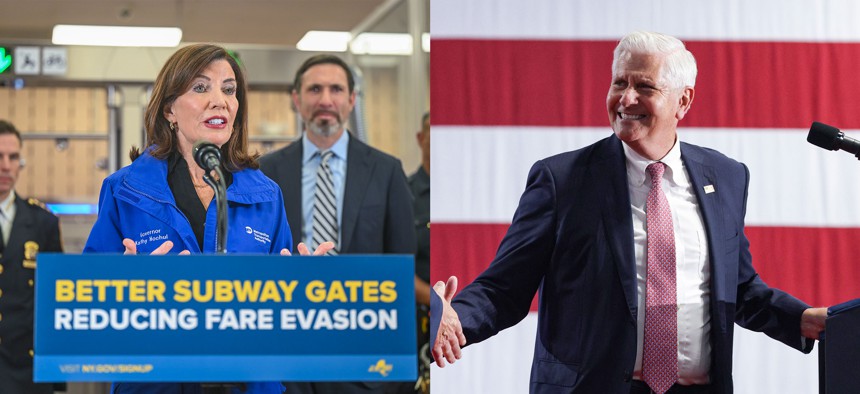
Gov. Kathy Hochul and Nassau County Executive Bruce Blakeman will hit the debate stage on Tuesday night. Susan Watts/Office of Governor Kathy Hochul, left; Alex Wong/Getty Images

It’s debate night in New York as Gov. Kathy Hochul and Republican gubernatorial nominee Bruce Blakeman will square off on Spectrum News’ NY1 at 7 p.m. for the sole debate of this year’s race for the Executive Mansion. With three weeks to go before Election Day, Hochul will look to maintain her lead over the Nassau County executive, with recent polls showing her up anywhere between 9 percentage points and 19 points (though the most recent sit at 11 and 12). As for Blakeman, while any challenger needs things to go smoothly on debate night, he really needs things to go off without a hitch. With his campaign war chest dwindling and errors in reporting his finances, not only could Blakeman use the free media, but he’s running out of time with his statewide name recognition still limited. Here are five things we’ll have our eyes on during the debate.
The elephants in the room
Both candidates have made it clear they are campaigning against a surrogate for the movements they oppose as much as they are against each other. For Hochul, that’s President Donald Trump, and for Blakeman, that’s New York City Mayor Zohran Mamdani. Hochul has made tying “100% MAGA” Blakeman to his “good friend” Trump a cornerstone of her campaign strategy. Hardly an ad or public statement goes by without the governor invoking Trump when discussing Blakeman.
Blakeman has similarly attempted to use democratic socialist Mamdani as a left-wing boogeyman and as evidence that the moderate Hochul – who has endorsed the mayor – is simply another far-left progressive radical. So expect to hear both the mayor’s and president’s names plenty of times out of the mouths of the candidates as they attempt to negatively associate each other with high-profile officials who won’t actually appear on the November ballot.
Gaffe watch
Though her lead in the polls may not be quite as comfortable as some would like for an incumbent Democrat in an expected blue wave year, Hochul is still the incumbent governor and the frontrunner. But let’s not forget: It took until August for the governor to agree to a debate (Blakeman is participating in the public matching funds program, which means he is legally required to partake in a debate; Hochul did not opt into the program). As much as that gives her the upper hand going into Tuesday night’s debate, she also runs the risk of failing to meet expectations. And that means avoiding a gaffe. Hochul may be seasoned and enthusiastic in front of a crowd, but she’s had her own missteps, too – like when she suggested some Black kids in the Bronx “don’t even know what the word ‘computer’ is” or when she urged members of a Black church in Buffalo not to spend their inflation reduction checks at the liquor store (she has apologized for both). Those are reasons to be wary of going off script, as Blakeman could seek to attack her for them or it could alienate parts of the base. At the same time, a rigid Hochul likely won’t inspire more voters to turn out.
Top issues
While debates rarely change voters’ minds, some issues will draw more attention than others – namely affordability, immigration and artificial intelligence. Hochul and Blakeman likely won’t stray from their tried- and-true strategy: blast each other for their respective records – or lack thereof – as opposed to offering more detailed proposals. It doesn’t mean that either candidate won’t make any broad promises, but it’s more unlikely at this stage of the game, as Blakeman and Hochul will want to avoid opening themselves up to new attacks.
Lowering the cost of living will likely be the main event, as recent polling shows the issue is the top concern for New Yorkers, but the pair is known to clash on data centers and AI, especially since Hochul enacted a one-year pause on new data center construction, which Blakeman has criticized as bad for businesses and developers. And it’s tied to the parties’ longstanding stalemate over climate issues, high utility bills and strain on the grid.
Democrats and Republicans continue to be divided along clear ideological lines over federal immigration policies, and the state's new law restricting local law enforcement from assisting U.S. Immigration and Customs Enforcement in civil enforcement matters. The issue is more motivating for Republicans compared to Democrats, per the latest Quinnipiac poll, and blasting the new policy continues to be a public safety talking point for Blakeman and the GOP.
Blakeman’s elevator pitch
As Blakeman tries to convince New Yorkers it's time for a new face in the Executive Mansion, he’ll have to decide if he wants to spend the last few weeks of the race primarily bashing Hochul's record or selling himself as the stronger leader. He’s quick to blame the governor for things like high taxes, and his campaign has proposed broad cuts to services that could have broad, uncertain consequences. But he has failed to adequately flesh out his own policy platform.
It’s easy to criticize Hochul's actions, like the data center moratorium or immigration policies, but his arguments must go beyond the quick sound bite to prove he’s got the chops for the job. Doing both isn’t easy, as will be on display Tuesday night.
Courting the base vs. appealing to independents
In a midterm election with an unpopular sitting president from the opposing party in a state where Democrats outnumber Republicans two-to-one, Hochul’s best course of action is probably rallying the base. Delivering a strong debate performance to energize that base is easier for the frontrunner, and easier than trying to walk a tightrope in hopes of winning over independents in a state where most voters already have an opinion of her.
For Blakeman, the calculus is different, as he’s still unknown to about one-third of voters. A statewide televised debate is one of his best shots to make a good impression with voters – especially independents who may be on the fence or don’t know him.Though Blakeman has certainly run a campaign that seems focused on energizing the MAGA base, the debate could offer him his last real chance at courting disaffected voters who may otherwise stay home.