

New York State
Kathy Hochul won in a landslide. What will she do with that mandate?
The governor has been light on specific policy she’ll champion next year, as progressives nipping at her heels feel emboldened in their vision.
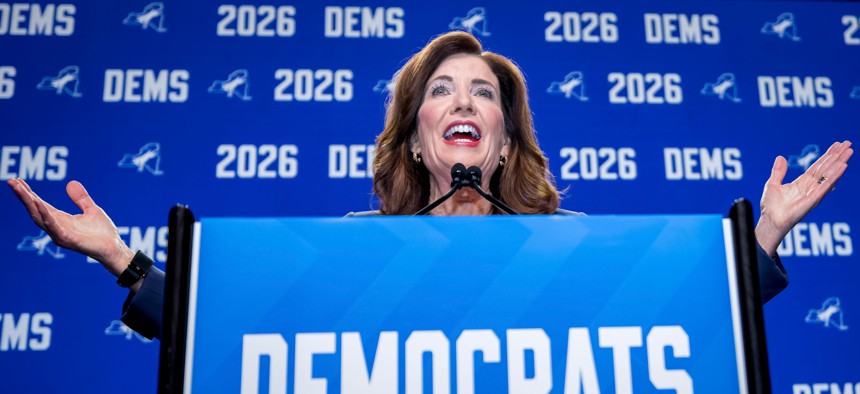
Gov. Kathy Hochul won a commanding mandate Tuesday night – and a new opportunity to define her agenda. Michael Nigro/Pacific Press/LightRocket via Getty Images


Taking the stage to address Democratic supporters on election night after her landslide victory over Republican Nassau County Bruce Blakeman, Gov. Kathy Hochul was greeted by whoops and cheers that lasted a full minute as she beamed and waved to a crowd of exuberant partygoers, with “Stronger” by Kelly Clarkson playing over the speakers.
She had just overperformed every poll, winning with a nearly 20-point margin of victory and 60% of the vote overall. Democrats took control of both the House and U.S. Senate, meaning the next leaders of both chambers will likely be close allies from Brooklyn. And with her on the top of the ticket, Democrats flipped a key House seat and picked up over a dozen state legislative seats to create historically large supermajorities.
In other words, Hochul’s statewide political influence has never been greater. But, as political consultant Joe Bonilla told City & State, she has the time and capital to accomplish her policy goals, so it begs the question: What does Kathy Hochul want to do with this brand-new mandate?
Hochul ran heavily on her existing track record, including victories just this year to expand and invest in universal childcare and enacting a moratorium on data centers. The other part of her campaign was spent trashing President Donald Trump, whose unpopularity played a huge role in driving voters to the polls across the country. Missing from her campaigning, however, was a clear and specific agenda for what Hochul wants to do over the next four years.
“Together, New York Democrats are leading the way for a country that is hungry for progress, and we’re giving people a reason to believe again,” Hochul said on election night after discussing middle-class tax cuts, free school meals and free community college, among other accomplishments from the past four years. The next four years, according to Hochul, is “to finish what we started,” with “ambition and a sense of urgency.”
Despite the enormous victory, she’s also competing with an emboldened left flank of the party that also lays claim to the success – and the governing mandate – for their own priorities. A swath of new progressives, including members of the Democratic Socialists of America, will enter huge, veto-proof supermajorities in both chambers. The Working Families Party delivered enough votes to Hochul on its line that it will likely move up the ballot and displace the Conservative Party on the third line for the first time. And young leftists in the “Commie Corridor” who backed New York City Mayor Zohran Mamdani and Rep. Alexandria Ocasio-Cortez bolstered her margins.
And the left has a clear agenda with specific policy proposals to increase taxes on the wealthiest New Yorkers to pay for social programs. The governor now has the opportunity to define her own bold agenda for her next term thanks to a clear mandate from voters.
“My only issue with Hochul is that I don’t know her full vision for a New York state aside from: keep Donald Trump from destroying it, and fix all the problems that he already caused,” said Actum political consultant Ryan Adams. “So I feel like without a vision, she will struggle to be the more powerful person in Albany compared to a loud progressive (state) Senate or a loud progressive Assembly or a socialist caucus that’s got some of the most popular people in the country as friends.”
Setting the agenda
So far, politicos in New York have only gotten glimpses of what a post-election Hochul will look like when she returns to Albany. Aside from a focus on affordability and a promise to build on her existing successes, the governor has offered little insight both before and in the immediate aftermath of the election into what she wants to do over the next four years.
“New Yorkers turned out in historic numbers to give Governor Hochul four more years to build on the progress we’ve made and tackle the challenges families still face,” Hochul spokesperson Jen Goodman said in a statement to City & State. “From expanding access to child care and building more housing to putting commonsense safeguards around AI and strengthening public safety, the Governor intends to make the most of the next four years with an ambitious agenda focused on making New York a more affordable place to live, work and raise a family.”
But there’s no doubt she’s well positioned to achieve the agenda she pursues thanks to her massive victory and hardball negotiating tactics in the budget. “She has an opportunity to use the political capital from this victory to define her priorities early and build consensus around them,” said Marc Cohen, an upstate Democratic consultant for O’Donnell & Associates. “I expect we’ll see a governor who is confident in her mandate, but also very deliberate about where she chooses to spend her political capital.”
A look at Hochul’s past initiatives could provide insight into her future policy goals. During the lone debate of the election, Hochul said she wished she “had fought harder to get more housing built” during the first year of her first full term. In 2023, the governor proposed an ambitious housing plan she dubbed the New York State Housing Compact to spur development, even in recalcitrant suburbs. The plan went over poorly as the prospect of overriding local zoning laws to hit construction mandates led to swift and intense backlash from Democrats and Republicans alike.
The idea was easily among her boldest original agenda items. Though she has championed other issues, including free school meals, expanded immigrant protections and regulations on artificial intelligence. But housing has been a hallmark of Hochul’s tenure. “Hochul has a big reelection win behind her, real momentum that didn’t exist even a few years ago, and four years in front of her, and she has a unique opportunity to set the example for the country of what a pro-housing governor can look like and where New York can go next,” said Annemarie Gray, executive director of Open New York.
But even after such a strong rebuke to Trump, the president still looms large as the full cuts of the One Big Beautiful Bill Act are set to take effect in January. “Unfortunately, there is still a tremendous amount of strife that will be coming from the federal administration,” said Jeff Lewis, a former top adviser to Hochul and the state Democratic Party. He said those will pose obstacles to any governing mandate right at the start of Hochul’s new term. “I think it is going to unfortunately be on the defensive more so than what we’d like,” he said.
The impact of a new class of staunch progressives, and supermajorities in both legislative chambers that include diverse ideologies among members, is sure to influence both Hochul’s priorities and her ability to legislate. “I think that they’re going to come in and have a very strong agenda,” said Democratic consultant and lobbyist Yvette Buckner of the new bloc of progressives. “And because (Hochul) had such a good relationship with the mayor, who is also a DSA member and progressive, it’ll be interesting to watch and see if she continues to open up the lane for more progressive policies.”
Hochul helped get a new tax on luxury second homes in New York City approved at the state level at the request of Mamdani earlier this year to help solve the city’s financial problems. And she has shown a willingness to move to the left on certain issues and work with legislators on bills that haven’t traditionally been among her top priorities.
“Whatever disagreements I may have had with the governor and will continue to have, I know that she is a smart woman,” said state Sen. Gustavo Rivera, a longtime progressive voice in the Legislature. “And I would hope that what she sees here is what everybody else sees, which is an electorate that got mobilized precisely because the Democratic Party candidates … are talking about the real issues that impact people.”
Adams suggested in that vein that Hochul will recognize the popularity of certain left-wing priorities that resonated among voters in New York and around the country, and find ways to moderate and market versions of them as her own. “I don’t think she's going to dye her hair purple and start hanging out in Bushwick,” he quipped. “But I do think that she’ll start adopting some of these policies as just ‘common sense.’”
Paying the piper
The Sunday before the election, Hochul watched a Buffalo Bills game at an Astoria, Queens, bar with Mamdani and Ocasio-Cortez. For the mayor, it was the second weekend in a row that he stumped with the governor, a clear sign that Hochul recognized the popularity and political sway he holds with young left-wing voters. And it was the first time the progressive darling Ocasio-Cortez appeared on the campaign trail with the governor after spending her own political capital on races around the country.
“To Mayor Mamdani, thank you for standing with me and bringing a whole new energy to New York City,” Hochul said to voracious applause in her victory speech. She has spoken frequently in the past several weeks about the positive working relationship the pair have despite some ideological differences, breaking with the trend of feuding governors and mayors. Former New York City Mayor Bill de Blasio recently called their partnership the big story of 2026.
Now, the left sees the opening in next year’s legislative session. “I think she understands that she couldn’t have won without the help of the mayor, without the help of the Working Families Party, without the help of AOC, and that means we’re all in this governing partnership together, and we will figure it out,” state Working Families Party Director Jasmine Gripper told City & State on election night. “I’m not saying it’ll be easy, and we’re not going to have to push her, but we’re going to figure it out, and we’re going to make sure we deliver for our community.”
DSA legislators also expect that the mayor will play an important role in ensuring their priorities are heard by the governor. “I do know that we will be able to count on (the Mamdani) administration to be a strategic partner with our Socialists in Office to push for an agenda of affordability that includes taxing the rich,” said Assembly Member Diana Moreno, who won a special election to succeed Mamdani earlier this year. “And because he also has a relationship with the governor, we think that our relationship with the administration will be a point of leverage and potential cooperation.”
Some political observers, especially those on the right, have contended that Hochul will be beholden to a vocal left and the mayor. “She has some good political capital in this blue hurricane that took over New York state, but she’s also going to have to pay the piper a little bit,” Bonilla said.
While Mamdani and his supporters delivered a large boost to the governor in New York City, Hochul also won all but one downstate suburb county. That included Blakeman’s own Nassau County. It was a complete flip from the results four years ago, when Hochul won just a single suburban county in the downstate metro area. Even with New York City removed, the governor would’ve still won this year, albeit by a much smaller margin.
“If she won the election (with) 50.01%, they would have an argument to make,” state Democratic Party Chair Jay Jacobs said of the idea Hochul would bend the knee to Mamdani and the DSA. “But when you win the election in a landslide over 60%, that argument is just ludicrous.” He acknowledged the influence of the left in the elections this year, and said that he expects Hochul to work with them. “She’s a consensus builder, and she’s going to look to do the right thing,” Jacobs added. “But Kathy Hochul, for anybody that knows her, doesn’t bend to anybody’s desires.”
Maintaining positive ties with the state’s business community has also consistently been a hallmark of Hochul’s tenure. That’s in part because the governor has repeatedly said that she will not raise income taxes, regardless of wealth. Bolstered by stronger than predicted tax revenue in the state’s midyear budget update, the governor has an additional reason to resist calls to raise taxes for now.
“I think the (governor) recognizes that there’s an opportunity to grow the tax base by attracting businesses, encouraging investment and creating jobs rather than simply raising taxes on those already here,” Cohen said. “That’s been an important part of her economic philosophy, and I don’t see the election fundamentally changing that.”
Speaking to reporters in Puerto Rico during the annual Somos conference, Hochul toed the line. Standing next to Mamdani, she suggested she would be open to new revenue raisers if needed to fully fund child care into the future – but said nothing she does will be arbitrary. “I don't raise taxes for the sake of raising taxes,” Hochul said. “I've said that many times, and that's not going to happen.”