

News & Politics
Kirsten Gillibrand’s leadership lessons
After flipping at least seven Senate seats, the DSCC chair wants to stay in Democratic leadership.
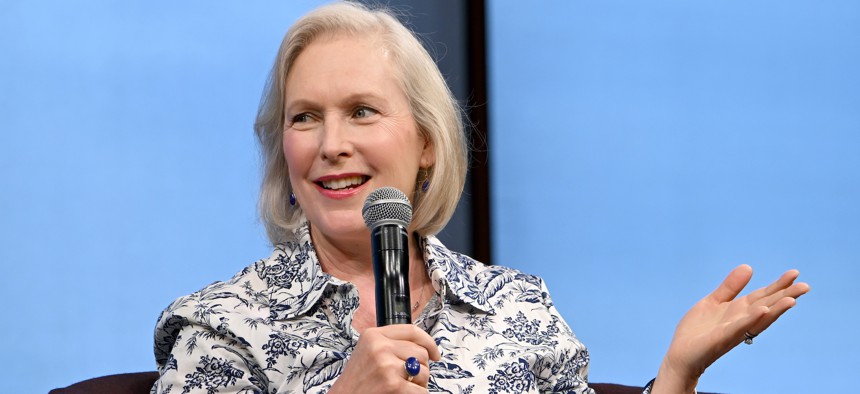
She wasn’t on the ballot, but U.S. Sen. Kirsten Gillibrand is feeling very good about last Tuesday. Bryan Bedder/Getty Images for Theodore Roosevelt Presidential Library



While remaining coy on her exact long term plans, U.S. Sen. Kirsten Gillibrand wants to remain as part of the Democratic leadership team in the Senate, after last week’s “blue tsunami.”
Gillibrand hopes to stay on as the chair of the Democratic Senate Campaign Committee for a second term following an Election Day that exceeded even the Democrats’ most optimistic assumptions. The party picked up at least seven seats in the upper chamber, with two more outstanding but leaning Democratic. It recalls 2006, when U.S. Senate Minority Leader Chuck Schumer led Senate Democrats to a majority, helmed the DSCC for a second term and later became the party’s Senate leader.
“I do. I definitely want to be part of our leadership going forward,” Gillibrand told City & State when asked if she wanted to run for the leadership in the future. “I want to be a voice to get commonsense things done that help the American people. And so I hope that I can keep building my capabilities and building my ability to help people by doing politics well. And hopefully, I can continue to lead through that process.”
Asked specifically about the possibility of following Schumer’s path to the top Democratic job in the Senate, Gillibrand was more coy. “I will look at all opportunities for sure,” she said.
Of course, that would mean holding her seat, when she’s up for reelection in 2030 – far from a sure thing in New York, where an emboldened progressive movement is itching to take her out.
The DSCC chair is appointed by the Democratic leader, not elected by the full Democratic caucus – which means the only one she needs to convince is Schumer (assuming he’s reelected as leader). Gillibrand said one reason she wants to stay on at the DSCC is because the job gives her a seat at the Democratic leadership table, enabling her to help set the party’s agenda and message as they retake the majority for the second half of the current Trump presidency.
Under Gillibrand’s leadership, the DSCC raised $200 million and opened up new Senate opportunities that had not been anticipated – from Kansas to Mississippi.
Gillibrand sees a lot of similarities between the current midterms cycle and the one Schumer led two decades ago. It was then, amid a similar climate of economic distress and overseas wars (then, in Iraq; now, in Iran) that Gillibrand first made it to Congress, flipping a Republican-leaning congressional seat in 2006 before being reelected in2008 and then appointed to the U.S. Senate in 2009.
“I think I'm uniquely positioned to understand what it takes to win red and purple places because of my own experience,” she said. “So I want to continue to do this work. I want to do it for the caucus. I want to do it for the country, and I want to help people.”
Colm O’Comartun, a national political strategist who runs 50 State, described roles like the DSCC chair as high-risk and high-reward for an ambitious politician like Gillibrand – who launched, and soon dropped, a presidential campaign ahead of 2020. She can bask in the glory of a wave election like this year, but will also take the blame if the party does not do as well going forward.
“I think it's a great sign that she's somebody who's really interested in helping her caucus and and helping build a team and a bench and in some ways thankless job, and hopefully she'll be able to get something miraculous, which is two of these difficult years in a row (because) these these maps aren't easy for Democrats,” he said.
O’Comartum, a former executive director of the Democratic Governors Association, said two terms at the DSCC could position Gillibrand well for a future leadership bid. He said the 59-year-old Gillibrand could take advantage of the call for generational change in the Democratic ranks and easily build relationships with the younger Senate generation in the party by campaigning with them and positioning them to get to Washington.
“There's every reason to believe that she's just at the right age to assume leadership, and will have a better relationship through her campaigning with these new members than maybe some others,” he said.
Last September, Gillibrand predicted to City & State that Mississippi would be a 2026 U.S. Senate battleground – an idea that at the time seemed borderline-delusional. But Gillibrand would prove eerily accurate; in Mississippi, Democratic challenger Scott Colom now narrowly leads Republican U.S. Sen. Cindy Hyde-Smith in a race that still hasn’t been called.
Gillibrand said that she became intrigued by Colom’s candidacy after meeting him and hearing about how Hyde-Smith blocked his bid to become a federal judge. She said data from previous elections suggested a Black Democrat had the potential to do well in the state. Recalling how Georgia Democrats had flipped two Senate seats in a fellow southern state in 2020 and thinking back to her own 2006 congressional run in a ruby-red district, she could see a pathway in a state that Democrats traditionally wrote off.
“I wasn't daunted that it was R+23 because, again, my district hadn't been Democrat since Nixon, and so I thought, this is just like my election, just on a Senate-wide basis in a red state that needs to be organized just like Georgia. And if we start putting the time and effort in (and) have the best kind of candidate possible, everything is in play, and it was,” she said.
Looking ahead to 2028, Gillibrand sees opportunities for Democrats in some of the same states that helped to fuel this year’s blue wave, including North Carolina, South Carolina, Kansas and Iowa (all of which just flipped U.S. Senate seats to the Democrats), along with Wisconsin (where Democrats swept statewide offices and picked up congressional seats), and Alaska (where Democrats lead in still-uncalled Senate and gubernatorial races). She indicated that North Carolina and Wisconsin will be top targets given the Democratic registration numbers.
Gillibrand said the key will be for the new Democratic Congress to focus on the issues that fueled this year’s victories like affordability and healthcare, particularly Medicare. She added that new members in Republican-leaning and swing districts need to better communicate Democratic accomplishments over the next two years. By New York standards,Gillibrand is ideologically a moderate, and although she does not believe Republicans will be able to weaponize the new crop of democratic socialist electeds against the Democratic Party, she does want to caution the party against tacking too far to the left, which she blames for its 2008 losses.
She attributed the victories of leftist leaders Rep. Alexandria Ocasio-Cortez, New York City Mayor Zohran Mamdani and Michigan U.S. Sen.-elect Abdul El-Sayed to their focus on affordability over unrealistic and alienating progressive policies. “They ran on costs. They made costs a cool message. They brought in new voters. Young people were excited about their youth, and that's exciting.” she said. “They were on message. Do not get that confused. They were on message on the economic priorities and concerns of everyday voters across the country.”