

News & Politics
Will we see the return of the veto override in the Legislature in 2027? History suggests it’s unlikely.
Democrats have strong supermajorities after the blue wave. But just because they can doesn’t mean they will.
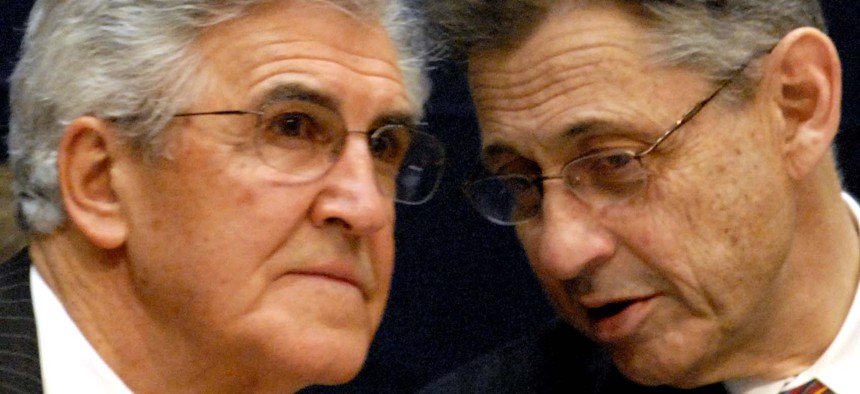
Former state Senate Majority Leader Joe Bruno and former Assembly Speaker Sheldon Silver pushed through the state’s most recent veto override in 2006. Michael P. Farrell/Albany Times Union via Getty Images



Democrats in both chambers of the Legislature are set to start 2027 with the largest majorities in state history. Mechanically, that means both the state Senate and Assembly have more than enough members to hit the two-thirds majority needed to block vetoes issued by Gov. Kathy Hochul. But don’t hold your breath on that one – the practice is exceedingly rare. Legislators last used it two decades ago – when Republican George Pataki was governor and the GOP controlled the state Senate – and the number of successful overrides since the mid-1800s number less than a dozen.
Rewind the clock to 2006, Pataki’s last year in office. It was the final chapter in a particularly tense political time period characterized by major budget disputes (Silver v. Pataki anyone?), and legislators took the extraordinary step to override roughly 200 line-item vetoes in the spending plan. Even though Pataki said he would ignore the most significant of the overrides, it’s still one of the few levers of power lawmakers have in the state’s executive-centric budget process.
Overriding line items may sound a little lame, especially with the number of high-profile bills today where various activists or lobbyists may prefer to see the power wielded. But the fight in 2006 was contentious, and the action a significant milestone in the evolving relationship between the Legislature and the executive. And it was notable not just for the rarity of the power being used at all, but also that the Republican-led state Senate joined with the Democratic Assembly to oppose who would be the last Republican statewide official for 20 years and counting.
That bipartisanship didn’t happen 12 years later, when both chambers had different leaders. In what turned out to be one of the final actions by GOP leadership before Democrats won control of the upper chamber, the state Senate in 2018 voted unanimously to override then-Gov. Andrew Cuomo’s veto of legislation to require full-day kindergarten. It was a minor bill all things considered – only a handful of districts in the entire state at the time didn’t offer it – but it was more of a symbolic gesture for the Senate anyway.
Though the bill unanimously passed the Assembly, Speaker Carl Heastie declined to bring it to an override vote. “There is no need for the Assembly to take up an override of the Governor’s veto of A1625 related to kindergarten expansion,” Heastie said at the time. “The Assembly has worked with the Governor to resolve the concerns that the bill sought to address.” And so died the last attempt by legislators to wield their override power.
Despite Democrats gaining control of both chambers the next year, and having held historic supermajorities between 2021 and 2025, neither Heastie nor state Senate Majority Leader Andrea Stewart-Cousins has pulled the trigger to override a veto from a fellow Democrat. In fact, state lawmakers haven’t overridden a veto from a Democratic governor (Pataki was a Republican) since 1982 when the Legislature reinstated spending then-Gov. Hugh Carey had attempted to reject.
During the Carey era, the Legislature was uncharacteristically gung ho about overriding vetoes, many of which were budget-related. It came after 100 years of not using the power at all. After Carey, the lever continued to be pulled only sparingly – just a handful of times, all under Pataki, with the most recent overrides in 2006. And before 2018, lawmakers attempted only one other override in 2010. The Democrat-led Assembly voted to reject then-Gov. David Paterson’s veto of an ethics reform bill, but it failed in the state Senate during Democrats’ short and tempestuous control of the upper chamber.
Just as they did then, Democrats now control both chambers and the governor’s mansion – but with even more power in the Legislature thanks to their super-duper majorities, as Stewart-Cousins has called them. But Heastie hasn’t changed his tune about veto overrides. Speaking earlier this month on WNYC’s “The Brian Lehrer Show,” he used his favored metaphor of likening the power to a nuclear weapon. “It's good to have, but you hope to never have to use it,” he said.
Stewart-Cousins didn’t seem in any rush to use the little-used legislative power, either, when asked last week. “This is not a tool that I’m looking to wield,” she told reporters in Albany immediately after her election to a historic ninth year leading the chamber.
NEXT STORY: Hakeem Jeffries’ biggest haters