

sponsor content What's this?
Events
Housing advocates discuss frontline solutions
State Housing Commissioner RuthAnne Visnauskas was among the speakers at the HELP USA and City & State forum.
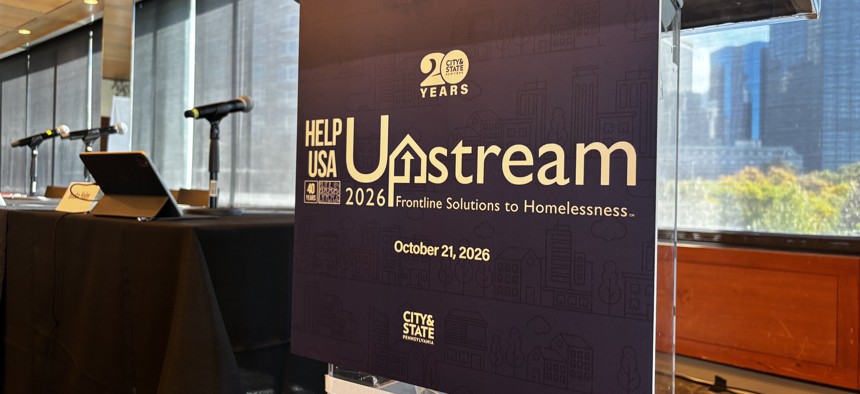
Senior officials discussed how government agencies are working towards making permanent housing the end goal, as opposed to an endpoint people struggle to reach after a crisis. Jeff Coltin/City & State


Public and private sector leaders from across New York City convened Wednesday at City & State’s Upstream 2026: Frontline Solutions to Homelessness, a day-long event presented by the nonprofit organization HELP USA that was dedicated to mitigating New York’s persistent housing and homelessness crisis.
After introductory remarks from HELP USA Executive Director Ramzy Badawy and Assistant Vice President of Support Services Danielle Devine, HELP USA President and CEO Dan Lehman opened the event by reminding guests of the critical need for providers to move beyond New York City’s “right to shelter” and prioritize a right to housing.
“Nowhere else has nearly the number of people meeting the federal definition of homelessness, in total or per-capita,” Lehman said. “Nowhere else spends nearly what New York City does on shelter for people experiencing homelessness – over $3 billion per year for the primary Department of Homeless Services system that now houses roughly 1 in every 100 people in NYC each night.”
Lehman highlighted that despite more people being placed into permanent housing in New York City than anywhere else, and the city’s relative success in minimizing unsheltered “street homelessness,” homelessness in remains persistently high.
Lehman tasked attendees with “harness[ing] all that experience, all that dedication, all that ingenuity – and all that money – to make mass homelessness a thing of the past, and a home for every New Yorker a reality.”
Though the event at the Museum of Jewish Heritage in Lower Manhattan gathered industry experts, many of whom have long worked to find innovative pathways towards curbing homelessness, guests were also reminded to put themselves in the shoes of the very New Yorkers who depend on the services in question.
“Think about – all of you in this room – not having a home to go back to,” said Andrea Reid, executive deputy commissioner of the New York City Human Resources Administration. “You may start thinking about, ‘Oh, I’m going to go to my sister, my brother, uncle, a family friend or someone.’ But imagine that you’ve already exhausted all of those options. Where are you going?”
“Think about your children that may be in school, thinking, ‘How am I focusing on class if I don’t know where I will be tonight, I don’t know where I’m going to go home and sleep, and I don’t know where my parents are?’” she added.
Speaking on a panel at the event, Reid laid bare the most recent statistics of the shelter system, reporting that 84,037 individuals currently lived within the system as of October 14, 2026. Of that growing number, 28,157 children, 19,400 single men, and 7,583 single women depended on shelter services.
Despite the challenge, she believes that improving economic self-sufficiency – meaning that New Yorkers in need should be better situated to be able to afford living expenses – and logistical advancements that expedite existing processes can help close gaps in service and effectiveness.
RuthAnne Visnauskas, commissioner and CEO at New York State Homes and Community Renewal, felt similarly regarding process acceleration and ensuring that those in need are able to get services quicker and with less friction.
“We need to stop asking people to give us – especially people who are not housed – to give us 17 pieces of paper to describe how unhoused and how little money they have to pay their rent,” she said.
Eyeing solutions to such a large-scale issue, Visnauskas pointed out New York’s “massive” supply issue, describing a systemic scenario where people are unable to afford better units, leaving them stuck in units that others in need, such as those in shelters, could benefit from.
“We need to make it less expensive to operate housing. [There’s] a lot of pressure on services and service provision. It sometimes doesn’t get attention … water bills, property tax bills, insurance bills,” she said, emphasizing that New York State Homes and Community Renewal is aiming to keep its “eye on the prize,” also paying attention to services just outside New York City proper, as people seek affordability and housing just beyond city lines as well.
Reid highlighted a number of initiatives the city’s Human Resources Administration is seeking to implement in an effort to mitigate bottlenecks in service, including a proposed “pre-qualified” list of unit inspectors for landlords to use as a resource, slated for the upcoming year.
This story has been updated with remarks from Lehman and has been labeled as sponsor content.
NEXT STORY: Policymakers and healthcare experts discuss access to equitable care