

NYN Media
Opinion: Invest in low-barrier, high-trust drop-in centers
A naked client on 125th Street couldn’t remember much, but he could remember how our open door made him feel.
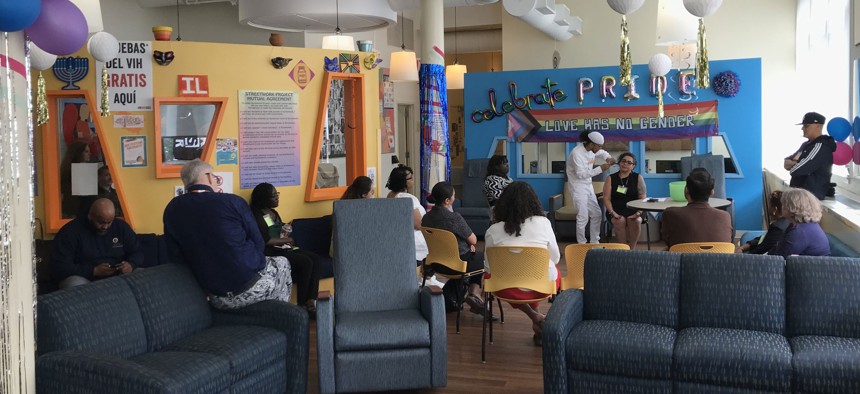
Safe Horizon’s Streetwork Project recently celebrated the reopening of its drop-in center after renovations. Safe Horizon


I've been working in runaway and homeless youth services long enough to know that the young men who come through our doors rarely announce that they're struggling. They don't walk in and say, I think I'm experiencing a mental health crisis. That's not how it works, if you’ve been conditioned, to equate silence with strength.
But they do show up.
Sometimes they come for a meal, a shower or a few hours off their feet. Sometimes they come in loud and charged, testing every boundary they can find because testing limits is the only language they have for “I'm not okay.” If we're paying attention, that's where the real work begins.
The numbers are sobering: 69% of youth experiencing homelessness report mental health challenges, and suicide is the leading cause of death among this population. Six million men are affected by depression in the United States every single year and half of all mental illnesses begin by age 14, with 75% emerging by a person's mid-20s – the window during which so many of the young men we serve are living without housing, consistent support, or anyone asking the right questions.
But awareness alone doesn't open the door. Someone must be standing on the other side of it.
At Safe Horizon’s Streetwork Project, our Drop-In Centers on the Lower East Side and in Harlem do just that. For many young men experiencing homelessness in New York City, we are the first point of contact with anything resembling a support system. A drop-in center asks very little and offers quite a lot – they are where some of the most critical early mental health identification happens but are rarely recognized for the clinical function they serve.
I think about a young man who first came to us when he was eighteen. He used the Drop-In the way he saw fit – and that's by design. At Streetwork, young people decide when they come, how they engage, and what they're ready for.
Over time he joined our men’s affinity group. Things began to surface in that space and we noticed a steady decline in his mental health – something we could only catch by investing in relationship-building as a clinical strategy.
One moment with this young man sticks with me. He walked out of our Uptown Drop-In Center after taking a shower – and just kept walking. Down 125th Street in Harlem. Completely undressed.
I ran after him with a blanket.
By the time I reached him, the police were already there. He was taken to the hospital, and then he was gone from our lives.
Then one day, over a year later, he walked back through our door.
He told me he was on medication and that he was doing better. He didn't remember much about that day on 125th Street, but he remembered how our program had made him feel and that someone had run down the street after him.
What he was describing wasn't a traditional clinical intervention. He wasn't thanking a diagnosis or a treatment protocol. He was thanking a relationship, and the support groups, the staff who knew his name, and the space that never required him to explain himself before he was ready.
There is a crisis of proximity in men's mental health. Young men of color navigating poverty and instability are not refusing help in a vacuum. They are refusing help from systems that have given them every reason not to trust them, from providers they've never seen, in languages that don't reflect their experience. The stigma that discourages men from seeking help is compounded enormously when systems feel foreign, judgmental or inaccessible.
Drop-in models work precisely because they dismantle the threshold. You don't have to name your pain to walk through the door. You don't have to have insurance, a referral, or a diagnosis. You just have to show up. And once you're there – once a staff member knows your name, knows your rhythm, knows when something's off – the chance for intervention becomes real.
I ask advocates, funders and policymakers to think carefully about what "access to mental healthcare" actually means for young men who are unhoused. It cannot only mean expanding the number of licensed providers. It has to mean investing in the low-barrier, high-trust environments where those young men already are – where skilled, caring people are already doing the quiet work of watching, noticing, and refusing to look away.
He didn't remember the day. But he remembered how we made him feel.
For a lot of young men, that's the whole ballgame.
Sebastien Vante is the associate vice president of Safe Horizon’s Streetwork Program, which has served runaway and homeless youth in New York City for over 40 years.
NEXT STORY: Opinion: Let’s treat our museums and libraries like soccer fields