

NYN Media
Opinion: New York’s wealthiest universities need to finally pitch in
It’s time to revisit Mamdani’s proposal to have NYU and Columbia help fund CUNY.
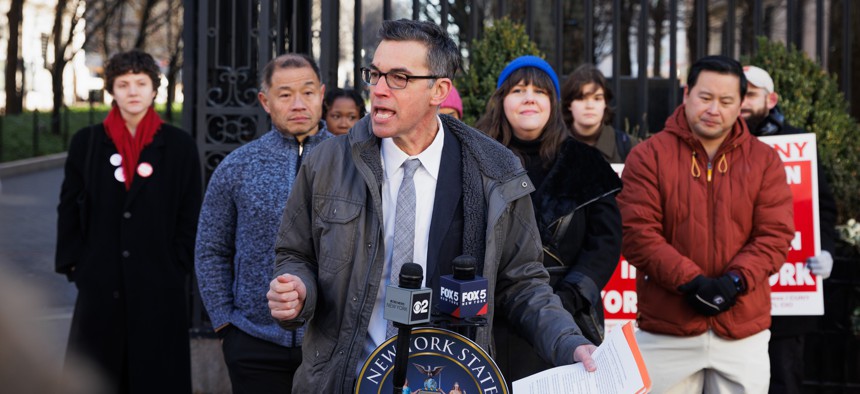
PSC-CUNY President James Davis speakers at a Dec. 12, 2023 presser calling for an end to Columbia and NYU’s property tax exemptions Paul Frangipane


In 2023, then-Assembly Member Zohran Mamdani introduced state legislation to repeal Columbia and New York University’s longstanding property tax-exempt status and direct the foregone revenue to the City University of New York. Today, we call on Mayor Mamdani to begin to address this glaringly unfair property tax exemption for two of the city’s largest real estate holders and deliver on his campaign promise of an affordable NYC, a city where we believe in taxing the rich to fund the public good.
New York City is a university town. According to a report by the New York City Economic Development Corporation, the city’s higher education sector includes 503,000 students and employs 142,000 people at over 100 colleges and universities in the metropolitan area. These institutions graduate over 150,000 degree-holders every year, making the city a beacon for research, economic mobility, intellectual inquiry, workforce training and cultural expression.
Universities are also among the largest private property owners in the five boroughs, with NYU and Columbia among the top ten. Collectively, NYU and Columbia possess 28 million square feet across over more than 315 buildings and rely on the city’s taxpayer-funded services and infrastructure. And due to a provision in the state constitution that exempts nonprofits like hospitals, churches and universities from paying property taxes, NYU and Columbia evaded paying $327 million in property taxes in 2023 alone, according to an investigation by The New York Times and the Hechinger Report.
In fact, the property tax exemption incentivizes these two magnificently wealthy universities to expand their rate of ownership. Columbia was exempt from paying more than $182 million in 2023, an amount that has soared from $38 million in 2008, as the university buys up more properties and their value increases. Though we associate universities with libraries, labs, and lecture halls, Harlem residents for decades have complained about Columbia as an aggressive gentrifier. A 1987 Village Voice report described the university as “a wolf in sheepskin clothing, a tax-exempt evictor,” and an aggressive gentrifier. NYU’s real estate holdings include the Trader Joe’s on Union Square, the Starbucks on Washington Square Park and a range of other spaces for commercial use.
Meanwhile, the City University of New York goes chronically underfunded. The public system that enrolls half of the city’s college students, CUNY was founded in 1847 as the Free Academy, providing tuition-free college education for "the children of the whole people." For over 130 years, CUNY was renowned for its world-class free education, referred to as Harvard-on-the-Hudson, graduating many generations of students whose lives and careers were transformed.
In 1976, the state took over CUNY during the fiscal crisis and tuition was imposed for the first time. Since then, CUNY has faced near-constant budget cuts and austerity measures. Talk to any CUNY student, and they will tell you about the broken buildings they learn in, classes cancelled at the last minute delaying their graduation and their overworked and underpaid professors, the majority of whom are adjuncts. But investing in CUNY makes economic sense. CUNY graduates half of New York’s nurses and a third of its educators – workers who remain here, pay billions in taxes and are essential to fulfilling the mayor’s affordability agenda.
If we want all New York City students to have access to high quality higher education, we should demand long-term structural changes. NYU and Columbia are renowned institutions of international stature. Their property tax exemption is predicated on their contribution to the public good. However, the state constitution’s framers never envisioned universities as large or as wealthy as NYU and Columbia, operating as real estate portfolios first and universities second. The property they own – and the resources siphoned from the city and state coffers – widens the budget gap the City and CUNY confront.
New York City recently passed the annual budget, and the urgent funding gaps are clear. In this volatile context, in a city riven by an affordability crisis, it is especially egregious to keep giving NYU and Columbia a pass in order to maintain their unearned advantage and forgo a sustainable revenue stream.
One immediate path forward is a Payment in Lieu of Taxes agreement. Across the country, universities enter into PILOTs with municipalities where they pay a portion of their property tax equivalent. Harvard, Yale, Brown, Boston University, Cornell, and Penn all have PILOT agreements benefiting their cities. NYU and Columbia are the outliers despite being among the wealthiest.
If Columbia and NYU truly want to fulfill their missions of teaching and learning in the city of New York, there is no better use of their property tax dollars than to help fund CUNY, the people’s university. A New York City mechanism, like a PILOT, would finally hold NYU and Columbia accountable for their fair share of property taxes, a meaningful step towards a New York City that understands higher education as a public good and acts on it.
Olami Ayebusiwa is a student at CUNY’s John Jay College of Criminal Justice and a member of the NYC Union of Students. James Davis is president of PSC-CUNY.
NEXT STORY: NYC sues feds over ‘public charge’ rule