

Education
Will AI ban for NYC students exacerbate the city’s digital divide?
Education experts and advocates weigh in on the potential equity drawbacks of banning artificial intelligence in classrooms through 8th grade.
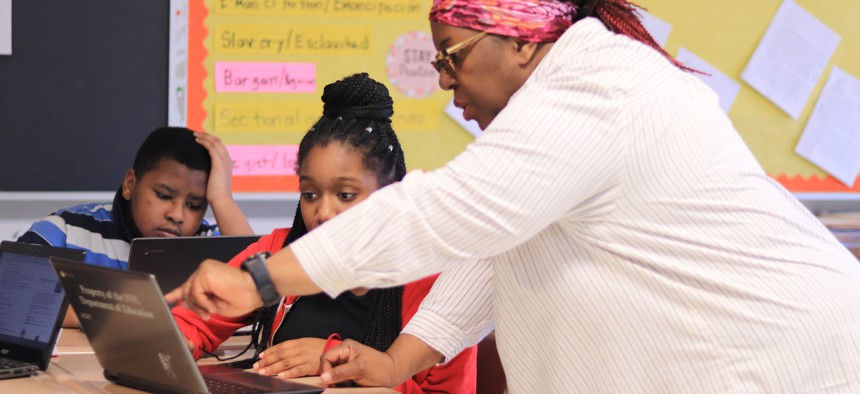
Students and a teacher at the Urban Assembly School of Applied Math and Science. The Urban Assembly

Earlier this month, New York City Public Schools pulled the plug on generative artificial intelligence for students in 2-K through eighth grade. The move, enacted for the current school year, came on the heels of last year’s statewide cellphone ban, which prohibits the use of personal internet-enabled devices such as cellphones, laptops, tablets and portable music devices throughout the school day.
Despite the tumult in recent weeks for the AI industry, prompting debates over the technology’s risk of existential threats and critical safety failures, some New York nonprofit leaders are expressing concern over outright banning AI in schools.
For students to be comfortable with AI, one leader argued, they need to use it. “The idea that you can learn AI fluency without using AI, I analogize this to trying to learn the piano by reading music,” said David Adams, CEO of the Urban Assembly, a nonprofit that promotes economic and social mobility and supports more than 20 public schools in New York City. “This kind of abstract reasoning, knowledge-based understanding of AI will never be as good as playing Für Elise and having to practice that and get that under your fingers.”
Under the current moratorium, all generative AI models and companion chatbots are banned from classrooms throughout the year. Educators can use AI for tasks like planning lessons but are not allowed to use it for grading, placement or other decisions about students.
Asked about concerns about limited AI exposure, a spokesperson for the city Department of Education referred City & State to a press release about the policy.
The ban does not apply to high school students. A maximum of 50,000 high school students (just 5% of the city’s public school student body) will participate in five limited AI pilot classes throughout the year. While all high school students will be able to attend two 45-minute AI literacy classes per year, aimed at briefly familiarizing students in AI literacy, bias, risks and ethical considerations.
Some think limited exposure could have an adverse effect on the digital divide, namely in digital fluency levels and access to technological resources.
“The real concern is that they aren’t learning, in school, skills and tools and a level of skepticism about how AI works to be able to take that into their future,” said Archana Jayaram, CEO of Brooklyn Community Services. “Kids who have resources at home, who maybe are participating in coding classes or summer camps or other places where they’re getting exposure to AI, will gain an advantage in their later educational experience and career.”
Major disparities in technological access, or the “digital divide,” became key concerns during the COVID-19 pandemic, which exposed gaps in internet connectivity and technological access that can lead to worse outcomes for underserved students. The pandemic also ushered major investments in student technology like laptops, and last year, the city furthered that investment with a $330 million initiative to provide 350,000 new Chromebook laptops with free T-Mobile internet service to students. Mayor Zohran Mamdani scrapped the internet service portion of that contract in a bid to cut costs, with the city saying it was paying for more service than necessary and could fill the need for a lower price.
Proponents of the AI moratorium stress that exposing students to AI before grasping the fundamentals of reading, writing and math can be detrimental to their progress.
“I think we’ve made this assumption that more equals better and earlier equals better, and it’s all through the lens of future job skills training,” said Jodi Carreon, national director of Schools Beyond Screens, a nationwide coalition of advocates against corporate-sponsored technology in classrooms.
“We’re really kind of pushing back on that idea and questioning the developmental appropriateness of giving some of these tools much too early,” she added. “Does it make sense to have a first grader have access to a spell-checker when they haven’t learned the skill of spelling yet?”
Advocates like Carreon also caution against an overreliance on AI, warning it could lead to cognitive stunting.
But for educators who are up against workforce shortages and limited resources, AI can be of vital support, such as helping provide feedback for students with higher needs, according to Adams, touting one of the Urban Assembly’s AI-powered programs that helps train teachers.
“At some point, I’m up on a time constraint, and there’s not that many knowledgeable adults in the room,” said Adams. “Why would I deprive myself of a way to support students’ writing when I know students of color, in particular, are coming in with lower levels of reading and lower levels of writing?” he said.
Carreon urged that AI exposure should be accompanied with stricter guardrails, a view shared even by leaders more optimistic about AI who emphasize that critical thinking skills should be reinforced in parallel.
“The skill building is really to understand when to have skepticism and discretion and when to really rely on it,” said Jayaram. “And really making sure that we are in an educational setting creating that discernment and those critical thinking skills.”
Phenix Kim is a regular contributor for New York Nonprofit Media.
NEXT STORY: Opinion: New York’s wealthiest universities need to finally pitch in