

Artificial Intelligence
Opinion: Taxing AI labor to protect the future of work
If payroll taxes decline, governments will need a way to keep revenues steady.
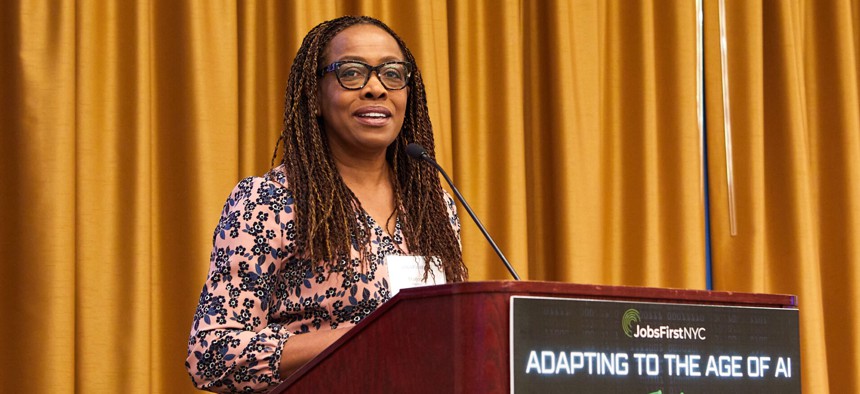
JobsFirst NYC President and CEO Marjorie Parker writes about the benefits of a potential AI labor tax. Christina Zhang


The prospect of artificial intelligence affecting the labor market is no longer reserved for the future; it is already underway. It is shaping entry points into work, transforming education pathways and redefining career trajectories. But instead of fighting this intrusion, we have an opportunity to employ innovative strategies that protect workers, specifically young adults, entering a volatile economy.
To address the labor displacement caused by AI and automation, a once-controversial idea is now taking center stage: the AI labor tax.
In plain terms, a tax on AI labor refers to proposals that would tax companies for using AI to replace or significantly reduce human work. While other ideas currently being debated include robot taxes and AI token taxes, the automation levy is especially interesting, and likely holds the answer to a true AI tax on labor. This mechanism ensures that AI systems performing the work of taxable human labor contribute to a social safety net directly proportional to where job displacements happen. In short, the automation levy taxes companies based on the exact amount of human labor their machines replace. Currently, our tax systems rely heavily on human wages via payroll taxes. As AI replaces human roles, that tax revenue disappears, even as corporate productivity hits record highs. By taxing the productivity gains of AI systems, we can stabilize public revenue and, more importantly, fund the support systems human workers need during this economic transition.
A growing chorus for reform
In a 2024 article “Taxing artificial intelligence,” Xavier Oberson, a Swiss and tax professor at the University of Geneva, wrote, “The loss of jobs and the increase in inequalities between labor and capital will have massive financial consequences for governments. Taxes and Social Security contributions on salaries are generally the most important sources of revenue for governments. It is therefore necessary to explore solutions to the impact of AI on the economy, should the pessimistic scenario become the reality.”
We are now seeing a rare alignment between tech leaders and policy advocates on this issue. In a recent edition of his newsletter titled “Tax the Bots,” Andrew Yang made a bold case for shifting our tax structure: “We generally tax things we want less of. ... We should stop taxing labor and instead take the advice of Dario Amodei, the CEO of Anthropic, and start taxing AI.”
This sentiment was also echoed by venture capitalist Vinod Khosla, who said in March that by 2030, 80% of all jobs will be capable of being done by AI. Khosla warns that $15 trillion of the United States’ GDP currently tied to human labor could essentially go away. He suggested that shifting toward a capital gains tax equal to ordinary income could eliminate the tax burden for the bottom 125 million taxpayers while remaining revenue-neutral.
The nonprofit sector: America’s new skills engine
While the tax code evolves, the nonprofit sector is uniquely positioned to bridge the gap. Backed by more than $600 billion in U.S. charitable giving, nonprofits can combine AI technology with community trust to become a skills engine.
Currently, AI-enabled nonprofit programs are delivering credentials that employers treat as equivalent to college degrees, particularly in tech, healthcare and the green economy. However, making these pathways accessible to all young people requires the dedicated funding that an AI labor tax would provide.
To create a roadmap for young workers to protect entry into the workforce, we must advocate for AI tax revenue to be redirected toward four key areas:
1) Reskill and upskill: funding the training needed to capitalize on emerging job opportunities
2) Protect entry-level roles: incentivizing employers to maintain human-in-the-loop roles for early-career talent
3) Support hybrid models: investing in environments where workers and AI co-exist and complement each other
4) Invest in holistic services: directing funds toward mental health and support systems as the nature of work changes
The local urgency: bridging New York’s gap
The argument for an AI tax isn’t just about future-proofing; it is about addressing the financial reality of our cities. As traditional payroll tax revenue becomes more vulnerable to automation, an AI tax would supplement this critical shortfall, ensuring that essential public services and workforce development programs remain funded.
In New York City alone, there are 106,000 young adults who are currently out of school and out of work. We cannot afford to let them fall further behind. These young people must be prepared to meet a labor market defined by rapid technological integration.
Taxing AI labor will not be easy; it requires a complete overhaul of complex tax codes. However, we can move the needle through collective bargaining and transparent conversations with tech developers, employers and policymakers.
If we do nothing, the wealth generated by AI will remain concentrated while the public ledger shrinks. By shifting the tax burden toward AI-powered capital, we ensure that AI advancement isn’t just about technological progress, it’s about human prosperity.
Marjorie Parker is the president and CEO of JobsFirst and JobsFirst NYC.