

Opinion
Opinion: The 40-year debate over school governance
Should the mayor be in charge of the city’s schools?
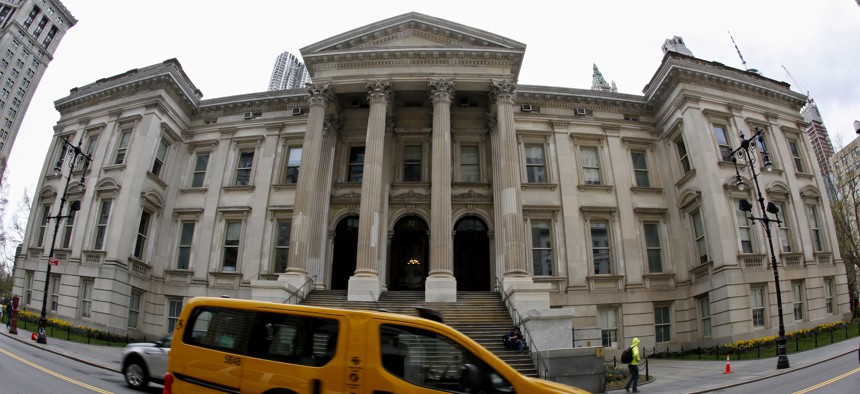
Tweed Courthouse, next to City Hall, is the current seat of New York City’s education department. John Smith/VIEWpress via Getty Images


This week, Mayor-elect Zohran Mamdani said he supports keeping a modified form of mayoral control of schools. That's a welcome shift from his previous opposition to the idea.
I would not have believed it in 1983 when I first suggested that the mayor of New York should be put in charge of the schools that we would still be arguing the point some forty years later. Nobody gave the idea much attention then. I had just served as aide to the schools chancellor and wanted to write a book about it. The title, “Across the River,” was a term commonly used among bureaucrats who reigned within the notorious school headquarters at 110 Livingston Street to refer to the occupants of City Hall who were just a short ride away over the Brooklyn Bridge. But that river might have been an ocean.
The school board that governed the system was composed of seven members who chose the chancellor – two appointed by the mayor and five by the respective borough presidents. The mayor’s primary role in the system was to come up with about half its budget. His two board appointees could be easily outvoted by the others. Mayor Ed Koch used to complain that Albert Shanker, the president of the teachers union, had more clout on the board than he did.
School governance did not become a topic of conversation again until Michael Bloomberg set his eyes on City Hall in 2001 and pledged a takeover. Five of six candidates who ran against him that year agreed on that point. In June 2002, I was asked by The New York Times to address the issue in an op-ed, which ran under the title “Abolish the Board of Education.” I explained that the existing body was a relic of 19th century reformers who believed that education should be shielded from politics and such an arrangement could do the trick.
If you buy that, then I have an offer for you concerning that bridge mentioned above.
Seen from the Chancellor’s Office, board members – consumed with petty patronage and endless trivial pursuits – could often serve as a distraction from the essential mission of educating 1 million children. More importantly, since board members owed their jobs to six different elected officials, it was impossible to hold any one person accountable for system-wide performance. Nor did a mayor overseeing 30 city departments have much of an incentive to invest resources in an agency over which he had little discretion.
Bloomberg finally got his way on school governance after he negotiated a generous contract with the teachers union and its leadership eased pressure on state legislators who had blocked his appeal for control. Simultaneously, lawmakers also eliminated 32 elected community school boards and replaced them with volunteer-based Community Education Councils whose members were chosen by borough presidents and local parents’ associations. Under the new law, the city’s schools would be overseen by a new 13-member Panel on Education Policy, chaired by the schools chancellor. Eight members, including the chancellor, would be appointed by the mayor, while five would be appointed by the borough presidents.
In 2007, legislative leaders in Albany asked then-Public Advocate Betsy Gotbaum to appoint a commission to study the experience with mayoral control, as Bloomberg was halfway through his second term and the governance law was scheduled to sunset in 2009. The Commission on School Governance was chaired by Stephen Aiello, who had ably served as president of the central school board before leaving to join the White House staff of President Jimmy Carter. Former Deputy Mayor Lillian Barrios-Paoli and Community Service Society President David Jones were appointed co-chairs of the commission, and I served as executive director.
Over a year, our commission conducted three public hearings at which more than 100 individuals testified, held parent forums in all five boroughs and met with more than 50 key stakeholders – including Schools Chancellor Joel Klein, United Federation of Teachers President Randi Weingarten and Partnership for New York City CEO and President Kathy Wylde, as well as former chancellors and two members of Congress. We commissioned eight scholarly papers from experts who had studied mayoral control in New York and in other cities, which were assembled in a book published by the Brookings Institution.
The Commission’s final report, which ran more than 40 pages, was the most comprehensive assessment of school governance ever conducted in New York City. In the course of our review, we found negligible support for returning to the seven-member central board, but we also heard concerns that there were too few checks on the power of the mayor. Nor was there much support for returning to locally elected school boards, many of which had been troubled by corruption scandals and all of which rarely attracted even 5% of the eligible voters. That said, we heard repeated complaints that the local school boards’ elimination left little opportunity for parental or community based input into the educational process.
The major issue that arose over the course of our review was one of accountability. There was a strong consensus that the mayor, as the most visible elected official in city government, should be held directly responsible for what happens in such a vital public service as education. Finding that local spending on schools increased from $4.8 billion to $7.1 billion under Bloomberg between 2002 and 2008, we observed that the new governance arrangement incentivized the mayor to prioritize education.
While the Commission concluded that the mayor should continue to appoint the schools chancellor and a majority of the Panel on Education Policy, it recommended that the chancellor be made an ex officio member without a vote, rather than chair the same body to which they should be accountable. We also recommended that a new unit of the Independent Budget Office be established to monitor school performance so that the public was not reliant solely on the mayor or the chancellor for such information. Both recommendations were enacted by the state Legislature. We also recommended that members of the Panel on Education Policy should be appointed for fixed four-year terms so that they could enjoy independence from the mayor, which the Legislature did not take up. Nor was much done to address concerns about the lack of community or parental access to decision-makers.
In 2023, in an attempt to improve representation, the Panel on Education Policy was expanded to 24 members: 13 appointed by the mayor, five by the borough presidents and five by the Community Education Councils. A 25th member was added last year when the mayor was authorized to appoint an “independent” chair from a list of nominees provided by state legislative leaders and the chancellor of the state Board of Regents. If the original seven-member board had difficulty finding a center of gravity because of its scattered origins, could the present 25-member body be any better?
Mayor Zohran Mamdani would be well-advised to reassess the present governance structure. There is more work to be done. Whatever the outcome of that review, however, ultimate responsibility for school performance must reside at City Hall. It is simply impossible to address the political and economic inequality that defined Mamdani’s historic election so long as race and class remain the most reliable predictors of educational achievement. As the city’s chief executive, the mayor is in the best position to lead that effort.
Joseph P. Viteritti is the Thomas Hunter Professor of Public Policy at Hunter College and the author of Radical Dreamers: Race, Choice, and the Failure of American Education (Oxford).
NEXT STORY: Opinion: Policy that performs is a win for New Yorkers