

Opinion
Opinion: What’s next for Mamdani’s criminal justice agenda?
His decision to retain NYPD Commissioner Jessica Tisch signaled a degree of capitulation, but there are issues and decisions to come that will reveal Mayor-elect Zohran Mamdani’s commitment to criminal justice reform.
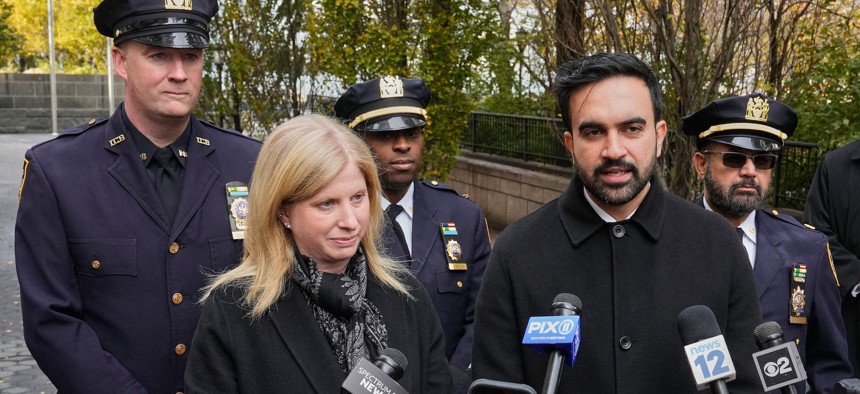
Mayor-elect Zohran Mamdani and NYPD Commissioner Jessica Tisch speak with reporters after visiting the New York City Police Memorial on Nov. 19, 2025. RICHARD DREW/POOL/AFP via Getty Images


Now that Mayor-elect Zohran Mamdani has thrown in with current NYPD Commissioner Jessica Tisch, the media spotlight has shifted away from his public safety agenda. But while his embrace of Tisch signaled a degree of capitulation on criminal justice reform, there are issues and decisions to come that will reveal further where progressive criminal justice reform ranks among his priorities.
On the legislative front, there are already rumblings about a movement to undo Raise the Age, a rollback supported by Tisch. The same holds true for the incessant legislative efforts to retract bail reform, despite the data showing no correlation between bail reform and an increase in crime. Although these are matters of state law, will the next mayor of New York City be a vocal opponent of that effort? There is also growing momentum for the Second Look Act, which would provide the right of sentence review to anyone who has served ten years in prison, regardless of their original crime of conviction or sentence. New York state Chief Judge Rowan Wilson has offered full-throated support for the legislation. Will Mamdani use his bully pulpit to urge passage of the bill?
More directly at home are matters of policing tactics and strategies. Tisch is a proponent of her version of controversial “quality of life” policing tactics and the use of gang databases that sweep up young Black and brown men. Will Mamdani put an end to those contentious tactics or in any way register his opposition?
In addition to state laws and policing practices, the mayor also has responsibility for making numerous appointments that impact the daily operations of the entire criminal legal system. Who will he appoint to run the Mayor’s Office of Criminal Justice (MOCJ)? The office is tasked with developing solutions to public safety challenges and reducing crime and incarceration, and it has a budget of over $800 million that includes payments to the city’s prosecutor and defense organizations. The head of MOCJ can, finally, ensure that resources are equitably distributed between prosecution and defense offices. MOCJ also funds various alternative-to-incarceration programs. Over the years, the same small number of organizations have received millions of dollars, but there has been scant independent, external review of the efficacy of their work. Will the new head of MOCJ make efforts to determine if these programs are in fact diverting people from jail or instead widening the net that captures people of color?
Mayor Eric Adams’ current and former deputy mayors for public safety had long careers as police officers. Will Mamdani appoint a deputy mayor for public safety, and if so, from what background and what influence will that person have over policy? Given the number of people who have died while being held on Rikers Island, the mayor-elect’s commissioner of the Department of Correction is another crucial appointment, especially amid the ongoing stalemate over the closing of Rikers Island. Proponents of the effort to close Rikers are already paying careful attention to see if Mamdani will actively support their efforts. Consider as well the Department of Probation. Adams chose to install a former police officer as commissioner. Will Mamdani follow a similar path or look to a reformer from outside of law enforcement?
The mayor shares authority with the City Council speaker to appoint the Chair of the much-maligned but critically important Civilian Complaint and Review Board (CCRB) and appoints several of its members. Given the historic contentiousness between the CCRB and the NYPD, these selections will reveal much about the mayor-elect’s willingness to support CCRB determinations that the NYPD, including its commissioner, may oppose.
And in New York City, the mayor has the power to appoint and reappoint judges to the Criminal Court. Historically, prosecutors are over-represented on the bench. Similarly, it is common for judges to be reappointed even in the face of complaints from the community. Will Mamdani follow his predecessors’ lead or look for a diversity of experience and choose only to reappoint judges who have a demonstrated record of fairness?
The Advisory Committee on the Judiciary (ACJ) vets and makes recommendations to the Mayor about judicial appointments and reappointments and therefore plays a significant role regarding the composition of the city’s judiciary. The Mayor appoints the chair of the ACJ as well as several of its members. These appointments, too, will reveal much about the Mayor-elect’s criminal justice agenda.
To the extent that keeping Tisch is seen as a sacrifice of a progressive agenda on criminal justice, Mamdani’s appointments and the public stances he takes on current issues will either further that belief or refute it. Only time will tell.
Steve Zeidman is a professor at CUNY Law School and the founder and co-director of Second Look Project NY.
NEXT STORY: Opinion: Task-sharing and the stepped-care solution to youth mental health care