

Education
Opinion: No child belongs in a box – or a broken school system
The Solutions Not Suspensions bill lets schools address students’ behavioral challenges early and consistently through evidence-based interventions, not punitive or exclusionary discipline.
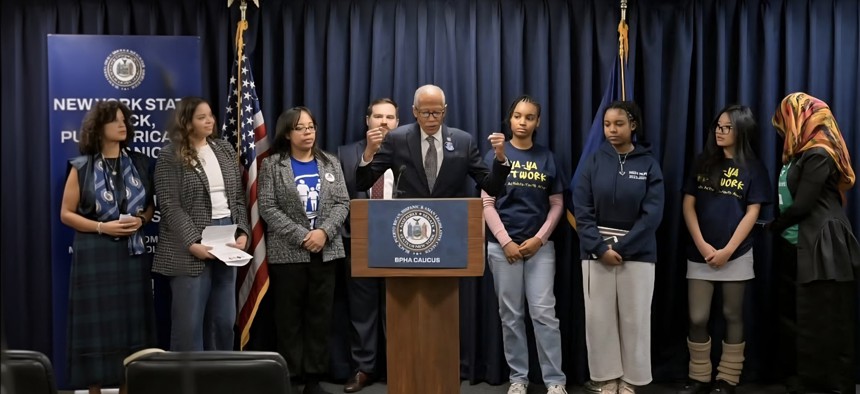
State Sen. Robert Jackson speaks in support of the Solutions Not Suspensions bill. Office of State Senator Robert Jackson


The recent discovery of a so-called “timeout box” in a North Country school rightly shocked New Yorkers. No child should ever be confined, isolated or traumatized in the name of discipline. The swift move to ban this practice is both necessary and long overdue.
But if we stop there, we will have failed to learn the most important lesson from this disturbing incident.
Timeout boxes did not appear in a vacuum. They are a symptom of a school system that too often leaves educators without the tools, training, staffing and supports they need to respond to student behavior in ways that are safe and effective. Banning one abusive practice is an important first step. But it does not prevent schools from turning to the next harmful or ineffective tactic when deeper problems remain unaddressed.
If we are serious about protecting students and supporting educators, New York must go further. That is why we are proud to co-sponsor Solutions Not Suspensions (SNS), legislation that will enhance trust and safety in our schools.
Across the state, educators are navigating unprecedented challenges. Students are entering classrooms with higher levels of anxiety, depression and unmet mental health needs than ever before. At the same time, schools are grappling with staffing shortages, burnout and high turnover that strain entire school ecosystems.
In New York City alone, nearly 40% of high school students report persistent feelings of sadness or hopelessness. Students are far more likely to seek mental health support at school than anywhere else, yet more than 70% of schools do not meet national staffing standards for social workers, and over half fall short for guidance counselors. Thousands of students – disproportionately students of color and English Language Learners – attend schools with no access to mental health staff at all.
When schools lack adequate behavioral health supports, clear guidance and evidence-based alternatives, discipline can become reactive instead of restorative. That is when harmful practices take place – not because educators want to cause harm, but because they are being asked to manage complex behavioral needs without sufficient support.
The disparities for students of color don’t end with a lack of resources. Even while overall suspensions fell across the five boroughs, lengthy suspensions for Black students and students with disabilities increased from the previous year. In Erie County, Black students account for 18% of the student body, but 72% of the referrals to law enforcement from the school system.
Punitive and exclusionary discipline practices severely impact educational outcomes and lifelong achievement. A study from the New York State Education Department found that suspensions and other forms of classroom removal increased the likelihood that a student will drop out of school and fail to enroll in higher education. These practices drive the school-to-prison pipeline, as students who are suspended are three times as likely to be involved with the justice system in the year following their suspension. The impact of harsh discipline has long-ranging, material consequences as a result of lost opportunities –for individuals, for families and for entire communities.
Simply banning timeout boxes without addressing these underlying conditions does not get at the root cause or ensure that similar practices will not resurface under a different name.
The Solutions Not Suspensions bill offers a different path forward, rooted in prevention, dignity and common sense. Rather than relying on exclusionary or punitive discipline, SNS helps schools address behavioral challenges early and consistently through evidence-based interventions that are proven to work.
SNS is not about taking tools away from educators. It’s about giving them better ones.
The legislation would expand access to proven behavioral supports, provide training and resources for school staff and help districts implement strategies that de-escalate conflict and improve school climate. This statewide solution would change the code of conduct in every school to implement social-emotional supports that create lasting change in culture and foster trust in each school community. Limits on suspension length, and the age at which a student can be removed from school, will reduce learning loss and continue providing children with the additional support that our schools provide, from nutrition and health care to the support of their peers.
We have heard from educators who want to do right by their students but feel unsupported or unprepared when behavior escalates. We have heard from parents whose children were impacted by exclusionary disciplinary policies that pushed them out of the classroom instead of helping them succeed. We have heard from students and adults alike about the negative impact that harsh discipline had on their educational and life trajectory.
However, we have also seen schools that, with the right resources in place, are able to meet students' needs without resorting to punishment that causes lasting damage and build an environment that creates respect and accountability.
New York has an opportunity to lead. Not just by banning what is clearly wrong, but by investing in what we know works.
No child belongs in a box. And no educator should be forced to work in a system that offers punishment instead of support. By passing Solutions Not Suspensions, New York can build safer schools, stronger communities, and a more just future for every student.
Robert Jackson is a state senator representing Senate District 31 in Upper Manhattan and the Bronx. Michaelle Solages is an Assembly member representing Assembly District 22 in Long Island and the chair of the Black, Puerto Rican, Hispanic and Asian Legislative Caucus.
NEXT STORY: Opinion: When media giants control the remote, New Yorkers pay the bill