

Opinion
Opinion: Protest is sacred
As faith leaders of three spiritual traditions, we oppose the City Council’s “security perimeter” legislation around houses of worship.
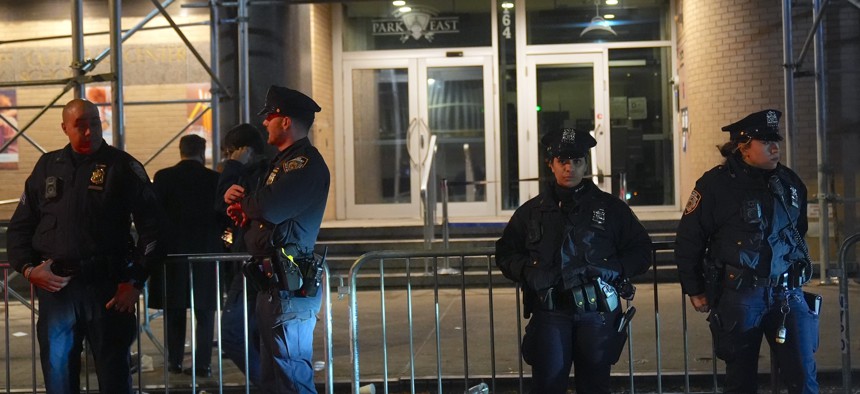
NYPD officers monitor a protest outside Park East Synagogue in Manhattan on Nov. 19, 2025. Selçuk Acar/Anadolu via Getty Images


There is a difference between seeking peace and enforcing quiet.
Protest is sacred. Frederick Douglass said, “I prayed for twenty years and received no answer until I prayed with my feet.” Across generations, New Yorkers have lived out that sacred act of resistance in the streets, on campuses and on the steps of houses of worship. Protest is both a moral and constitutional right, and it must be protected for all.
The New York City Council’s proposed “security perimeters” laws around houses of worship, educational facilities and beyond are being framed as a modest, even necessary, step to protect the sanctity of prayer. We understand the impulse behind it. Our city has a responsibility to safeguard the well-being of all residents, including faith communities. Anti-Black racism, anti-Muslim bigotry, antisemitism and hatred of all kinds are real threats. But the legislation does not address those threats. Instead, security perimeters risk silencing dissent. They do not make our communities safer. They just make dissent more dangerous.
At its core, the proposed “houses of worship” law speaks to a supposed need for physical distance between protestors and religious spaces. In theory, that might sound reasonable. But in practice, such laws rarely operate neutrally. They are deployed selectively, shaped by context and often reflect deeper anxieties about whose voices are considered legitimate in the public square. For Black and brown communities, Muslim communities and politically dissenting groups, including pro-Palestine protesters, such a law introduces yet another mechanism of disproportionate control.
The NYPD already has the authority and obligation to respond to genuine threats of violence, harassment and property destruction. State and federal laws already protect access to houses of worship and educational institutions. Doubling down on the police’s discretion to decide who may protest, and where, is a recipe for abuse. This authority is especially concerning given the department’s documented history of violating New Yorkers’ constitutional rights during protests.
We have seen what happens when protest is policed rather than protected. Communities of color, students and organizers know firsthand how aggressive responses to dissent lead to violence and arrests for simply making their voices heard. Rather than protecting safety, this legislation could create anti-speech zones and undermine hard-won protections like those in the Payne v. de Blasio settlement, which limited police presence at protests and codified a tiered approach to First Amendment activities.
The timing and framing of these proposals also cannot be separated from the broader political context. Pro-Palestinian advocacy in New York has been increasingly scrutinized and, at times, targeted as an exception to the First Amendment. The City Council’s proposed laws risk functioning less as neutral protections and more as instruments to suppress a particular kind of speech, namely speech that challenges dominant narratives about Israel and Palestine. As it is, we are living in a moment of rising authoritarianism where speech suppression has become a governing strategy at multiple levels of government. New York City must not follow that path. The question we must ask is not simply what these laws say, but what they do, and to whom.
There is a profound theological and moral question at stake. Many faith traditions do not view protest as antithetical to worship. On the contrary, protest is an extension of prayer, and a manifestation of moral urgency and prophetic witness. Faith leaders across traditions have historically welcomed protest, even when it is uncomfortable. Dissent outside sacred doors is not a threat. It is an invitation to reflect, to respond, to engage, and, when necessary, to repent. Legislating against this dynamic imposes a vision of religion that is insulated, static and disconnected from the public good. It offers a false dichotomy, mistakenly pitting prayer against protest.
Legitimizing the idea of “security perimeters” around education facilities and beyond would also expand the powers of policing, granting subjective authority to define disruption or intimidation. This sets a dangerous precedent that goes far beyond houses of worship, further entrenching a system that disproportionately affects marginalized communities.
In a city as diverse and dynamic as ours, the challenge is not to eliminate tension between protest and prayer but to navigate it with care, justice and integrity. True peace is not the absence of noise. It is the presence of dignity, accountability and engagement.
As faith leaders, we stand firm that the right to protest is a moral and sacred right. We call on the New York City Council to reject these “security perimeter” proposals and recommit to a city where every New Yorker of every faith, background and political belief can make their voices heard.
The Rev. Stephen A. Green is the senior pastor of the Greater Allen AME Cathedral of New York. Imam Khalid Latif is the director and co-founder of The Islamic Center of New York City. Rabbi Sam Kates-Goldman is the rabbi of Kolot Chayeinu.
NEXT STORY: Opinion: If New York wants affordability, it must eliminate discriminatory auto insurance pricing