

Budget
Opinion: I’m not a millionaire, but I am against more taxes on the rich
And here’s why you should be too!
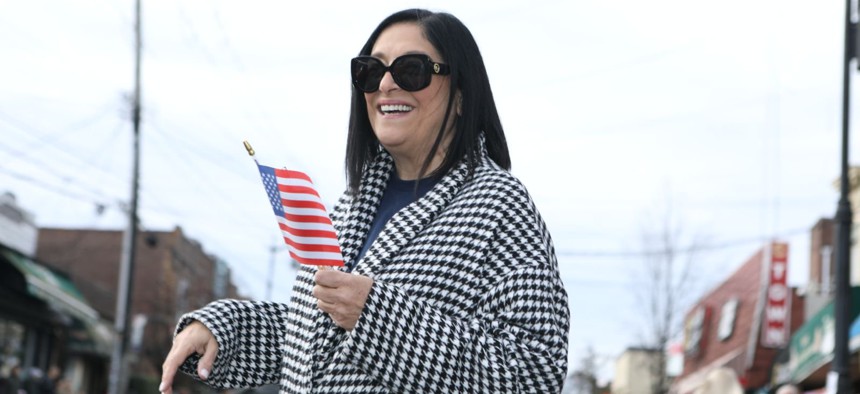
Joann Ariola attends the Queens Veterans Day Parade on Nov. 10, 2024. Alex Krales/NYC Council Media Unit


Mayor Zohran Mamdani’s drive to levy an additional 2% tax on the wealthiest New Yorkers may, to some people, seem like a no-brainer. Those people are making a lot of money, so why not have them contribute a little more to make life easier for the rest of us, right?
Wrong.
The highest tax bracket in New York is already shouldering nearly half of the income tax burden in the state. This is an enormous share and provides us with much-needed funding for an array of programs and public works. But when the members of this tax bracket change their address and stop paying their income taxes to the Empire State, the government will be left with no other option than to push that burden down to the middle and working classes.
This is exactly why Gov. Kathy Hochul was just recently begging ex-New Yorkers to come back home. Just a few years ago, you might recall, the governor was gleefully telling New Yorkers with conservative values to pack their bags and move to Florida. As it turns out, hundreds of thousands of them did, and they took their tax dollars with them. Now the state is struggling to make up for the lost revenue, and Hochul is singing a very different tune.
Let’s take a look at the numbers – because there have been quite a few skewed statistics out there. In 2010, New York State was home to 12.7% of the nation’s millionaires, according to the Citizens Budget Commission. Just 12 years later – and largely due to the fact that New York City residents are already paying the nation’s highest top marginal personal income tax rate – our share of the nation’s millionaires fell to just 8.7%.
Critics might sit there and say “Aha! Percentages aside, the actual number of millionaires in New York state has grown!” and they would be right – but so has the state population that their tax dollars are now supporting, and the rate of millionaire growth here in New York is severely lagging behind other top earning states like Texas or Florida.
The CBC study clearly lays out the results of this loss: “Had New York State and City had the same share of millionaires in 2022 as they did in 2010, the State would have received $10.7 billion more in (personal income tax) revenue, and the City $2.5 billion more.”
And then there are the members of the middle class who are also starting to feel the sting of higher taxes and a deteriorating quality of life, who also took Hochul’s advice to get out of dodge. This middle-class exodus is further chipping away at the tax base that the state and city have traditionally been dependent on.
According to studies conducted by the Empire Center – an independent, non-partisan, non-profit think tank based in Albany – New York state saw a domestic migration net loss of 137,000 residents, and took in 96,000 immigrant arrivals, from 2024 to 2025. Previous studies by the Empire Center found that the bulk of those fleeing New York are coming from New York City, Long Island and four lower Hudson Valley counties, with Florida being their number one destination.
Now, here’s where it gets really important. Per the Empire Center’s EJ McMahon, “the average income of all New Yorkers moving to Florida was $182,895.” Those moving to nearby Connecticut had a similar average income – $184,529 – and those moving just across the river to New Jersey were making an average income of $126,326.
Taken all together, we can see that this is a huge portion of the state’s tax base being eroded, and it’s being largely replaced by people who are making significantly less and are typically more dependent on government services.
This is not me making generalizations either.
According to the Center for Migration Studies, naturalized immigrants make an average of $27 per hour – about $56,160 a year – while legal noncitizens and undocumented workers earn far less. And as for services, the Mayor’s Office of Management and Budget has stated that, since Fiscal Year 2023, the City of New York has doled out $8.77 billion dollars in immigrant services, and continues to plan for billions in expenses for these services for the foreseeable future.
So what does all of this mean?
It means that, inevitably, the costs are going to keep going up, but the money to pay for them isn’t going to be there. The current system is unsustainable.
If we want to actually expand the tax base and bring more money into the city, we need to provide incentives for the wealthy to return. Because, as the numbers show, many of those with the means to do so will and are simply packing up and moving just across state lines, and this leaves the working classes and the middle-class civil servants who are too invested in the city to just up and leave shouldering the burden.
Former British Prime Minister Margaret Thatcher once said “the problem with socialism is that you eventually run out of other people's money.”
Eventually, if we keep adding more taxes, we will eventually run out of rich people’s money. And when we do, it will be on the rest of us to fill the gap.
Joann Ariola is a New York City Council member representing District 32 in Queens.
NEXT STORY: Opinion: Building a stronger New York starts with a fairer tax system