

Opinion
Opinion: Economic development + economic justice = economic diversity
Increasing economic diversity is a strategy for both growth and justice.
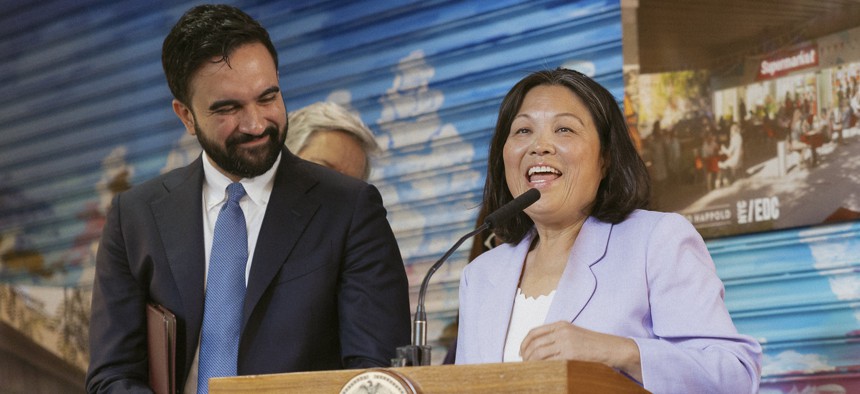
Mayor Zohran Mamdani and Deputy Mayor for Economic Justice Julie Su announce La Marqueta in East Harlem as the first site identified for the City’s public grocery stores on April 14, 2026. Kara McCurdy/Mayoral Photography Office


In a recent interview, New York City Deputy Mayor for Economic Justice Julie Su declared that her goal was to both expand New York’s “economic pie” and to make sure that pie was filled with “good ingredients” for workers in the form of affordable housing and quality jobs. A healthy economy, she argued, was an equitable economy – and vice versa.
But if Mamdani hopes to balance economic growth with working-class well-being, he'll need a more cohesive strategy than what we’ve seen so far. The top post at the city’s Economic Development Corporation remains unfilled, and the city’s current initiatives to promote economic justice, while necessary, are not enough to reverse the outmigration of working-class jobs and middle-class families. To extend Su’s metaphor: if we’re going to build a better economic pie, we’re going to need a better recipe.
Here is one approach worth considering: both economic development and economic justice require the cultivation of economic diversity. In an age when AI threatens to eliminate many entry- and mid-level jobs in finance, technology and media, we can’t rely on traditional strategies of attracting outside corporations and firms through expensive subsidies. Instead, we need to cultivate a mixture of enterprises – small and large, private and worker-owned, manufacturing and commercial – in order to provide the growth and opportunity our economy needs.
The “sidewalk ballet” that is economic diversity
Historically, Gotham’s economy was made up of small, flexible firms staffed by skilled, diverse and often unionized workers. These enterprises competed and cooperated with one another to deliver innovative goods and services across fields ranging from manufacturing to show business, from fashion to media. This “agglomeration economy” flourished even as New York remained a working-class and relatively egalitarian city in the mid-20th century, demonstrating that economic justice and economic growth are not in conflict but are in fact mutually reinforcing.
In the 1960s, the great urban theorist Jane Jacobs applied these observations to the question of urban economic health. Just as a thriving city street was composed of many neighbors, she argued in The Economy of Cities, a thriving urban economy is composed of many businesses attuned to one another’s contributions and dependent on each other’s success. Only a diverse mixture of small and midsize firms can provide a stable foundation for lasting urban prosperity: a principle that even the city’s Economic Development Corporation has come to accept.
The goal of planners and economic development officials, therefore, should not be to maximize land values and rents at every turn, as that would exclude the lower-margin firms and lower-income residents essential to a truly diverse, flexible and vibrant economy.
For decades, however, that is exactly what has happened. The city's economic strategy has been to encourage high land and rent values at almost any cost, rendering city land increasingly less affordable for any but the wealthiest corporations and residents. City subsidies and assistance, even ones nominally directed towards small businesses, have similarly been largely directed towards wealthy financial and corporate firms.
The result has been a bifurcated economy – lavishly compensated white-collar workers on one side, low-wage service workers on the other, with the middle class getting squeezed out. This has steadily eroded the diversity of uses and users that made Gotham successful in the first place. And it has made New York's economy top-heavy and fragile, particularly as automation and AI threaten to displace white-collar work from the metropolis.
The economic future of the city depends on the rebalancing of the corporate attraction and retention model with one that harnesses the underdeveloped potential of the city’s existing diverse communities. Addressing this will take more than piecemeal efforts by one branch of the government. Rather, it demands a whole-of-government approach that addresses all the ways that economic homogeneity is undermining New York City. This requires a coordinated, citywide strategy that aligns housing, land use and economic development policy around a single goal: rebuilding economic diversity.
Policy proposals for economic diversification
A whole-of-government approach for Mamdani might look something like this:
New York’s Industrial Business Zones are one of the few existing tools that align with this “middle-out” approach to economic development. A realistic step is to strengthen Industrial Business Zones through long-term land control and assembly mechanisms, including public acquisition of key sites, long-term ground leases and restrictions on conversion. The goal is not to freeze these places in time, but to ensure that productive uses are not displaced by higher-value residential or logistics. But more importantly, this would provide new and expanding manufacturers long-term stability and opportunity to scale.
Another land-use reform policy should include updating zoning to enable hybrid environments – not in just a few special districts, such as OneLIC, but more broadly. Modern firms combine light industrial, design, retail and distribution in a single operation. Current zoning often forces these uses apart. Allowing them to coexist increases the speed at which ideas can move from concept to product.
The city should also find ways to fast-track more developments like the Peninsula in the Bronx and the Kingsbridge Armory; these projects combine deep affordability and small business protections with family-sustaining jobs and social infrastructure. The city should use land value taxes on projects like Sunnyside Yards and IBX to ensure that the value created through these initiatives does not result in economic monocultures.
The city should also work with anchor institutions to strategically shift procurement away from Amazon and other global chains toward local businesses and worker cooperatives, which have succeeded in providing more and better paying jobs.
Finally, in the era of turbo-charged corporate consolidation, there is a critical need to rebalance the attraction-and retention model with one that harnesses the underdeveloped potential of the city’s existing communities. This requires a wholesale recalibration of how billions of city and state tax incentives accrue primarily to big business (without much evidence of effectiveness). Even though many incentives can technically be used by small and mid-sized firms, they mostly do not for structural reasons that both the city and state need to address.
Mamdani’s economic instincts point in the right direction. But accomplishing his goals will require more than clawing back benefits from wealthy corporations. It will require cultivating a dense, diverse economy that enables small businesses to become medium-size businesses that spin off new businesses – an economy that grows from the bottom-up, not the top-down. Jane Jacobs made this point eloquently more than fifty years ago: “Cities have the capability of providing something for everybody, only because, and only when, they are created by everybody.” To do this, we need to create an economy as diverse as its citizens. Mamdani has the opportunity to do this now. Will he take it, or waste it?
Daniel Wortel-London is a policy analyst and historian of urban politics who currently serves as visiting assistant professor of history at Bard College. Lisa Chamberlain is an urbanist, writer, and communications consultant at Strategies for City Builders who teaches public communications at Hunter Urban Policy & Planning.
NEXT STORY: Opinion: All media needs help