

DSA
Opinion: DSA’s championship performance
The Democratic Socialists of America capitalized on anger with Bibi Netanyahu, Israel’s embattled prime minister, to (almost) sweep this week’s primaries.
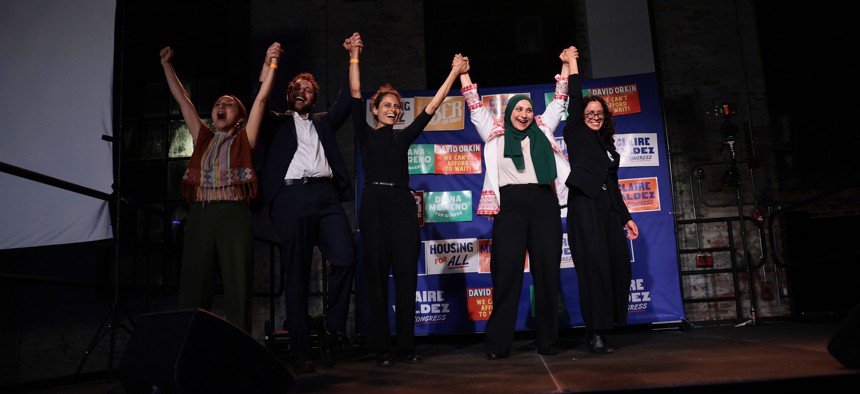
Winning DSA candidates Diana Moreno, David Orkin, Samantha Kattan, Aber Kawas and Claire Valdez celebrate at a DSA watch party at 99 Scott Studio in Brooklyn on June 23, 2026. Michael M. Santiago/Getty Images


Two weeks ago, a once-underestimated Knicks team finished an impressive playoffs run, losing just one game in the finals and winning the championship for the first time in 53 years.
On Tuesday night, the New York City chapter of the Democratic Socialists of America and its standard-bearer Zohran Mamdani completed their own clean sweep of federal and state legislative primaries, adding two new members to Congress (not including presumptive congressional representative Brad Lander, who’s DSA-adjacent) and adding six more members in the state Legislature, while knocking out three incumbent state lawmakers.
Like Mamdani’s breathtaking run in 2025 – is he the Jalen Brunson of politics? He was down for three quarters of the race but made a shocking comeback in the last quarter – Tuesday was a night where DSA put points on the board. Come next year, the socialist group will have 15 state lawmakers in Albany.
DSA is still a minority in both the state Legislature and in Congress, but they’re gaining nationwide on the executive level as well. Washington, D.C. just elected its first democratic socialist mayor, Janeese Lewis George.
Think about it: President Donald Trump will reside for two years in a city run by a democratic socialist. Can’t wait to see the pyrotechnics of that relationship.
It was the issue of affordability that gave these neophyte DSA candidates some wind in their sails. However, it was their criticism of Israel and rejection of money from AIPAC that put the challengers over the finish line. One could even argue that if the war in Gaza had never happened, we might currently have Mayor Andrew Cuomo.
For the last two years and nine months, it’s been the misguided and lethal Gaza War – and its face, Israeli Prime Minister Bibi Netanyahu – that has lit a fire under the far left and animated people in their 20s and 30s, shaking up New York’s political ecosystem more than anything else since 9/11.
When I was very young, it was protests against the Vietnam War that galvanized a new generation of voters and led to significant political upheaval. When I was in college, the cause célèbre was opposing apartheid in South Africa. I went to a few divestment rallies as a student at Cornell University.
It’s the age-old dynamic of young, rebellious voters who want to change the world latching onto a cause to elevate the underdog, the oppressed. It’s obviously a noble one. But let’s make no mistake: last year’s NYC Democratic mayoral primary and this year’s legislative primaries were in many ways a referendum on Netanyahu, Trump and the interminable war in Gaza.
There were some outliers Tuesday night: Harlem Assembly Member Jordan Wright fended off a strong challenge by a DSA candidate. And on the West Side and East Side of Manhattan, voters selected Micah Lasher – a centrist Democrat who is more supportive of Israel than most other candidates – to succeed retiring Rep. Jerry Nadler. Lasher was supported by “establishment figures” like Gov. Kathy Hochul and Nadler, and even former Republican Mayor Mike Bloomberg spent $10 million of his endless capital to help Lasher make it to Congress.
While Mamdani and DSA are clearly ascendant in New York, it was sad and troubling to wake up the morning after the primary to news that yet another high-level Adams administration person was indicted for alleged corruption. Along with Ingrid Lewis Martin, Adams’ former top advisor, who faces her own serious legal troubles, Frank Carone has been laid low by this indictment and the recent unraveling of his firm, Oaktree Solutions.
This is the poignant coda to a mayoralty that started so promisingly but quickly went downhill due to the former mayor’s lax relationship with ethics and questionable approach to management.
For those of us who’ve been closely observing New York City politics over the past four decades, it’s important to realize that powerful leaders and their teams are on the clock each day, and even those who seem ascendant could fall very quickly. Just ask former Mayors Eric Adams and Rudy Giuliani. Or ex-Govs. Andrew Cuomo and Eliot Spitzer.
Whether you agree with his policies or not, it’s been refreshing to observe the team Mamdani has put together. They all seem skilled for their roles and there appears to be no bad apples. Contrast that to the swamp at 1600 Pennsylvania Avenue and the Albany rogue’s gallery of the past two decades, including former Assembly Speaker Shelly Silver and former Senate leaders Dean Skelos, John Sampson and Malcolm Smith – all of whom went down in corruption scandals.
That’s why Hochul’s squeaky-clean administration for the past five years has been so impressive. Her leadership style and interpersonal skills are far superior to those of her three Democratic predecessors.
What’s next as the dust settles on the New York Democratic primaries of 2026? We’ll likely have to wait two years to see whether Tuesday’s paradigm-shifting results will continue to reshape the party or if the Democratic establishment will figure out a way to turn back this crimson wave of democratic socialist leaders.
Next year is one of those anomalous election years, which happens once every four rotations around the sun, where there are no significant city or state legislative primaries. And in 2028, with the presidential sweepstakes likely to overshadow everything, we will see whether DSA can move to the next level or if they’ll suffer a backlash.
If AOC, one of the most famous democratic socialists in this country along with Vermont’s U.S. Sen. Bernie Sanders, runs for president or U.S. Sen. Chuck Schumer’s seat in 2028, she will bring democratic socialism even further into the spotlight and the national conversation, which will make for fascinating fodder for political junkies as well as the media. It will likely inspire a new generation of voters in a similar way that another three-lettered politician, JFK, did back in 1960.
Michael Woloz, the founder of CMW Strategies and a good friend and fellow political junkie, summed up this week’s primary: “The old ethnic politics are dead. DSA’s biggest victory was upending norms,” he wrote. “Youth. Ideology. Energy. That’s the new politics. Ethnic groups pridefully voting their ethnicity as primary motivator – over. Voting for seniority in Congress because that’s how you get money to the district and NYC – over. Post 9/11 politics are over. Youth don’t give a flying f--- about any of that.”
“And youth are running the city,” Woloz concluded.
He’s right. There has been a huge changing of the guard over the last two years of elections. At 27 years old, Mamdani’s wunderkind strategist Morris Katz is only five years out of college. Anti-incumbent fervor is growing. Maybe term limits for Congress and the state Legislature will blunt that, but good luck getting octogenarian Congress members or territorial state legislators on board with that.
Like the Knicks two weeks ago, the DSA can bask in its impressive performance – the culmination of nearly two years of continuous campaigning – and dream of a future with democratic socialists up and down the ballot. But they shouldn’t get too comfortable. There’s always next season.
Tom Allon is the founder and publisher of City & State.
NEXT STORY: Opinion: Universal childcare means expanding after school programming too