

Opinion
Opinion: New York’s kids are falling through the cracks between our agencies
The mayor has proposed defunding the Portal software platform, which connects people across different city agencies and nonprofits who work with the city’s children.
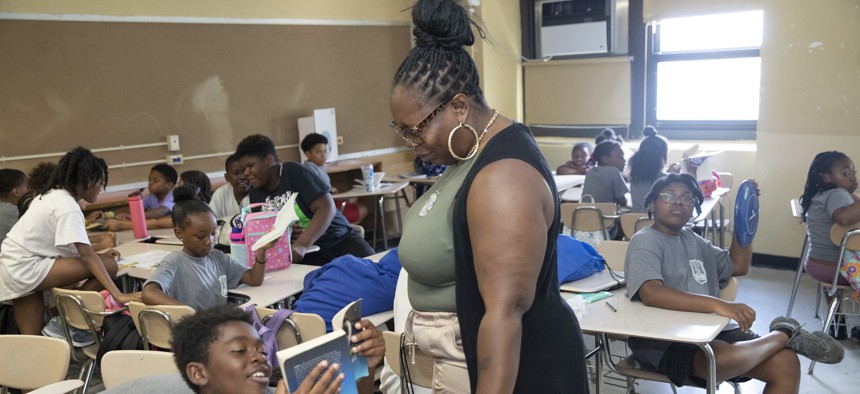
New York City Council Member Althea Stevens tours Community Voices Middle School on July 28, 2023. John McCarten/NYC Council Media Unit

I have spent my career – first as a community organizer in the South Bronx, now as chair of the City Council's Committee on Children and Youth – watching New York City's services for young people work in parallel rather than together. The city runs extraordinary programs through the Administration for Children’s Services, Department of Youth and Community Development, Department of Homeless Services, our public schools, CUNY and dozens of nonprofit partners. Each of those agencies is full of people who care deeply about the children they serve. The problem has never been the people. The problem is that the systems they work in cannot see each other.
I see the cost of this every day in my district. A young person in foster care whose school doesn't know they have a caseworker. A family in a shelter whose children's attendance pattern is invisible to the staff who could help. A high school senior eligible for a CUNY College Now course no one ever told her about. A teenager who participated in a Summer Youth Employment Program last year and whose school has no idea the experience could count toward a graduation pathway. Tens of thousands of these gaps, every year, all of them invisible until the consequences arrive – a missed graduation, a delayed referral, a benefit that went unclaimed, a young person who ended up in a system no one wanted them in.
Recently, I co-chaired an oversight hearing in the Council on strengthening CUNY pathways for current and former foster youth. The testimony we heard was painful and familiar: young people falling through gaps between ACS, CUNY and NYCPS because no one system holds the full picture of their lives. Our recommendations included exactly what you would expect– better coordination, better data sharing, real-time information across agencies, support that actually follows the student.
What too few New Yorkers know is that one of the most promising answers to this problem is already operating quietly across our public school system.
It's called the Portal. It's a software platform built and maintained by the nonprofit New Visions for Public Schools, and it does something that, until recently, no one in this city has managed to do at scale: it connects the people serving children across the agencies and organizations they rely on. Mayor Zohran Mamdani’s executive budget calls for the Portal’s $8.9 million in funding to be cut, which would shift its users to other internal tools. That cut would be a mistake.
Nearly every public school in New York City uses it. So do Department of Homeless Services shelter staff supporting students in temporary housing. So do CUNY admissions and program staff helping high schoolers apply for college courses. So, increasingly, do community-based organizations providing tutoring, mentoring and family support. And starting next school year, foster care agencies will join them – under a pilot the city is developing with ACS.
The Portal is the data and management platform for Every Child and Family Is Known, the Children's Cabinet initiative serving thousands of children and families in the Bronx shelter
system. It tracks who has been connected to a Caring Adult in their child's school, what services families have requested and whether those services were actually delivered. It is, to my knowledge, the first time the city has built a real feedback loop for whether its services are reaching the families that need them.
This is exactly the kind of infrastructure the state comptroller's recent audit of New York City public school data practices called for: centralized, transparent, governed under a single set of agreements and accountable. It is also exactly the kind of cross-agency work I have spent the last four years arguing the city does not do enough of. Most importantly, it is working.
I want to be clear about what I am not arguing. I am not arguing that our agencies' internal teams should be replaced. They are doing essential work and they need more resources, not less. I am arguing that when a partnership with a mission-driven nonprofit produces what the Portal has produced – connecting agencies that have never been connected before, at a fraction of what an internal build would cost, with philanthropic dollars covering much of the bill – the city should treat it as exactly what it is: critical public infrastructure worth protecting and expanding.
The City Council and the Mamdani administration will soon make important decisions about where to invest in the children and families of this city. We will talk about youth employment, afterschool programs, foster care, mental health and the universal childcare promise the mayor has made central to his agenda. None of those investments will work as well as they should if the agencies delivering them can still not see each other's work.
The Portal isn't the whole answer. But it's the closest thing this city has built to one. Let's keep building.
Althea Stevens is a New York City Council member representing City Council District 16 in the Bronx. She is the chair of the Council's Committee on Children and Youth.
NEXT STORY: Opinion: That day at departure