

Opinion
Opinion: Meeting the moment for New York’s homeless youth
New York City made real progress on youth homelessness. Albany is coming up short.
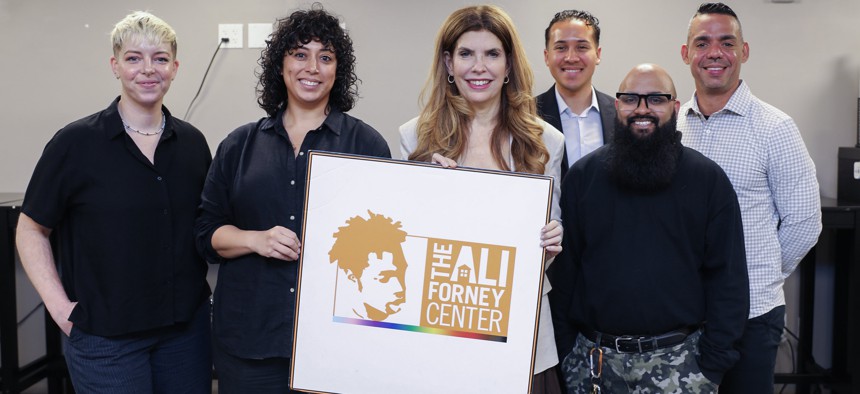
New York City Council Speaker Julie Menin, center, visits the Ali Forney Center on May 4, 2026. Alex Krales/NYC Council Media Unit

An 18-year-old comes through the Ali Forney Center’s doors most days in my district. They come after being rejected by their families and escaping tremendous abuse. They arrive with a bag, sometimes less, and they wait for a bed or a case manager or a voucher that, for years, might as well not have existed. Multiply that young person by 400, and you have the current waitlist to enter an Ali Forney Center shelter today. Multiply it further and you have thousands of LGBTQ young people across this city and state.
Over 40% of all runaway and homeless youth in New York identify as LGBTQ. For them, a shelter bed is the difference between a system built to protect them, and one that exposes them to the very harassment and violence they fled their home to escape.
We have seen what's possible when this city chooses to show up for these youth. In July 2021, a pilot program opened 50 CityFHEPS vouchers to youth in city shelters and drop-in centers. That December, legislation made time in youth shelters and foster care count toward voucher eligibility. The results were immediate and proved that this crisis is solvable when the city funds the solution: 280 young people moved from shelters into apartments of their own. Another 115 stood on the threshold, leases in hand. Homeless youth exits from Department of Youth and Community Development (DYCD) shelters rose 350%. At the Ali Forney Center, the waitlist fell below one hundred youth for the first time in memory.
But then momentum stalled, funding tightened and the road out narrowed again. A bill to allow for youth access to CityFHEPS passed in 2023 thanks to advocacy by the Coalition for Homeless Youth, but then-Mayor Eric Adams vetoed it. The City Council overrode that veto, but Adams refused to implement it. Next, emergency federal vouchers that helped close the gap ran out by 2024 and forced the city to scramble for new placements with no cushion left. Ali Forney’s waitlist climbed back past 400; that is how quickly progress can slip away the moment funding does.
This year, Mayor Zohran Mamdani, City Council Speaker Julie Menin and Housing Committee Chair Pierina Sanchez did something this city hasn't managed to in years: in one of the hardest budget cycles in recent memory, they chose to protect and expand rental assistance for homeless New Yorkers, including young people, rather than let it become collateral damage.
The FY27 budget and Int. 966 deliver $175 million this year, and a baseline $125 million the year after, to fund a new rental assistance program with more accessible guidelines that will finally reach shelter populations that CityFHEPS has never covered. This includes the DYCD youth shelters, where Ali Forney's youth live while they wait.
For the first time in years, a young person in a city youth shelter has a real, funded path home. Speaker Julie Menin's insistence that no budget move without real voucher funding, and Council Member Pierina Sanchez's sustained work to get this across the finish line, were essential to this victory for young people and others facing housing insecurity.
This voucher expansion for youth is one of the most consequential city measures in years for reducing youth homelessness. The rest of New York state should be studying its success.
While the city was proving that funding works, runaway and homeless youth providers across the state have been asking for a modest, multi-year build to bring New York state Runaway and Homeless Youth funding to roughly $30 million – enough to align per-bed rates with what care actually costs. The state’s current Executive Budget offers just $8.4 million. That is not enough.
I am proud to represent Council District 3, which has a long history, from former Council Speaker Christine Quinn to state Sen. Erik Bottcher, of leading on this issue. New York City just showed, in real numbers, what happens when a government funds this work at the level the crisis demands, and what happens when it doesn't. Albany must pay close attention.
Carl Wilson is a New York City Council member representing Council District 3 in Manhattan.
NEXT STORY: CEO’s note: Reflecting on 20 years of City & State