

Opinion
Opinion: Specialized solutions
It’s time the mayor and chancellor reform the exam for specialized high schools – and add additional schools to serve more ambitious students.
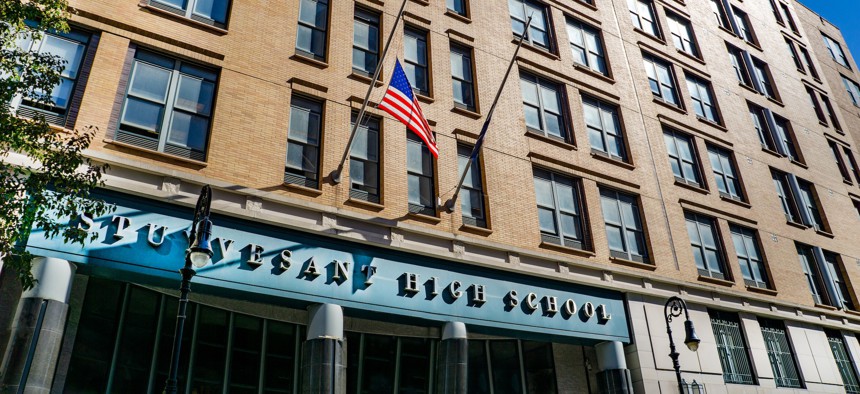
Stuyvesant High School is one of New York City’s eight elite specialized high schools that admit students based solely on the result of a standardized test. Education Images/Universal Images Group via Getty Images


When I was a teacher at Stuyvesant High School in 1987, I taught the after-school SAT prep class for the English section of that exam.
One day, the English department chairman summoned me to his office and told me that an academy in Flushing was looking for a Stuyvesant teacher to teach a three-hour English SAT prep class that Saturday. They were offering $50 per hour, a princely sum for someone making only $23,000 per year as a rookie teacher in the New York City public school system. (Wages have improved since then, though they are still woefully low to attract the best and the brightest – but that’s a topic for another column.)
I accepted this offer and got up early Saturday to make the long trek from my home on the Upper West Side to the last stop on the No. 7 train in Queens. At the Elite Academy on Main Street in Flushing, Mr. Kim greeted me at the front door and brought me to the class I was asked to teach.
When I entered the classroom, I saw 27 Korean American students at their desks – but they were each approximately 10 years old, not the 17-year-olds I was expecting for SAT prep.
“This must be the wrong class,” I said to Mr. Kim. “I was asked to teach SAT prep.”
“Oh, no, we asked for SHSAT prep,” he said in his amiable, high-pitched voice.
That’s the test taken each year by 29,000 eighth-grade students to gain entrance into New York’s eight specialized high schools – including Stuyvesant and Bronx Science.
So, I adapted my lesson plan, taught the class the appropriate material for three hours and then went to the main office to collect my envelope with $150. I waved goodbye, but Mr. Kim stepped in front of me: “Oh, you must come back again next week.”
“It’s a very long commute from my home,” I replied. “I don’t think so.”
“We can send a limousine to pick you up and take you home,” Mr. Kim said.
And thus began my semester-long tenure at The Elite Academy, a tutoring program for Korean American students. They videotaped my class and then featured me in a television commercial on cable TV, on a Korean station that touted the Elite Academy’s Stuyvesant High School teacher.
I later realized that I was the marketing vehicle for the city’s first “cram school,” many of which have proliferated around the city since then.
That summer I was asked to teach 20 hours a week (for $1000!), but I already had summer plans to try to write a screenplay in a picturesque town in upstate New York.
Mr. Kim was disappointed and insisted I find a colleague to fill in. So I asked Frank McCourt, a friend and fellow Stuyvesant teacher, to take my spot. McCourt, who was then still a decade away from writing the Pulitzer Prize-winning “Angela’s Ashes," was delighted to make an extra $1,000 per week to supplement his meager teacher’s salary and cover his “two alimonies” and other bills.
That fall, when I left teaching to pursue journalism, Frank took over my Elite Academy class and stayed with it for the next four years. He called me one day with startling news: “Tom, do you remember that class of 27 Korean children I took over from you? Well, 26 of them were admitted to Stuyvesant.”
I realized then that students who were willing to devote four years (weekends and summers) – not just mere months or weeks – to studying for the entrance exam were gaining a huge competitive advantage in this academic race to the top.
A troubling trend
I have a unique history with Stuyvesant: I was a student there from 1976-1980, and then I did a “Welcome Back Kotter” routine as an English and Journalism teacher in 1986-1987. In 2011, I returned to the school to speak to a class of high school journalism students.
What I noticed that day in 2011 – almost a quarter century after I left teaching – was that on my way to the 5th floor class, I didn’t encounter any students of color. The hallways were teeming with pubescent white and Asian teens.
This change in the student body composition made me eager to look into what was going on. What I discovered after drilling deeper was that the number of African American and Latino students enrolled at Stuyvesant had plummeted since my teaching and student days.
It wasn’t exactly representative of the make-up of the city in the 1970s and 1980s, but Black and Latino students made up at least 15-20% of students in each Stuyvesant class back then. By 2011, less than 5% of Stuyvesant students were Black or Latino.
I wrote a series of columns in The New York Daily News and then City & State decrying these shameful statistics and offering potential solutions, and the issue became a centerpiece of my 2013 mayoral campaign. Although I didn’t win, I took solace in the fact I had at least put this issue on the radar of government officials and the media.
The winner of that mayoral race, Bill de Blasio, seemed to agree that something needed to be done, especially since his son Dante attended Brooklyn Tech, a specialized high school.
But his eight-year tenure ended with no change in policy or improvement to this festering state of affairs. Eric Adams, the city’s second African American mayor, likewise did nothing to right this wrong.
So here we are.
This summer, like clockwork, The New York Times reported that the entering class of Stuyvesant students in the Fall of 2026 – with a total of 777 new matriculants – will only include three African American students.
This is literally a new low.
In the four decades since I taught that SHSAT prep class in Flushing, the demographics of Stuyvesant’s student body have undergone a marked shift.
In the class of 2030 at Stuyvesant, in addition to the three African American students, almost 70% of the class will be Asian (close to 500 matriculants), and I’d bet that many of those students either were enrolled in a “cram school” for years or spent a very significant amount of time preparing for this “all-or-nothing” test.
But nothing they are doing is illegal or even unethical. Most of those Asian students come from poor backgrounds; they and their parents have decided that with extraordinary hard work they can climb the academic ladder and ensure themselves a seat at a great high school and then hopefully a prestigious college and eventually lucrative work in the ever-competitive job market.
But test-taking ability isn’t everything. As the Stuyvesant English department chairman told me in 2011, many of the students being admitted are poor writers even though they are very smart and are superior test takers.
Clearly, something has to be done to shake things up and allow for a more diverse student body at all eight specialized high schools – and particularly the crown jewel of the system, Stuyvesant.
An abundance of solutions
The buzzword in the Democratic party and progressive circles a few years ago was “abundance,” the title of a best-selling book by New York Times columnist Ezra Klein and Atlantic writer Derek Thompson.
They posited that we need to get away from a scarcity mindset about the things that are working in the public sector – affordable housing programs, mass transit upgrades, energy and infrastructure expansion.
One area where we must apply the “abundance” mindset right away is public education. It’s time to scale up those things that are working – and that means more specialized high schools.
The elite specialized public high schools each year attract 29,000 test applicants for roughly 4,000 spots in eight schools. This means that 25,000 ambitious students are denied their desire for a “specialized” education.
It’s a complicated public policy problem, but there are multiple ideas that can help improve the shameful lack of integration and equity, long-standing stains on our schools.
An “abundance” mindset, rather than a “scarcity” or “zero-sum” approach, will go a long way towards fixing this.
Here is a list of ideas I’d like to propose to improve our high schools while at the same time better integrating these specialized schools.
Increase the number of specialized high schools from eight to at least 13 by 2028-29. Add a new one in each borough.
Each year, more than 29,000 eighth graders take the SHSAT exam to gain entrance to one of these eight specialized schools, but only 4,000 are admitted. That means that 25,000 New York students who want accelerated learning in high school – or what’s called a “specialized high school education” – are denied this life-changing opportunity. Surely, at least 4,000 more of them can handle this rigorous curriculum and could then be admitted to one of these five new schools.
Perhaps you could put a Stuyvesant 2 in Harlem, a Bronx Science 2 in the South Bronx and so on. And because these are new schools, and not subject to the “test only” system mandated by the Calandra-Hecht Bill of 1972, the mayor and chancellor can dictate new criteria for admission.
How about each eighth grader in the Bronx who is the valedictorian or salutatorian of their class is guaranteed admission at Bronx Science 2? The same rule would apply to Manhattan middle schools for Stuyvesant 2 and so on.
And perhaps there could be 100 seats in each school reserved for children from impoverished households who score within 20 points of the cutoff score but who are willing to take a summer academic program right before they start ninth grade (essentially the same as the Discovery Program that some specialized high schools employ effectively). Undoubtedly, the racial composition of those new schools will be much more diverse than their sister schools.
Expand the City’s accelerated learning programs and begin them in fourth grade rather than Kindergarten.
The city’s accelerated learning programs (which have been badly mislabeled as “gifted and talented” programs) currently begin in Kindergarten, which is too early and has led some to call for the programs to be scrapped altogether.
But by fourth grade, it becomes clear to teachers – and the students as well – who the accelerated learners are who need to be grouped together so they can take on more challenging work without harming their classmate’s education.
We should make sure every elementary and middle school – especially in poor neighborhoods – has an accelerated learning program.
Reform the exam by adding an essay and changing the format each year.
As I illustrated in the anecdote about “cram schools,” there are too many young students spending weekends and summers for years preparing for the SHSAT. If you changed the format of the exam from year to year (perhaps by randomly rotating through different formats) you’ll take away the advantage for long-time “crammers.”
Essays are tough to prepare for, and adding a composition component to the SHSAT will measure applicants’ writing ability – an extremely important predictor of academic success in high school and beyond. With the assistance of AI, it shouldn’t be difficult to quickly grade 29,000 essays.
Change the criteria for admission at the five newer specialized schools one by one to experiment with ways to increase diversity.
Only Stuyvesant, Bronx Science and Brooklyn Tech are actually constrained by the Calandra-Hecht statute that enshrines the test as the sole criteria for admission.
That means the mayor is free to experiment with the other specialized high schools’ admissions processes. Perhaps we should take Boston Latin High School, for example, and allow admission there to all middle school valedictorians and salutatorians, and then fill the rest of the class with students who score high enough on the SHSAT.
Make the SHSAT mandatory for eighth graders and offer algebra to all eighth-grade classes.
There are likely dozens of students, including many Black and Latino students, who don’t currently take the exam but who would score high enough to gain admission to one of the eight schools.
Mandating the SHSAT as a test for all eighth graders – and requiring that students are automatically considered for specialized high schools unless they affirmatively opt-out – would ensure that these students are not falling through the cracks.
Make the test available during school time rather than just on a weekend day — this will help boost participation as well.
We also need to ensure that all schools offer students the tools necessary to succeed on the SHSAT, which means providing optional algebra classes to all eighth graders. If you have not taken algebra before you take the SHSAT exam, you’re at a huge disadvantage.
These are just a few proposals that can help reform a broken system. Expanding the number of schools is by far the best thing we can do to increase rigorous academic opportunity and ensure greater equity.
I look forward to hearing from the mayor and chancellor soon how we can finally break this pattern of unintended segregation.
Tom Allon was a student at Stuyvesant High School from 1976-1980 and a teacher there from 1986-1987. He is the founder and publisher of City & State.
NEXT STORY: Opinion: On National Lead Poisoning Prevention Week, we must protect the most vulnerable among us