

New York City
Exit Interview: Brad Lander talks about his immigration work and future political plans
The New York City comptroller served as a check on the Adams administration and a safeguard from the feds.
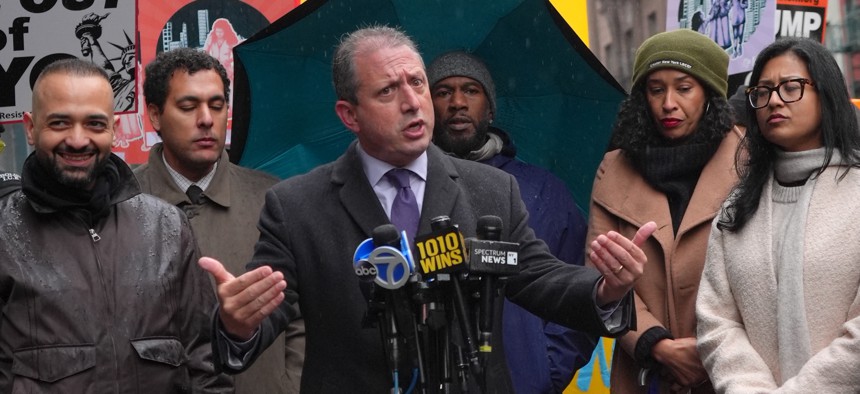
New York City Comptroller Brad Lander has been working to protect immigrants at 26 Federal Plaza. Selcuk Acar/Anadolu via Getty Images



New York City Comptroller Brad Lander has had a busy year. He ran for mayor, forged the city’s first true cross-endorsement with Mayor-elect Zohran Mamdani, was arrested escorting immigrants from court hearings at 26 Federal Plaza and now he’s weighing a run for Congress. And that’s to say nothing of his day job as New York City’s chief financial officer, which will come to an end later this month.
As comptroller, he has spent the past four years managing the city’s immense pension funds, issuing audits, operating as an independent check on the Adams administration – and more recently, attempting to safeguard the city’s finances from an increasingly hostile presidential administration.
City & State caught up with Lander to chat about his relationship with Mamdani, how he has balanced his progressive values with the day-to-day responsibilities of being comptroller and his plans for the future. This interview has been edited for length and clarity.
First, what were you doing on the side of the Municipal Building last month?
We were filming a little video to go with a report we’ll be releasing soon. Going in, we’d done a transition document called Accounting Together for a More Thriving, Equitable and Resilient City that proposed what we would do. I’m pleased to say we delivered on the promises we made. Obviously, lots of challenges we did not anticipate came up along the way. And, you know, it’s an accountability job so I thought it would be important to provide accounting on the way out. I was out on that ledge taking some pictures and making some videos for our farewell. I’ve loved serving from the Municipal Building, and I thought it would be great to say my farewell from there.
It was a fitting location.
I didn’t mean to give Rev. Frederick Crawford a fright. I do feel bad about that. I did call him after to say, “I’m sorry I gave you such a fright, but thank you for praying for my mortal soul.” You know, I didn’t think I was in danger – it’s a pretty big ledge and I’ve been on it before, but who is to say when our mortal soul is or isn’t in danger? I was very grateful for his prayers.
New York City Council Speaker Adrienne Adams has talked about the high hopes she had at the beginning of her tenure of being able to collaborate with Mayor Eric Adams’ administration and how those hopes were dashed. Did you have high expectations going in?
Oh, I would say it was maybe pessimism of the intellect, optimism of the will. We did some things together at the beginning of the term, and I’m happy to talk about them. We did manage to get some nonprofits paid in a more timely way – that’s not been fixed but it’s gotten better – we launched this project called Public Solar NYC to do new rooftop solar, and our work to protect rent-stabilized units put at risk when Signature Bank failed was done in partnership too. Part of that was the fact that the comptroller’s office and the mayor’s office are doing things together every day, issuing bonds and registering contracts.
I was realistic that it would be a messy administration, and I was not surprised when it was. We suited up from the beginning to be able to do the accountability job – to look seriously at contracts and move them quickly when they could be moved quickly and to cancel them when they were corrupt. Some of that really is dictated by the charter. Regardless of the administration, the charter assigns places where the comptroller has to work together with the mayor and the charter assigns places where the comptroller has to provide independent oversight of the mayor. Most mayors and comptrollers do some initial work together and often have some sour contention.
Was there a moment when you felt like you were able to successfully use the oversight and accountability powers of the comptroller’s office to force a change in action from the mayor’s office?
Getting the DocGo contract canceled was probably the biggest of those things. That was this half-billion dollar contract that we had called out before they submitted it for registration. We then asked them to withdraw it, refused to register it, revoked their emergency contract powers – not only over it, but in no small part. When they chose to move forward with it anyway, we let them know we would be doing this first-time ever simultaneous audit. Usually, the comptroller’s office lets something happen and then audits it, but we had enough concerns that we decided to audit every invoice. Sure enough, they couldn’t document 80% of the cost, so they had to cancel it a year later.
When Elon Musk stole that $80 million from the city’s bank account, we found it – that was right at the same time when Gov. Kathy Hochul was threatening the mayor’s powers and the Law Department going into court to sue to get it back. We still don’t have it back, but the Law Department is in court to get it back.
I’ll give a quirky one, this is less about big conflict and more about the kind of oversight any comptroller is supposed to do. We did an early audit of the New York City Ferry and found that they had underreported about a quarter-billion dollars in costs and that there was a series of problems in how the system was operating. (The New York City Economic Development Corp.), to their credit, made many of the changes we called for and New York City Ferry is on much firmer footing now than it was when we came in.
What do you consider your highest and lowest points in the comptroller’s office?
If I had to pick one thing for the highest point, it would be the investment we made to save the rent-stabilized housing in the Signature Bank portfolio. When Signature Bank failed, it put 35,000 rent-stabilized housing units in New York City at risk, which could easily have been bought by a speculator and lost as affordable homes. This was probably the most innovative pension fund investment of my tenure. I’m a housing guy, so this was one where I went to our real estate asset class head and said, “Hey, I think we could team up with some of our asset managers and buy the mortgages on those loans, and it would be a great deal financially and we could preserve 35,000 units of affordable housing.” It worked. We went to the FDIC, we teamed up with Community Preservation Corp. and Related and today, it’s crushing its 11% hurdle rate and helping secure retirement for New York City workers. Every one of those units is preserved as rent stabilized.
And lowest?
Lowest point … I’m such an optimistic guy. I did not expect to get tackled and arrested by ICE agents. I guess what I’d say is watching the family separations at 26 Federal Plaza. I mean my arrest, whatever, but, you know, knowing that Edgardo is back in Venezuela, where he fears for his life – seeing so many families separated and cruel abductions – has been the low point.
Accompanying immigrant New Yorkers and observing court hearings at 26 Federal Plaza is something you’ve been doing for a bit now. I would imagine after your arrest, there was even more reason to go, given the number of eyes on you.
You know, I spent the last couple of weeks thinking about this with the ICE raid on Canal Street and then what happened in Chinatown last weekend. I was not there when it happened either time, I showed up afterwards or to the pressers, but I’ve been really moved and encouraged by New Yorkers showing up to protect their neighbors. In the case of Canal Street, those weren’t people who had gone through training. They were just New Yorkers who don’t like when their neighbors are grabbed. It’s been powerful to be part of.
Last month, you declined an offer from federal prosecutors to drop the obstruction charges you faced for your arrest protesting at 26 Federal Plaza in September. The other elected officials who were arrested that same day all took the deal. Why didn’t you?
Crime is not us sitting down and singing songs in the 10th floor elevator. Crime is what ICE is doing on the other side of those locked 10th floor doors. I want the opportunity to question the federal officer who arrested me, who I know has been behind those doors, about what’s going on there. That’s why I want to take this to trial.
In the City Council, you garnered a reputation for your strong ideological values, advocacy and progressive stances. But the job of comptroller doesn’t necessarily naturally go with those things. How have you balanced or blended your values with the day-to-day nuts and bolts of the job?
The way I think about it is that the nuts and bolts hold up the schools. The nuts and bolts hold up the subway. The nuts and bolts make public goods possible. They are the public infrastructure that sustains the city and our lives. Making sure they’re sound is progressive. That’s the approach we’ve taken in many ways. Take the pension funds. Responsible investing is investing with a long-term view. Investing in climate solutions and divesting fossil fuels is responsible investing because it’s aligned with the long-term view on the city. Today, I did an investor call on behalf of the Starbucks workers whose backs we’ve had. Starbucks will return better for shareholders when they sign a contract and don’t have a strike and conflict with their workforce.
The same is true in my opinion with the budget. I’m a big believer that we should have more deposits into our rainy day fund. That’s not because I want fewer services today. It’s because there will be a recession or an economic downturn in the future, and if there’s enough money in your rainy day fund, you’ll have resources to protect people and avoid layoffs when you need it. It’s tempting to not worry about the rainy day fund, and say, “Come on, let’s just spend that money now! There’s so many good things we could do.” But that’s not progressive; it’s just short-sighted. When you have that recession, people will suffer.
The comptroller does have this responsibility to insist on taking the long-term view, to remember that the nuts and bolts better be screwed in tightly and oiled or they’ll corrode. That might not be the sexy work, but it’s making sure government is strong enough to hold people up.
What’s one piece of advice you would impart to your successor, Mark Levine, as he prepares to take office? Will you be passing on your series of controller Halloween costumes?
Yes, I will donate the controller Halloween costumes to Mark. I’m enthusiastic about Comptroller-elect Levine. This is a stewardship job that holds up a lot of parts of the city that people don’t see every day. I know Mark is going to pick up where we left off, do great new things and take it to new levels.
I guess what I have found most powerful, or at least something that might be helpful: Last night, we had the last meeting on this thing we created called the NYCHA Resident Audit Committee, where for the first time, we invited NYCHA residents to apply for a committee that oversaw the system’s audits. They were still done by auditors in our office using objective techniques, but the committee helped decide what to audit, engaged residents around the audits and advocated. I was nervous going in that it would be hard because an audit can’t get a roof leak fixed or a boiler repaired, and residents have been let down a lot of times. But people really valued being included and having the opportunity to shape the audits.
Part of what the comptroller’s office can do is strengthen trust. Trust is at a very low level in all quarters of government these days. That’s a huge problem. I think people think of the comptroller’s office as finding problems and calling out where things are broken. That is often the job, but if you engage New Yorkers and build relationships – as we were able to do with public housing residents and beyond – we engaged more diverse pension fund managers, we looked for ways to engage nonprofits in the contracts process, etc. Bring the oversight and transparency, but do it in a people-powered way and it’s possible to build and strengthen trust. That is an immeasurable asset.
Do you have any regrets about running for mayor?
No, I have no regrets running for mayor.
There’s that optimism again.
Look, I know no one will believe it, but I did not plan to run for mayor when I took office four years ago. Had Eric Adams not been indicted and gone out in a blaze of corruption, I would have run for reelection. But after that happened, I did not think that Eric Adams should be mayor. And I sure did not think that Andrew Cuomo should be mayor. I’m proud of the campaign we ran and of the role that I was able to play down the stretch. I feel optimistic about Zohran’s mayoralty and the future of the city. I look forward to figuring out the best way that I can continue to serve.
It was a wild ride. I got to see so much of the city and talk to so many people. I fell in love with New York City all over again.
There’s been a lot of reporting about your relationship with Mayor-elect Zohran Mamdani, including that you two had a falling out after you reportedly told people that he would make you first deputy mayor. Could you set the record straight? What kinds of conversations have you had with Mamdani about his administration and about your interest in running for Congress?
Zohran and I have had many conversations – through the mayor’s race, down the stretch after our cross-endorsement, on primary election night, all the way through the summer, down to his general election victory and continuing now into transition. I’m proud to have lots of staff from my comptroller’s office and from my campaign on the transition team.
I certainly never told anyone that I would have any role in the administration, so whoever reported that is just reporting gossip, because it just never happened. It’s not a thing I would ever do or did ever do.
We have had a really constructive dialog through a very tumultuous year. We spent much of the year running against each other for mayor and always had a good relationship through it. The cross-endorsement not only had the strong impact of helping defeat Andrew Cuomo, it engendered such goodwill for the idea of politics as a team sport where you try to advance your goals for the city, instead of the sour, selfish, ego-driven politics of Eric Adams and Andrew Cuomo. I have been honored to help in the general election and offer what advice and counsel I can throughout the transition. I look forward to continuing to do that.
You recently confirmed you are indeed seriously considering challenging Rep. Dan Goldman for his House seat. Is there anything you can add at this time? And if not, what are you watching as you make this decision?
What did I say earlier, that I was seriously considering running?
I think it was technically “very seriously considering running.”
All right, you can add another “very.” I am very, very seriously considering it. Look, I’m talking to a lot of people about where our politics stand – both in New York City and in Washington – and what way I can be of most service at this moment. Now is a moment that calls for Democrats to fight harder to protect the city and the democracy we love. I want the mayor-elect to have an ally and not an adversary. But mostly, I want to be in a position where I can organize together most effectively, with our neighbors. I’ll make my decision pretty soon.
NEXT STORY: This week's biggest Winners & Losers