

Interviews & Profiles
WFP head Jasmine Gripper talks state budget priorities
An interview with the state director of the progressive third party.
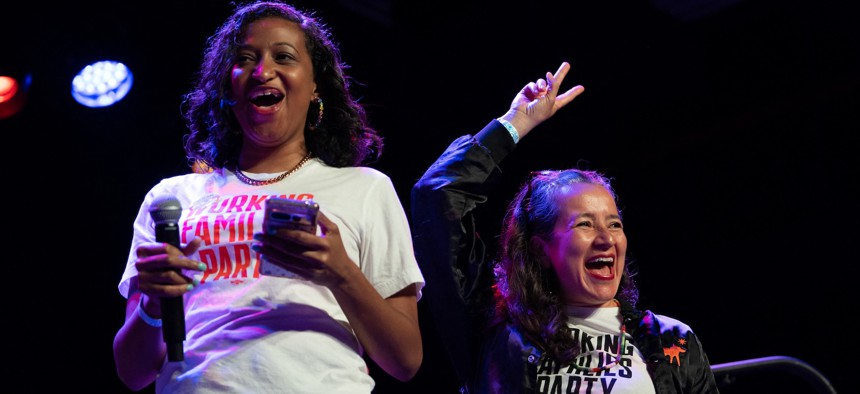
Jasmine Gripper, left, is the state director of the New York Working Families Party. MADISON SWART/Hans Lucas/AFP via Getty Images



The state budget is now over a week late, but progressive activists are not letting the delay take any wind out of their sails as they pressure the governor to raise taxes on the wealthy. The New York Working Families has continued to lead the left-wing charge in the negotiating process, remaining in constant communication with supportive elected officials.
WFP State Director Jasmine Gripper – newly minted as the party’s sole leader after her previous co-director left to join New York City Mayor Zohran Mamdani’s administration – offered an optimistic yet candid assessment of the state of play. At the start of the budget process, she thought this time would be different, smoother than the past four years of later and later spending plans. But that changed when Hochul turned weakening the climate law into a last-minute priority that has gummed up discussions.
City & State caught up with Gripper to discuss the WFP’s ongoing advocacy in Albany, dealing with Hochul as a governor in negotiations and what she hopes to see from the governor before the party considers giving her its ballot line. This interview has been edited for length and clarity.
What are your next advocacy pushes now that we've got a second week-long extender and making sure your priorities are part of these delayed budget talks?
The New York Working Families Party convenes about 50 state electeds weekly. We meet on Friday mornings – at 8 a.m., Assembly and senators together – and we talk about our priorities. We give updates to each other, and then we map out our next steps of how we're going to push together. And so some of that is what's happening externally to apply pressure, and then also what's happening internally to apply pressure. And so we're organizing electeds, we're organizing our people and of the advocacy community to all continue to pressure all three branches of government.
What kind of reactions have you been getting in these weekly check-ins? Are lawmakers feeling optimistic?
We all know the New York state budget negotiating process is pretty opaque, and it happens behind closed doors. They leak information to the press, and they put some information out. Everyone's just actively following, gathering information everywhere we can, to assess the field and to know how to apply pressure. At the end of the day, we would love more transparency in the state budget negotiation process, but we take what information we have, and we leverage that to fine-tune our pressure points, and to even fine-tune our talking points to make sure we're driving the most important message home.
Have any of your demands or asks changed since the start of the budget process?
I think the only thing that changed for us is that we had no intention of talking about the (Climate Leadership and Community Protection Act), so the governor threw it in as a wrench that she was considering rolling it back. So now we have added and had to issue a whole opposition memo on rollbacks to the CLCPA.
Beyond that, no, we're still focused on – we want to secure the $250 million that the Senate and the Assembly put into the Housing Access Voucher Program. We want to make sure there's a solution for health care coverage for New Yorkers. Now we have a sharper ask, pointing to the bill that (state Sen.) Gustavo (Rivera) and (Assembly Member) Amy Paulin have as a real, tangible solution to keep New Yorkers covered in a way that's actually really affordable. We applaud the governor's initial investment in child care, but want to uplift that the Senate has a crucial additional piece around the child care workforce, which we believe is essential. And then, we do all of this by raising taxes on the ultra-wealthy. We now have a plethora of options before us from what the Senate and the Assembly have put forward. And so our core demands have not shifted.
When do you think the budget might pass? Or too soon to say?
My guess is end of April, early May. That's my guess. We could all hope it's sooner. I'm sure the Legislature wants to be sooner. They're the ones who don't get paid. The annoying part of the budget dance (is) that I think some of the strategy of the governor is to kind of wear out the fight in the Legislature and wear them down so that they take a bad deal. We're going to continue to encourage them to keep the fight up, to stay strong and be committed to not a budget, but a good budget.
Have you spoken to the governor’s office recently about these priorities?
We talk to the governor's campaign side and her government side to make sure we're communicating what's important to the party.
Have you gotten any indication that she's listening?
It's hard to tell. My understanding is they were quite surprised by the number of electeds and the breadth of electeds who stood up around the CLCPA rollback. It isn't just the left of the left in the Legislature. It's a lot more of the mainstream Dems who are also showing up at the CLCPA press conferences and speaking up in conference. And the governor is taking note of that, and that gives us more pressure to say that she's being mindful that she can't just steamroll back the state's climate laws and that the Legislature is not going to allow it. So definitely could be room for more of a compromise on her end.
You nominated a placeholder for governor on your ballot earlier this year. Has the party made any kind of formal decision yet whether to give the line to Hochul?
No, we will likely not do that until August. If you think about it, a lot of the labor unions haven't made an endorsement in the gubernatorial. Kathy Hochul did secure a lot of elected officials endorsing her, leading up to the Dem(ocratic state nominating) convention. But we want her to continue to work towards earning the party’s endorsement by delivering for working families, which is why we're still in talks with her team about what we hope to see in the final budget.
And how has this budget felt so far compared to past ones you've worked on and around?
In the beginning of the budget process, it felt different. Now it feels like we are back at the typical Kathy Hochul approach to the budget. What I mean by that is that she throws a wrench in last minute, some new thing that wasn't in the executive (budget), wasn't in either one-houses, but all of a sudden is now on the table and is being used to hold up the whole negotiation. She's doing it now with the CLCPA rollback. She did it before. I think she's also done this thing where she looks at all the things we've won, and then starts to roll back – attempts to roll back victories. And then the Legislature spends a lot of their time and energy maintaining and restoring the previous victories.
It is frustrating to have to deal with that. I'll be honest, every governor who I've dealt with has been frustrating to deal with. It wasn't a walk in the park with Andrew Cuomo, by any means. Where I'll give Cuomo a little bit of credit, that I think he often had some signature program that at least appeared bold and transformational at times. I think she's less performative than Andrew Cuomo in that way, and she doesn't do funny math. And so I deeply appreciate that, but I do wish she actually would create bold, transformative change in a meaningful way for working-class New Yorkers.