
Policy
Hochul and legislative leaders play game of chicken with AI regulations
Gov. Kathy Hochul wants to rewrite the RAISE Act with language nearly identical to a California law, a hard no for lawmakers.
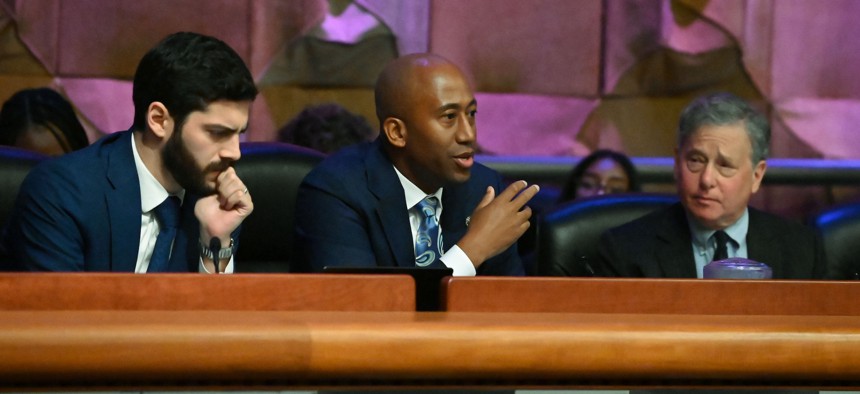
Assembly Members Alex Bores, Clyde Vanel and Steven Otis question witnesses during an Assembly hearing on artificial intelligence on Sept. 20, 2024. Will Waldron/Albany Times Union via Getty Images


Gov. Kathy Hochul and legislative leaders are at an apparent stalemate over a bill recently sent to her desk that would impose new safety regulations on major AI companies, according to sources familiar with negotiations. Hochul wants the law to more closely reflect a similar law recently signed in California, but lawmakers consider that too watered down to accept.
According to a draft chapter amendment shared with City & State, the governor’s rebuttal to the Legislature consisted of a complete rewrite of the Responsible AI Safety and Education Act, also known as the RAISE Act. The proposal crosses out the entirety of the bill passed by the Legislature and replaces it with new language taken nearly verbatim from California SB53, which is more favorable to the tech industry. The American Prospect first reported the proposed changes. But bill sponsors state Sen. Andrew Gounardes and Assembly Member Alex Bores had explicitly wanted to enact a law stronger than that on the West Coast, which also underwent changes at the apparent behest of Big Tech.
According to three sources with knowledge of negotiations, neither side appears willing to budge on their positions for the time being. The governor called up the legislation on Monday, which gives her until Dec. 19 to make a final decision on the measure. So things could still change – but it’s not so clear that they will.
Legislators have received Hochul’s complete rewrite of the bill as a take-it-or-leave-it pitch, with little to no discussion about compromise since the governor’s office provided her proposed chapter amendments. According to the sources, as things stand now, a veto appears likely if Hochul’s rewrite is in fact in her last and best offer since leaders wouldn’t accept a straight copy of California’s law.
The RAISE Act as passed and the proposal from Hochul have several key differences. Hochul’s version removes the requirement that companies not release unsafe AI models and changes the threshold for applicability from a computational cost of $100 million to revenue of $500 millionn. That would excluding tech companies that are making less profit – like those in China – but still developing AI with high computational power. The California law that Hochul has proposed replicating also does not require disclosure of threats of critical harm, only when such harm has actually occurred. The version of the RAISE Act passed by lawmakers would require disclosure within 72 hours if the company believes harm may be imminent.
Members of the tech industry have lobbied for New York to adopt the California law instead of the RAISE Act, which would in effect create a national standard for AI regulations and make it harder to enact stronger measures. “In the absence of congressional action, Gov. Hochul and the bill sponsors have an opportunity to streamline our framework with the framework that was already more or less agreed to and is being implemented in California,” Julie Samuels, president and CEO of Tech:NYC, said in a statement. “And if California has a similar framework, then we've just created a national standard, which is what the country needs."
But the sponsors have in the past expressed their desire to treat the California law as the floor for regulations, rather than the ceiling. “The RAISE Act is critical legislation to set the rules of the road for AI,” Bores said in a statement to City & State when asked about negotiations over the bill. Gounardes said he and Bores “carefully designed” their bill to balance consumer safety and technological advancement. “Our bill is like putting seatbelts in a Lamborghini; it's common sense, and it's supported by experts who know this technology best,” he said in a statement to City & State. Neither would comment specifically on Hochul’s proposed amendments or the state of negotiations.
The debate around the RAISE Act comes as President Donald Trump has signed an executive order meant to prevent states from regulating AI at the state level. A Republican attempt to pass legislation on the matter died in Congress earlier this year. If the RAISE Act goes into effect, the Trump administration could try to challenge the law under the new executive order.
Deep-pocketed tech and AI interests have already taken aim at pro-regulation candidates like Bores, with the super PAC Leading the Future pledging $100 million to keep them out of Congress. The PAC has already received millions from Andreessen Horowitz’s company, which has lobbied heavily against regulations and worked to weaken the California law. With Hochul’s own reelection next year, unhappy tech billionaires could turn their sights on the governor.
A spokesperson for Hochul did not directly address the prospect of a veto, nor the specifics of her proposed changes. "In the absence of federal leadership on responsible AI, New York is leading with common-sense laws to protect children, families, and consumers and our approach should be a model for the nation,” Hochul spokesperson Kristin Devoe said in a statement. “Governor Hochul has been at the forefront of the innovation economy and remains committed to advancing AI responsibly as she reviews the legislation.”
– With reporting from Annie McDonough
NEXT STORY: Lawmakers seek to expand New York Power Authority board