

Eric Adams
The City Council will let three of Eric Adams’ vetoes stand – while overriding 17 others.
A bill opposed by the real estate industry known as COPA and a police accountability bill are among the pieces of legislation that won’t become law under new Council Speaker Julie Menin.
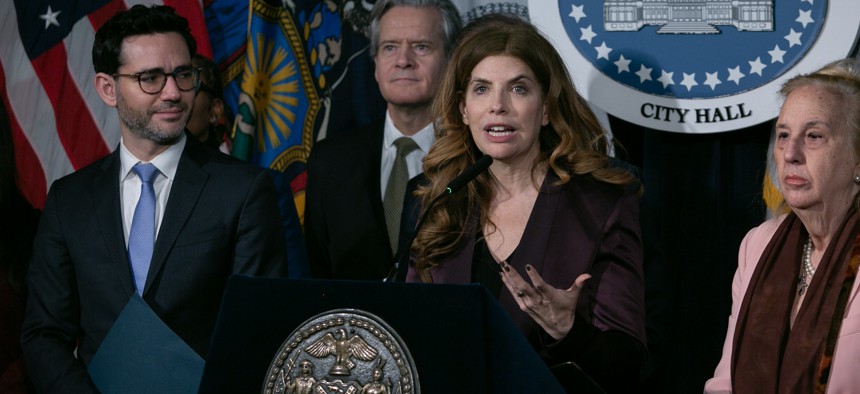
Former Mayor Eric Adams left a whole bunch of vetoes for newly-elected City Council Speaker Julie Menin to deal with – her first legislative test in the role. William Alatriste/NYC Council


New York City Council Speaker Julie Menin plans to lead the council to override 17 vetoes later this week, giving new life to a flurry of measures former Mayor Eric Adams sought to kill in the final hours of his tenure. But she’s also letting three of his other vetoes stand, according to five sources with knowledge of Menin’s plans.
One of the measures that won’t become law is the Community Opportunity to Purchase Act, also known as COPA, or Int. 902-B, which would have given certain nonprofits and local housing preservation groups the first chance to purchase distressed apartment buildings up for sale. Another bill that won’t be overridden, Int. 1433-A, would have required a minimum percentage of all newly built affordable housing financed by the city to have two or three bedrooms. The third bill, Int.1451-A, would have granted the Civilian Complaint Review Board direct access to body camera footage instead of getting it through the New York City Police Department. All except COPA passed late last year with a veto-proof majority. Menin’s plan to not override COPA was first reported by The Real Deal.
Jack Lobel, a spokesperson for the speaker’s office, said that members discussed the vetoes in a meeting of the Democratic conference Monday and were given ample opportunity to express any concerns they had outside the meeting as well.
"In one stated meeting, this City Council will override more bills than in the last decade combined,” Lobel said in a statement. “This was an unprecedented number of vetos, and the City Council is ready to override bills that have a clear supermajority of support.”
While the bills passed the City Council at the end of 2025, eight new members took office in the new year who had not previously voted on the legislation. All were subject to furious lobbying over the past few weeks as they decided which bills they’d be willing to override. Override votes need a two-thirds majority to pass, or 34 votes in the 51-member council.
The stated meeting on Thursday will be the first time Menin leads the City Council in a veto override. With seventeen bills on the docket, it’ll be a busy day. Many of the would-be laws vetoed by Adams on his way out the door have garnered a great deal of attention – and backlash after the former mayor sought to kill them. A measure to raise the cap on street vending licenses, another to prohibit federal immigration authorities from keeping an office on Rikers Island and one seeking to ban the wrongful deactivation of for-hire vehicle services are among the vetoes the council plans to revive this week.
While those bills were all vetoed by Adams on New Year’s Eve, Menin is also planning to override another bill the then-mayor vetoed separately a week prior. That measure, Int. 1297, would extend the lookback window for legal claims made under the city’s gender-motivated violence protection law.
Council Member Eric Dinowitz, the sponsor of the multi-bedroom affordable housing bill, said he would reintroduce a new version of the measure this session. While it initially passed late last year with a veto-proof majority, he said the council opted not to pursue an override on the bill. The Adams administration’s primary argument against the measure and several other housing-related bills was that they would be costly and add red tape to the housing process.
While the police body camera footage bill also passed with a narrow veto-proof majority, its lead sponsor, former Speaker Adrienne Adams, is no longer in the council. A source close to Menin with knowledge of discussions said that some of the members who’d voted for the bill last year no longer support it, with Adams term-limited out of her powerful role. “Some members have had a change of heart,” they said. “If a bill doesn’t have 34 votes, it’s not going to be up for a vote on Thursday.”
The Police Benevolent Association has also lobbied against the bill, arguing it would hurt recruitment. Supporters have argued the legislation is a necessary accountability measure – especially amid delays in the NYPD fulfilling public records requests for body camera footage. In the last few weeks alone, three people were shot by police officers, two of whom died.
Efforts to gather enough support are ongoing for another one of three vetoes. COPA’s sponsor, Council Member Sandy Nurse, said she’ll keep pushing to pass the bill, whether on Thursday or later in the year.
“COPA is the number one priority of the Progressive Caucus. We stand behind it. And we support a veto override. And that’s what we’re working towards,” she said.
Doing so won’t be easy. The bill initially passed with just 31 votes and faced a mountain of opposition from landlord and real estate industry groups. And while New York City Mayor Zohran Mamdani has supported COPA and said he hopes it passes, the city’s Law Department recently raised legal concerns about the bill, Politico New York reported, further clouding its future.
It’s rare to have mayoral vetoes not overridden by the council, as the speaker’s office generally won’t bring a bill to a vote unless they’re certain it can become law. Such override votes are often presented as a way to assert the council’s power over the mayor’s office, leading more members approving a veto override than the number that initially passed it.
This story has been updated with more details about Int. 1451-A and to clarify that Mamdani has said he supports COPA.
NEXT STORY: Good government watchdogs want COIB to restrict electioneering