

Policy
Hochul budget director hints at rolling back state’s climate law
Blake Washington, the governor’s top budget adviser, called the current energy transition benchmarks “own goals” as they place financial burdens on New Yorkers
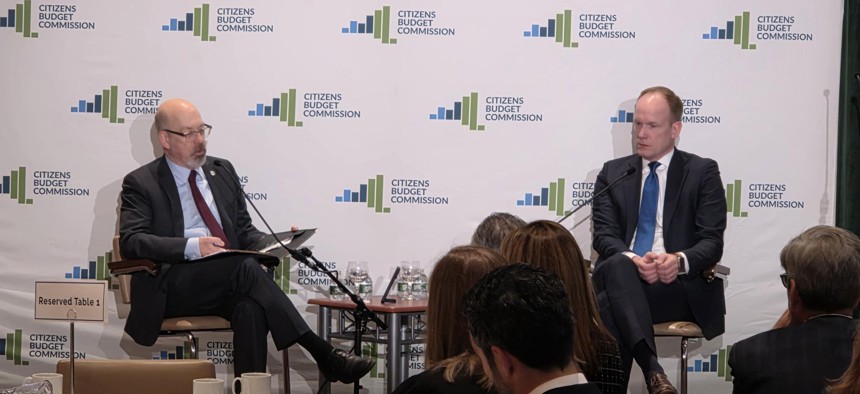
Citizens Budget Commission President Andrew Rein, left, interviews state budget director Blake Washington, right, at a Citizens Budget Commission breakfast on Feb. 25, 2026. Rebecca C. Lewis



Gov. Kathy Hochul’s budget director all but confirmed that the governor plans to propose changes to the state’s climate law to ease statutory mandates for the costly clean energy transition.
Speaking at a Citizens Budget Commission breakfast on Wednesday, state budget director Blake Washington described the cost burdens of the green energy requirements on average New Yorkers as “own goals.” He called the Climate Leadership and Community Protection Act “well-intentioned,” but said circumstances had changed since former Gov. Andrew Cuomo signed the law in 2019. “Sometimes you can change governmental rules to just fit the times and actually adapt to the realities, the realities before us, not how we wish them to be,” Washington said. He added that the estimated average cost to New Yorkers of the energy transition under current rules comes to roughly $3,000, a number the governor finds “unacceptable.”
Hochul has hinted at her desire to make changes to the climate law, and the state is already not on pace to hit many of the benchmarks currently set up. The law requires the state to reduce carbon emissions by 40% by 2030 and 85% by 2050. It also requires that all state energy come from clean and renewable sources by 2040. Hochul has insisted on an “all of the above” to the state’s massive energy needs, which includes extending natural gas pipelines, both to address the impending energy crisis the state faces and in a bid to reduce the cost of utilities for New Yorkers struggling with an affordability crisis.
Speaking to City & State after the CBC breakfast, Washington said state officials must have “honest conversations” about the goals currently in place the state must meet. “It's important that we highlight the inequities that are before us,” Washington said. “If you were to follow the current law … follow the goals, you're looking at upwards of $1.90 extra at the pump, which is not something the governor's willing to tolerate.”
Washington strongly implied the governor wants to include changes to the climate law as part of the budget, though he stopped short of stating so explicitly and didn’t say when she would release her proposal. The executive chamber didn’t include the potential policy reforms as part of Hochul’s 30-day budget amendments, which are typically where a governor introduces new items they wish to negotiate.
But Hochul has thrown curveballs late in budget negotiations in the past, such as when she proposed numerous tweaks to the state’s bail laws in 2022 just days before the fiscal deadline. “It remains to be seen,” Washington said. “But the governor is not going to whistle past the graveyard either … Here she sees an affordability issue that's right before our eyes that must be addressed.”
Negotiations between Hochul and legislative leaders will begin in earnest once both chambers release their budget rebuttals in early March, and Washington suggested the governor will seek to find middle ground with legislators on the issue. “I think that with appropriate engagement of the policymakers that created these laws in the first place, I think that you can get to a place where reasonable people can agree that no New Yorker should be faced with thousands of dollars in new costs because of a mandate that cannot be met,” he said.
Legislative leaders may not be receptive to the governor’s plea, though. State Senate Majority Leader Andrea Stewart-Cousins told reporters on Tuesday that her members have no desire to amend the benchmarks and goals laid out in the climate law. “That's not a conversation that we've had,” she said, referencing instead legislation her chamber has passed meant to address rising utility costs in other ways.
Washington’s new comments also drew immediate condemnation from climate activists, who have criticized Hochul for delays in releasing key climate regulations and her willingness to expand natural gas use. Liz Moran, New York policy advocate for Earthjustice, said targeting the climate law isn’t the way to address the real utility squeeze residents are feeling. “The main driver of those increases is the cost of gas and gas pipes – not our climate law,” she said in a statement. “Failing to address gas as the problem is the actual ‘own goal.’ With the federal government decimating science-based climate protections every day, now is not the time for New York to do the same to our nation-leading climate law.”