

Policy
After years of missed transport targets, the NYC DOT says it’s reworking bus lane goals
New Department of Transportation Commissioner Mike Flynn said the Mamdani administration would focus on bus speeds and safety, not just more bus lane miles.
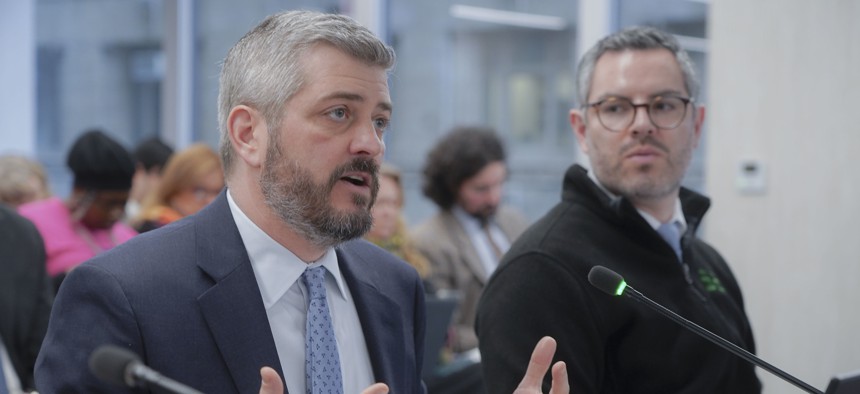
Department of Transportation Commissioner Mike Flynn testified about the NYC Streets Plan at a City Council hearing. Gerardo Romo / NYC Council Media Unit


The New York City Department of Transportation has a lot to prove, with Mayor Zohran Mamdani’s “fast and free” bus platform having to fill big gaps after the Adams administration failed to meet the goals set out in the city’s Streets Master Plan.
At a Tuesday City Council hearing, transportation committee chair and Majority Leader Shaun Abreu was uninspired by the Department of Transportation’s progress on bus and bike infrastructure, giving it “a big fat F.” “The numbers for protected bus lanes and bus stop upgrades are almost too low to believe,” he said, also listing issues with bike infrastructure.
The Streets Master Plan, originally passed in 2019 under former Mayor Bill de Blasio, required the city to build 150 miles of protected bike lanes and 250 miles of protected bus lanes by the end of this year. The Adams administration completed about 95 miles of bike lanes – a record number – and 28 miles of bus lanes by the end of 2025, but both fell far short of the legal mandate.
DOT Commissioner Mike Flynn said part of the problem was political and legal challenges, likely referring to issues such as the redesign project of McGuiness Boulevard in Greenpoint, which former Adams adviser Ingrid Lewis-Martin allegedly interfered with. She was later indicted for conspiring to stop the project, receiving perks like a speaking role on a TV show. The department is now restarting several bus and bike lane projects ahead of the next five-year streets plan, which is expected to be released at the end of the year.
But the commissioner, who was appointed by Mamdani on Jan. 1, is changing the department’s strategy. “This time, we’ll focus squarely on outcomes, not just miles,” he said. “We’ll ask clear, measurable questions. Are buses moving faster? Are fewer people being killed or seriously injured? Are New Yorkers choosing to bike?”
The department released a street plan update on the morning of the hearing, which mapped priorities and previewed major projects in the pipeline. Last month, the mayor said his team is “serious about achieving at least a 20% speed improvement on each of our bus priority projects,” but didn’t say over what time frame.
The hearing also touched on bills that would shape the streets plan, like Speaker Julie Menin’s proposal to install solar-powered crosswalks, and another that would require the DOT to install more bilingual street signs in Chinatown. Council Member Justin Sanchez, who represents the South Bronx, was interested in how his district could get street signage in Spanish and French, but even the English signs in his district have been slighted. “Justice for Throggs Neck–it’s with two G’s,” he said. “All of our signage now only has one G because the cost of an extra G. I’m not even joking.”
That was news to the DOT panel. They said the larger issue in placing bilingual signs was not the cost, but determining which areas truly need it.
According to the Department of Transportation, they will have a budget hearing in two weeks to determine the resources needed to tackle issues from fast buses to misspelled signs. For now, the commissioner is promising ambitious projects that “make our streets even safer, more welcoming, and more sustainable.”